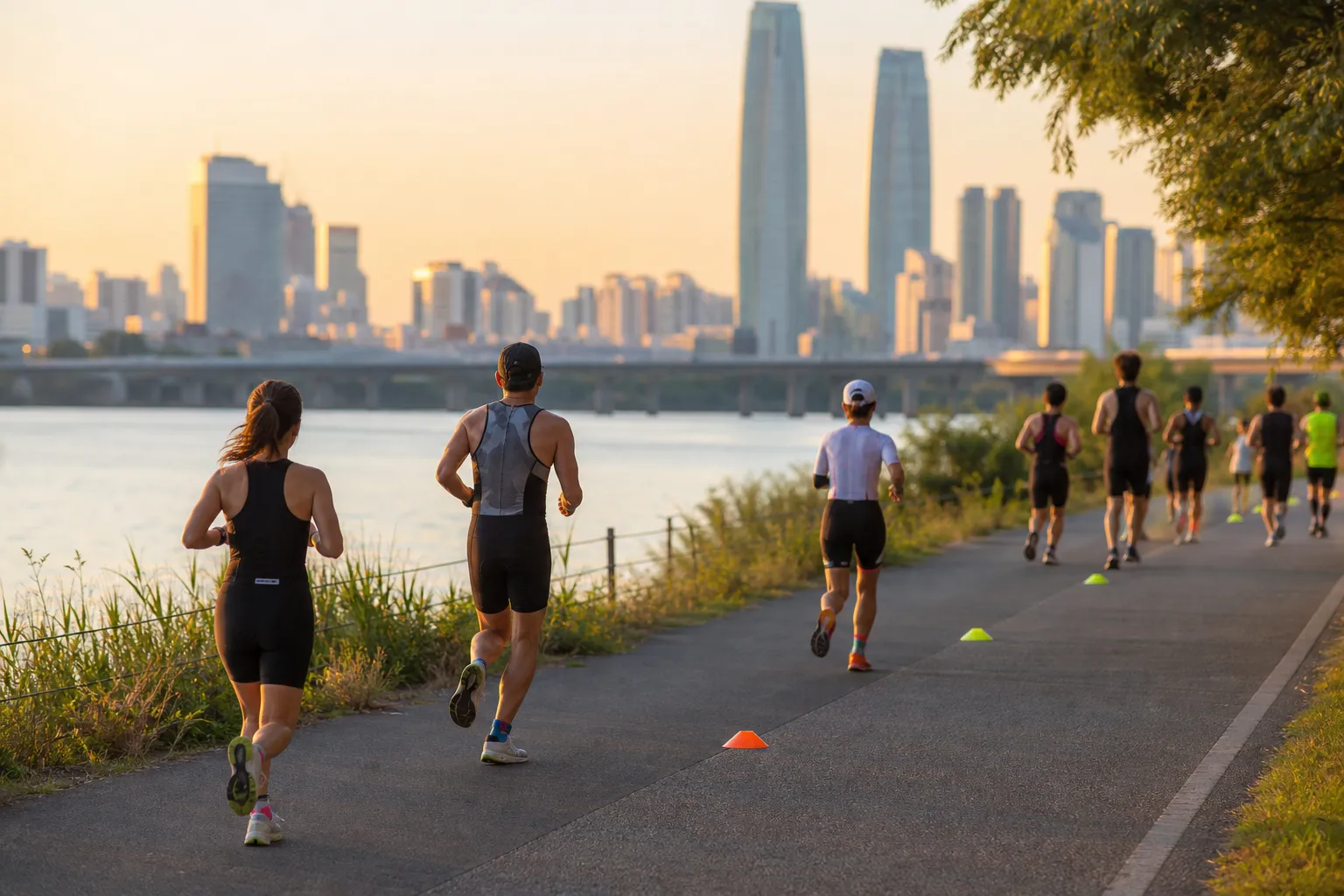
The Hangang triathlon running course at the 2026 Slow-Slow Hangang 3 Sports Festival gave participants three distance choices: beginner 5km, intermediate 7km, and advanced 10km. Held from June 5 to 7, 2026, around Ttukseom Hangang Park and Jamsil Hangang Park, the event framed running as part of a broader swim-bike-run festival rather than a record-focused race.1
For travelers planning Hangang running travel around organized events, this festival is useful because its course information shows how Seoul structured a riverfront running experience by distance, ability level, and return-point landmarks. The program has already taken place, so this guide focuses on what the official course structure was, how the running leg fit into the triathlon format, and what practical details were available from the source material.
Hangang Triathlon Running Course Distances
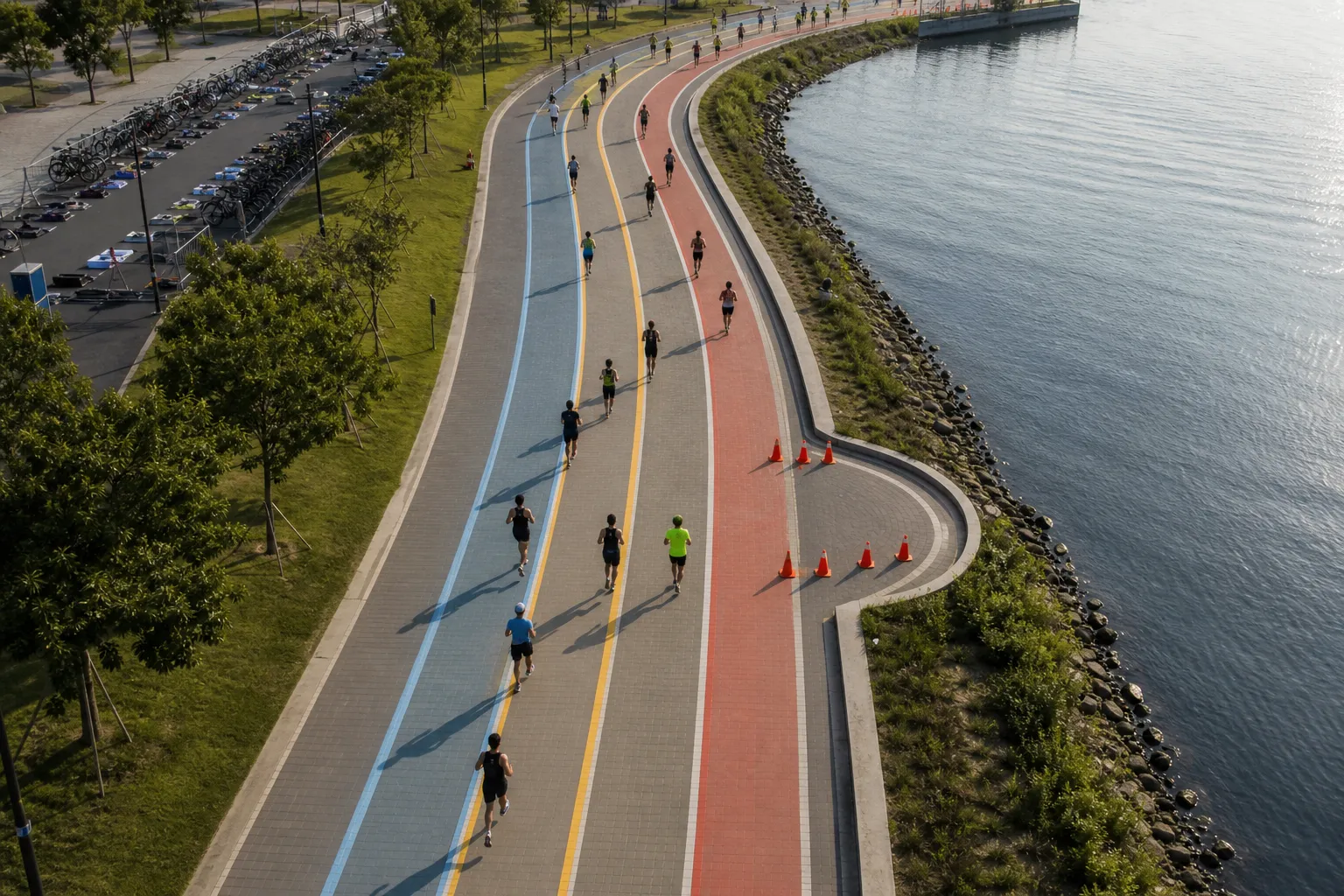
The official event page from Seoul’s Future Hangang Headquarters listed the running courses by level: beginner 5km, intermediate 7km, and advanced 10km.2 The beginner course started from the Ttukseom Hangang Park foot volleyball court 2 area and used Olympic Bridge as the turnaround point.2 The intermediate course used Cheonho Bridge as the turnaround point, while the advanced course listed Gwangjin Information Library or the Seoul Street Arts Creation Center as the turnaround-point area.2
That structure made the running segment easy to understand before choosing a level. The three distances were not presented as a single open-ended route but as defined out-and-back style courses with named landmarks. For a runner looking at the event from a travel perspective, the key planning point is that the courses were tied to recognizable Hangang-side locations rather than isolated track loops.
The running leg was also part of a flexible triathlon model. The main festival program combined swimming, cycling, and running, but participants could choose courses according to their fitness level.3 Another report summarized the full triathlon distance sets as beginner running 5km, cycling 10km, and swimming 200 to 300m; intermediate running 7km, cycling 15km, and swimming 500m; and advanced running 10km, cycling 20km, and swimming 1km.4
For the advanced course, a zero-stop flow was introduced from swimming directly into the cycling section.4 The source material does not say that the running leg itself had a zero-stop transition, so it is best understood as part of the full advanced triathlon format rather than a separate running-course feature.
How the Running Course Fit the Festival
The 2026 edition was the third Slow-Slow Hangang 3 Sports Festival, and Seoul described it as a summer festival built around swimming, cycling, and running.1 It took place across the Ttukseom and Jamsil Hangang Park areas, giving the event a broader riverfront footprint than a single-course road race.1
The defining idea was accessibility. Seoul’s tourism and sports bureau director Kim Myung-joo described the festival as “a representative summer festival of Seoul” prepared so that citizens could enjoy sports and rest along the Hangang at their own pace, beyond record competition.1 That quote is important because it explains why the running course was divided into three practical distance levels instead of being marketed only around speed or elite performance.
The 2026 event also added a new intermediate course. Seoul’s March recruitment notice said the city reflected feedback from participants in the first and second editions and introduced an intermediate course.5 For the combined triathlon, that middle option was 22km overall, while the running portion of the intermediate level was 7km.12 This gave runners who wanted more than the beginner 5km but less than the advanced 10km a clearer choice.
Registration details were also published before the event. Seoul began recruiting 30,000 race participants on a first-come, first-served basis from 2 p.m. on March 31, 2026.5 The participation fee was 30,000 won, and applications could be made through Naver Reservation by selecting a date and time slot.5 Because the event dates have passed, these details are historical rather than active booking instructions.
Safety and support were also part of the event framework. Seoul said more than 1,000 safety personnel and water rescue equipment would be deployed each day, and that Hangang open-water and crossing-section water quality, as of May 26, met International Triathlon Union competition-rule standards.1 Those details relate especially to the swim portions, but they also show that the running course sat inside a managed multi-sport festival rather than an informal public run.
Practical Takeaways for Hangang Running Travel
For a runner using this event as a model for Hangang running travel, the main lesson is to choose by distance and landmark. The beginner 5km route centered on the Ttukseom Hangang Park foot volleyball court 2 area and Olympic Bridge turnaround, making it the shortest official running option.2 The 7km intermediate route extended the challenge to Cheonho Bridge, while the 10km advanced course reached toward the Gwangjin Information Library or Seoul Street Arts Creation Center turnaround area.2
The festival also connected running with other river activities. Seoul’s May coverage listed associated programs such as the Haechi Island water playground, Haechi Mac, Danoje activities, an international swimming race near Jamsil submerged weir, a swimming event for people with disabilities, and an Iron Rookie children’s triathlon program.6 These were side programs, not running-course segments, but they explain why the festival functioned as a broader Hangang outing.
Cycling infrastructure was also part of the course setup. The event page announced beginner 10km, intermediate 15km, and advanced 20km cycling courses, and said about 2,600 Ttareungi public bikes would be placed at the venue.2 For participants comparing course levels, the running distance should therefore be read alongside the cycling and swimming distances, not as a standalone race category only.
Quick FAQ
Was the Hangang triathlon running course only for advanced runners?
No. The running program had three levels: beginner 5km, intermediate 7km, and advanced 10km.2 The festival’s stated direction emphasized participation at each person’s own pace rather than record competition.1
Can readers still register for the 2026 festival?
The 2026 festival ran from June 5 to 7, 2026, so it has already ended.1 The available source material says registration opened on March 31, 2026, with 30,000 participant slots and a 30,000 won fee through Naver Reservation.5 The 2026 Hangang triathlon running course was practical because it separated runners by clear distance levels, used recognizable Hangang landmarks, and connected the run to a wider swim-bike-run festival. For future planning, the most useful takeaway is the course pattern itself: 5km for an accessible riverfront run, 7km for a new middle option, and 10km for the longest official running leg.
References
- 기록 경쟁 없는 힐링 레이스, '쉬엄쉬엄 한강 3종 축제' 6월 5일 개막 (서울특별시, 2026-06-02)
- 2026 쉬엄쉬엄 한강3종 축제 (서울시 미래한강본부)
- 신한라이프, '쉬엄쉬엄 한강 3종 축제' 참여…'쿨-리닉' 부스 운영 (뉴스핌, 2026-06-04)
- 한강서 수영·자전거·달리기…'쉬엄쉬엄 한강 3종 축제' 예매 오픈 (이투데이, 2026-03-31)
- '쉬엄쉬엄 한강 3종 축제' 참가자 3만 명 선착순 모집 (내 손안에 서울, 2026-03-30)
- “해치랑 놀자” 새달 ‘쉬엄쉬엄 한강 3종 축제’ (서울신문, 2026-05-14)
About the Author