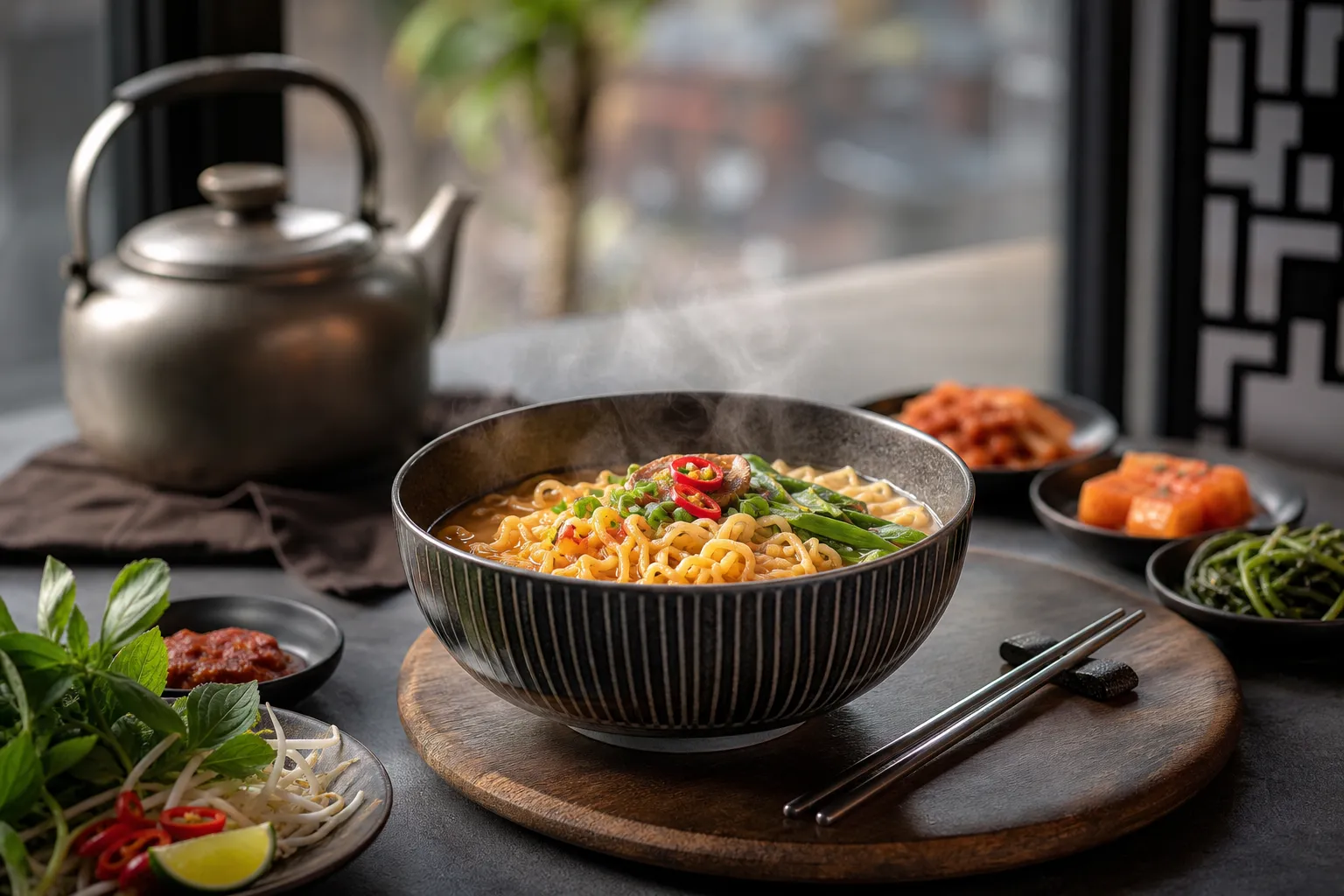
Hangang ramen in Vietnam became a clear focal point at the July 2026 Korean food and culture events in Hanoi. The strongest source-backed story is not simply that Korean ramen was served, but that a Hangang-style ramen experience was used to connect K-culture, food tech, and consumer-product exports in one public setting.
The ASEAN K-Food Fair and the 2026 Hanoi Hallyu Expo were jointly held from July 2 to 4, 2026, at the National Convention Center in Hanoi by South Korea’s Ministry of Agriculture, Food and Rural Affairs and Ministry of Trade, Industry and Energy. The event brought together 107 Korean companies and about 280 buyers from Vietnam and Southeast Asia, producing 1,512 consultations and about $33 million in MOUs and contracts.1
Hangang Ramen in Vietnam: What Visitors Actually Saw
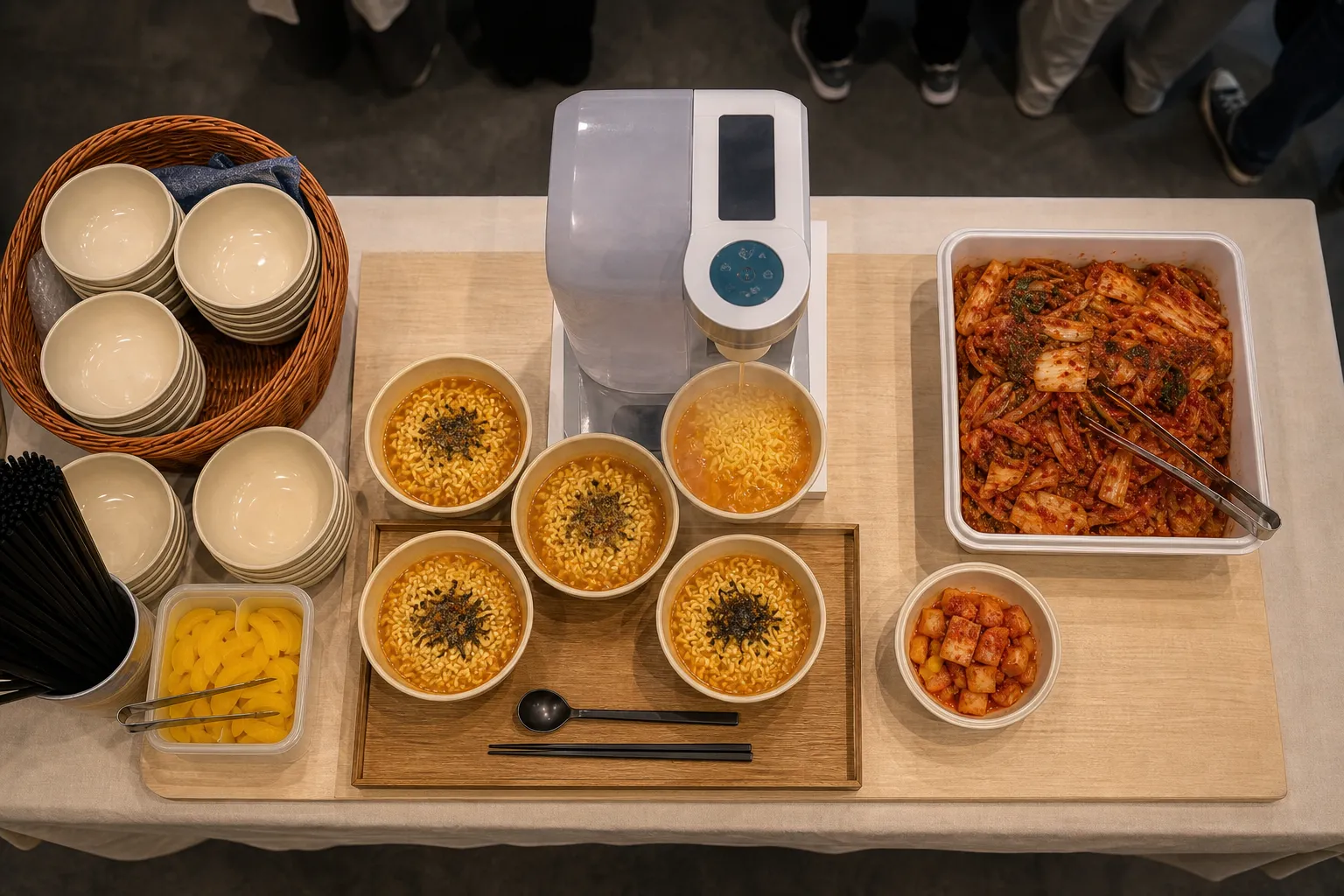
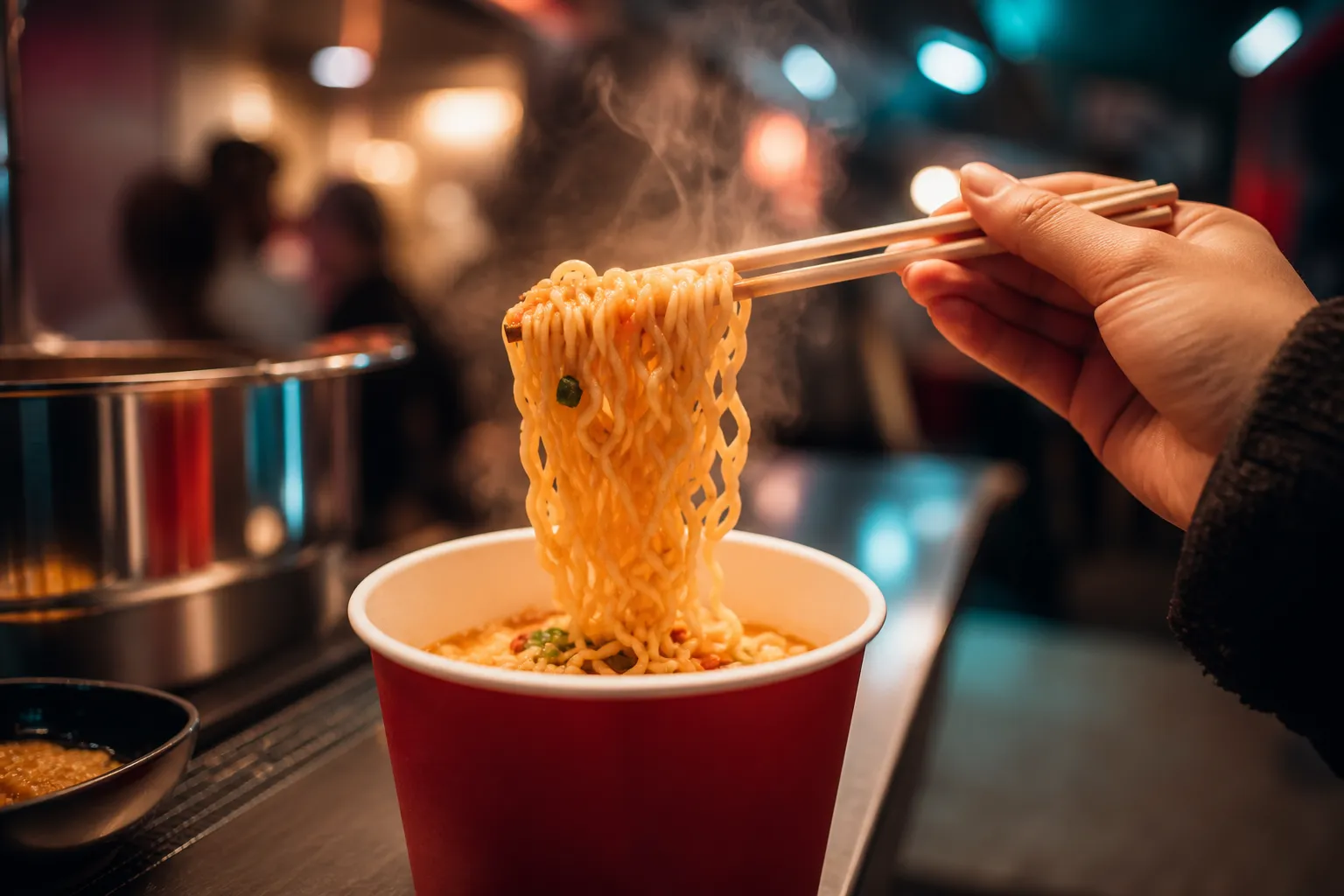
At the event site, Hangang ramen was presented as a hands-on food experience rather than just a packaged product. Visitors used Hangang ramen cooking machines at the food-tech special zone, while other Korean food experiences included tteokbokki and fish cake. Yonhap reported from the National Convention Center on July 3, 2026, that visitors were eating ramen at the Hangang ramen cooking counter in the outdoor lobby side-event area and moving through the venue with Korean street foods such as tteokbokki and fish cake.2
This matters because Hangang ramen is tied to a specific image of Korean everyday leisure culture: instant noodles cooked and eaten near Seoul’s Han River. In Hanoi, the same idea was translated into a demonstration format that visitors could understand quickly: choose the ramen, use the cooking device, and eat it on-site.
Kookmin Ilbo reported that about 20,000 people came to the three-day Hanoi Hallyu Expo to experience Korean consumer goods and culture, and that visitors cooked ramen using Hangang ramen machines at the venue.3 One anonymous visitor was quoted as saying, “I wanted to try Hangang ramen that I had only seen in dramas,” which shows how screen culture helped make the food experience recognizable before the first bite.3
The ramen experience was not isolated. The government release said the food-tech special zone’s Hangang ramen experience drew a favorable response, alongside 45 items in the Global NEXT K-Food special zone, including ten-won bread and cream glutinous rice cake.1 EToday also reported that Hangang ramen, ten-won bread, and cream glutinous rice cake attracted attention from local consumers and buyers in Hanoi, while spicy ramen, frozen cup rice, tteokbokki, and ade were among the items noted for interest.4
Why Vietnam Was a Strategic Setting
Vietnam was not chosen only as a backdrop for Korean pop culture. A Ministry of Agriculture, Food and Rural Affairs document posted through the Korea International Trade Association’s FTA platform described Vietnam as South Korea’s fourth-largest K-food export market and a strategic base for ASEAN expansion. The same material said that, around the July 2 to 3 ASEAN K-Food Fair in Hanoi, Korean officials reviewed local production and logistics bases and food-service franchise supply chains in Vietnam.5
That context helps explain why a familiar, easy-to-demonstrate product like Hangang ramen had value at a combined consumer and buyer event. It could appeal to general visitors who recognized Korean food through dramas and music, while also fitting into export discussions about packaged foods, food tech, and franchise supply chains.
The business side was substantial. The official government release reported 1,512 consultations and about $33 million in MOUs and contracts across the broader event.1 Kookmin Ilbo, citing KOTRA, reported $33.26 million in contracts and MOUs at the expo.3 A separate agriculture ministry item focused on the B2B export consultation program reported 46 MOUs worth $21 million.5 These figures refer to event-level business outcomes rather than Hangang ramen alone, so they should be read as evidence of the broader export environment around the ramen showcase.
The policy message was direct. Kang Gam-chan, trade and investment chief at the Ministry of Trade, Industry and Energy, described Hallyu as “the strongest soft power” that captures global consumers’ hearts and drives Korean consumer-goods exports.1 For a practical reader, the point is simple: Hangang ramen in Vietnam was part of a larger strategy that linked culture, food sampling, and buyer meetings.
What the Vietnam Ramen Market Facts Suggest
Vietnam already has a deep noodle culture, and that culture has expanded from traditional dishes such as pho into instant noodles. KATI’s November 19, 2025 Vietnam ramen market analysis, citing the World Instant Noodles Association, put Vietnam’s annual instant noodle consumption at 8.137 billion servings and about 81 servings per person per year, described as the world’s highest level.6
The same KATI analysis said instant noodles in Vietnam are generally prepared by pouring boiling water over them. It also said Korean ramen is consumed among urban middle-class and MZ-generation consumers, influenced by premium positioning, spicy flavors, and K-content.6 That makes the Hangang ramen format useful because it shows a different preparation and consumption scene from a standard cup or packet: a cooked, machine-assisted ramen experience associated with Korean leisure culture.
For brands, buyers, or readers tracking Korean food exports, the Hanoi case suggests three practical points. First, Korean ramen in Vietnam is not starting from zero; it enters a market where instant noodles are already familiar. Second, the Korean angle is partly experiential, built through dramas, K-pop, K-beauty, and event sampling. Third, the Hangang ramen format works best when it is presented as an easy, visible activity rather than only as a flavor claim.
Quick FAQ
Was the Hanoi Hangang ramen event a standalone ramen festival?
No. The Hangang ramen experience was part of the ASEAN K-Food Fair and the 2026 Hanoi Hallyu Expo, held in Hanoi from July 2 to 4, 2026. It appeared within the food-tech special zone alongside other K-food and consumer-product showcases.1
Why is Hangang ramen relevant to Vietnam?
Vietnam has very high instant noodle consumption, and Korean ramen is already linked to premium, spicy, and K-content-driven demand among urban middle-class and MZ-generation consumers.6 The Hanoi event used Hangang ramen as an experience that connected those market conditions with Korean culture. !Hangang Ramen in Vietnam Korean instant noodles market facts Hangang ramen in Vietnam should be understood as both a food sample and a cultural export tool. In Hanoi, it gave visitors a way to try a ramen scene they had seen through Korean media, while giving Korean organizers and companies a practical format for connecting food tech, packaged products, and ASEAN market interest.
References
- K-컬처와 소비재를 연계한 한-베 협력의 장 열려 (농림축산식품부, 2026-07-05)
- [르포] K팝에 환호, '한강 라면' 줄 섰다…계약 2배 뛴 하노이 박람회 (연합뉴스, 2026-07-07)
- 한강라면에 홍삼, 블핑 메이크업까지… 'K'에 빠진 하노이 (국민일보, 2026-07-06)
- 하노이서 터진 ‘K푸드 입맛’…한강라면·십원빵 타고 아세안 공략 (이투데이, 2026-07-05)
- 농식품부, 베트남 거점 삼아 아세안 ‘K-식자재·신선농산물’ 영토 넓힌다 (한국무역협회 FTA 통합 플랫폼 / 농림축산식품부, 2026-07-07)
- [베트남] 라면 시장 분석 (KATI 농식품수출정보, 2025-11-19)
About the Author