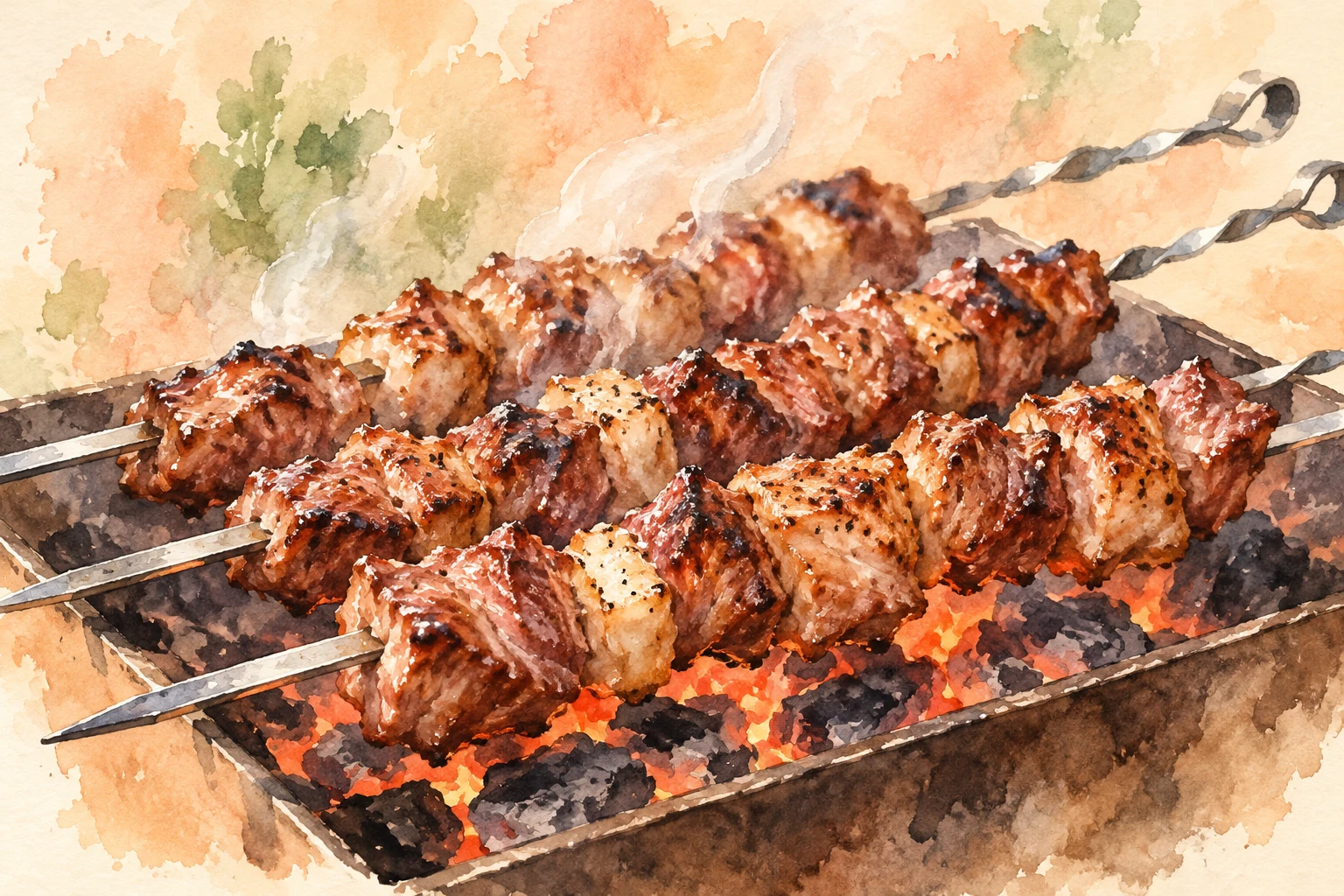
Uzbek meat skewers, Georgian wine and Russian Napoleon cake are on the announced menu for Gwanghui Road Festa (광희로드 페스타), scheduled for October 24, 2026, in Seoul’s Gwanghui-dong neighborhood. 1 The festival is scheduled to run from 11 a.m. to 9 p.m. around Central Asia Street (중앙아시아거리). 2 That sounds like an appealing excuse to build an afternoon around something savory and something sweet.
The food program connects visitors with local restaurants, and participants are due to receive a neighborhood food map introducing places to eat and the stories behind their food. 3 Think of the map as a starting point for choosing your own stops: would you rather investigate the grilled-meat options or leave room for cake?
Skewers, lamb ribs and a dessert possibility
Shashlik is the Uzbek offering in the announced lineup: meat threaded onto skewers and grilled. 4 Mongolian lamb ribs provide another meat option, while Napoleon cake represents Russian dessert in the program. 4 For a visitor choosing between those dishes, the useful distinction is straightforward: the skewers and ribs are savory possibilities, while the cake offers a sweet direction to explore. 4
Georgian wine is also included in the announced five-country food program. 1 You could make that your own point of interest rather than trying to sample every national offering. The combination of a wine stop and a dessert possibility sounds especially inviting to me.
Korean dishes belong to this neighborhood story, too: the announced program includes gukbap, seolleongtang and samgyeopsal. 4 Their inclusion reflects the area’s existing mix of Central Asian restaurants and longstanding Korean eateries sharing the same alleys. 4 The connection between the offerings is therefore geographic as well as culinary: these businesses operate alongside one another in Gwanghui-dong. 4
Follow the streets, then follow a food theme
Central Asia Street extends around Eulji-ro 42-gil and 44-gil near Dongdaemun History & Culture Park Station and Dongdaemun Design Plaza, or DDP. 2 Restaurants and food shops associated with Uzbekistan, Russia and Mongolia sit in this district alongside longstanding Korean restaurants. 2
The planned food map, Gwanghui Story (광희스토리), is intended to introduce neighborhood restaurants and food stories, including dumplings, fermented drinks, tea and Central Asian spices. 2 Its coverage of foods found across several cultures offers another way to explore the area beyond the festival’s country-by-country menu. 2
Try using one of those themes as a question for your walk. What might you learn by following the map’s tea stories, or by looking for its discussion of dumplings? That gives the restaurant search a focus without turning the outing into a checklist.
News Culture traces the district’s development to Russian shuttle traders gathering near Dongdaemun Market in the early 1990s, followed by arrivals from Uzbekistan, Mongolia and elsewhere. 2 Restaurants and trade-related businesses developed to serve the traders, helping explain the food businesses found in the neighborhood today. 2
A guided option for the curious
A guided walk covering the district’s history and representative shops is planned once during the day for around 10 participants, with advance telephone registration required. 4 If that appeals, check the registration arrangements; check current restaurant menus and service times when planning your food stops, too.
Personally, I’d keep the map handy and leave a little curiosity for the Napoleon cake.
Sources
- 서울 도심서 5개국 미식 즐긴다…2026 광희로드 페스타 | 연합뉴스
- 식사는 샤슬릭, 디저트는 나폴레옹 케이크 ‘광희로드 페스타’ – 뉴스컬처
- "몽골 양갈비부터 조지아 와인까지"…'2026 광희로드 페스타' 24일
- 몽골 양갈비부터 우즈베크 샤슬릭까지…서울 광희동서 24일 ‘5개국 미식축제’
About the Author