
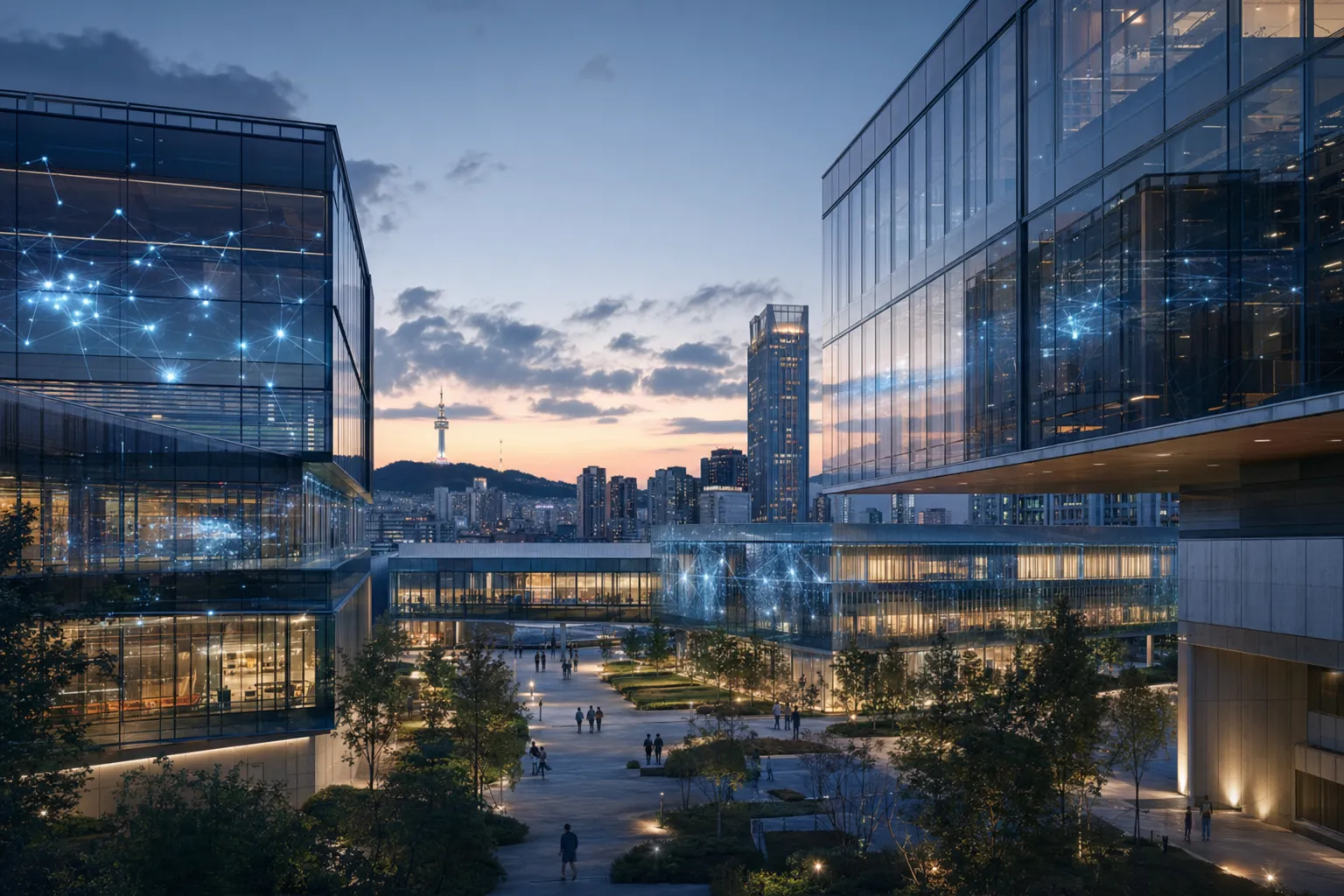
Google AI Campus will be established in South Korea under a new national AI partnership between Google DeepMind and the Ministry of Science and ICT, positioning Seoul as a major base for collaborative artificial intelligence research. The plan brings together Google AI experts, Korean universities, public research institutions, and startups in a shared facility designed to support scientific research, talent development, and responsible AI use.
Google AI Campus Sets Seoul as a Research Hub

The partnership was announced on April 27, 2026, as Google DeepMind and South Korea moved to formalize cooperation in advanced AI. The centerpiece is an AI-specialized facility in Korea, described as the first Google AI Campus of its kind. It is expected to serve as a practical base where domestic academic teams and research organizations can work directly with Google AI specialists.
The Seoul campus is planned around the redevelopment of an existing AI startup campus in Daechi-dong, Gangnam District. Reports describe the site as a roughly 1,980-square-meter space that will be remodeled into a hub for joint research, education, and collaboration. Google is expected to open the campus within the year, expanding cooperation with Korean researchers and startups.
The facility is not being framed as a symbolic office. Its stated purpose is to create a working environment where Google DeepMind researchers, Korean universities, research institutes, and startup teams can test models, use data, and pursue applied research on national and scientific challenges. The areas identified at launch include life sciences, energy, weather, and climate.
Initial collaboration is set to involve Seoul National University, KAIST, and an AI bio innovation research hub. These partners are expected to begin work with Google AI experts in fields where AI can accelerate scientific discovery and improve modeling capabilities. The emphasis on life sciences and climate-related research shows that the project is being positioned at the intersection of national competitiveness and public-interest science.
From AlphaGo to a National AI Partnership
The agreement carries symbolic weight because it was signed at the Four Seasons Hotel in Seoul, the same venue associated with the 2016 AlphaGo match against Go master Lee Sedol. That match became a defining moment in public awareness of AI in South Korea, and the return of Google DeepMind CEO Demis Hassabis to Seoul underscores how much the field has changed in a decade.
This time, the focus is not on a single demonstration of machine intelligence. The new memorandum of understanding covers scientific AI joint research, AI talent development, and responsible AI use. It also connects with South Korea’s K-Moonshot initiative, placing AI research within a broader national strategy for science and technology.
The partnership follows discussions involving President Lee Jae Myung and Hassabis. The talks addressed the future direction of AI development, the importance of responsible use, and the need for safeguards. South Korean officials said Google would open the Seoul AI campus within the year and expand collaboration with researchers and startups.
A further point under review is the dispatch of Google researchers to Korea. Officials said Google is considering sending around 10 researchers, and Hassabis agreed to a request for the assignment of Google research personnel. The available information does not specify final staffing details, the exact opening date, or the full operating structure of the campus.
Research, Startups, and Responsible AI
The planned Google AI Campus is designed to connect several parts of Korea’s AI ecosystem at once. Universities can bring scientific expertise and student talent. Research institutes can contribute domain knowledge and long-term projects. Startups can test practical applications and move quickly on product ideas. Google DeepMind researchers can provide advanced AI capability and technical guidance.
That combination is why the campus is being described as more than a training center. It is intended to become a shared research base where model validation and data collaboration can take place in fields tied to national problems. In weather and climate, that may mean cooperation around modeling and prediction. In life sciences, it may mean AI-assisted research with academic and bio-innovation partners. In energy, the stated focus points toward scientific and technical work rather than consumer services.
The agreement also places responsibility and safety alongside innovation. President Lee and Hassabis discussed AI safety, control, responsible deployment, and safeguards. That framing matters because the campus is being launched at a time when governments and technology companies are trying to balance rapid AI progress with public trust and institutional oversight.
The announcement also reflects Korea’s ambition to strengthen its position as an AI power. Hassabis said the era of artificial general intelligence could arrive within five years and stated that Korea has the foundation to become a strong player. The campus gives that assessment a concrete institutional form by linking Korean talent and research infrastructure with Google DeepMind’s AI expertise.

The Google AI Campus in Seoul is therefore both a research facility and a strategic partnership platform. Its success will depend on how effectively universities, startups, research institutes, and Google experts turn the agreement into sustained work in science, technology, and responsible AI development.
About the Author