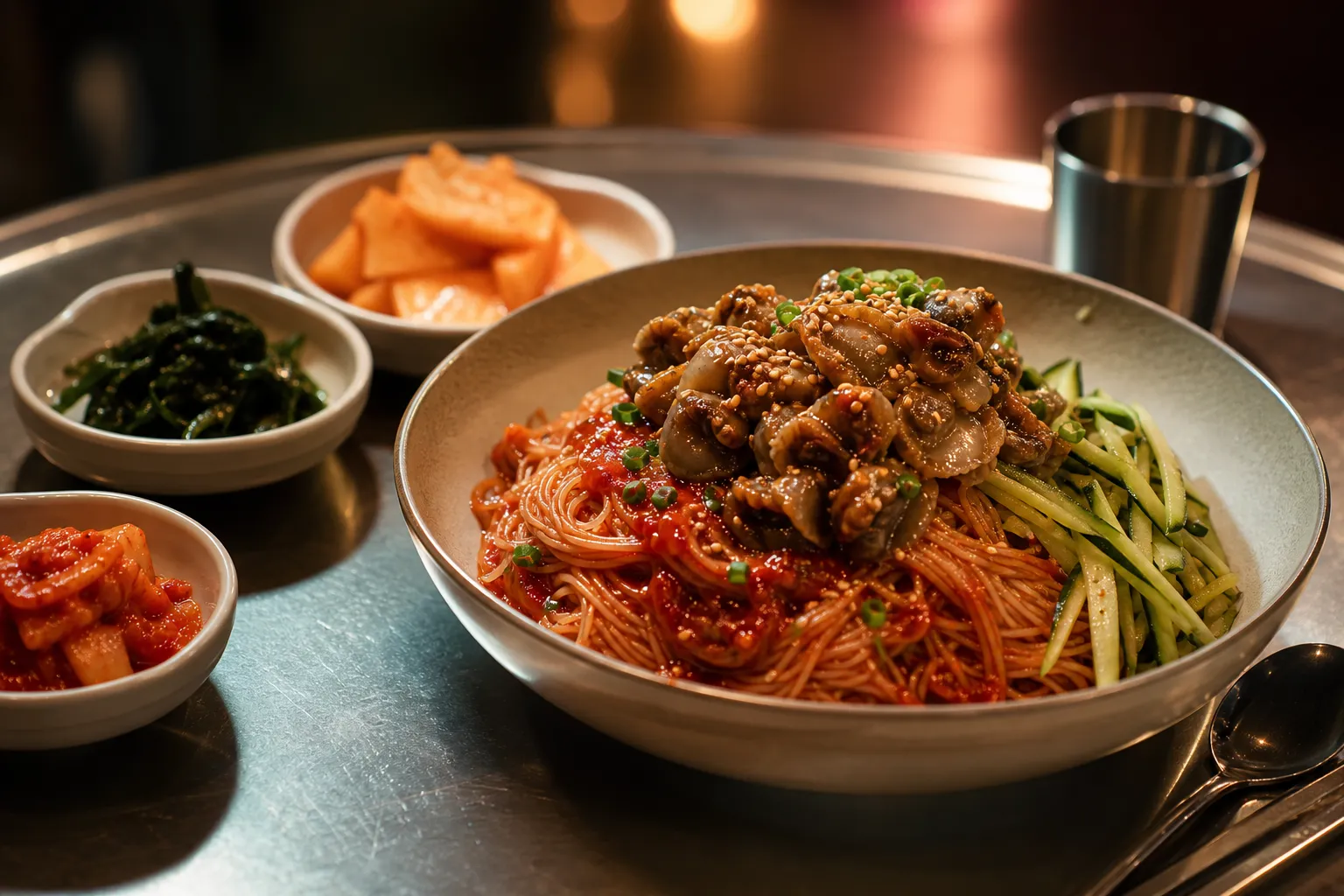
Dongpyo Golbaengi’s golbaengi somyeon is best understood as part of Euljiro’s old-school food culture: bold whelk, thin noodles, garlic, scallions, and a setting tied to central Seoul’s long-running alley restaurants. For English-speaking readers, “Euljiro Whelk Noodles” is a useful translation, but the Korean name, golbaengi somyeon, carries the local feeling of a shared dish built around chew, spice, and appetite.
The available source material identifies Dongpyo Golbaengi as a long-established restaurant in the Euljiro and Myeong-dong area, with its address listed as 43 Myeongdong 9-gil, Jung-gu, Seoul. 1 That gives the dish a clear sense of place without needing to overstate the story. This is not a case where every detail is documented; what the sources do show is enough to explain why this kind of whelk noodle dish has become closely associated with older Seoul dining streets.
Dongpyo Golbaengi Golbaengi Somyeon and the Euljiro Style
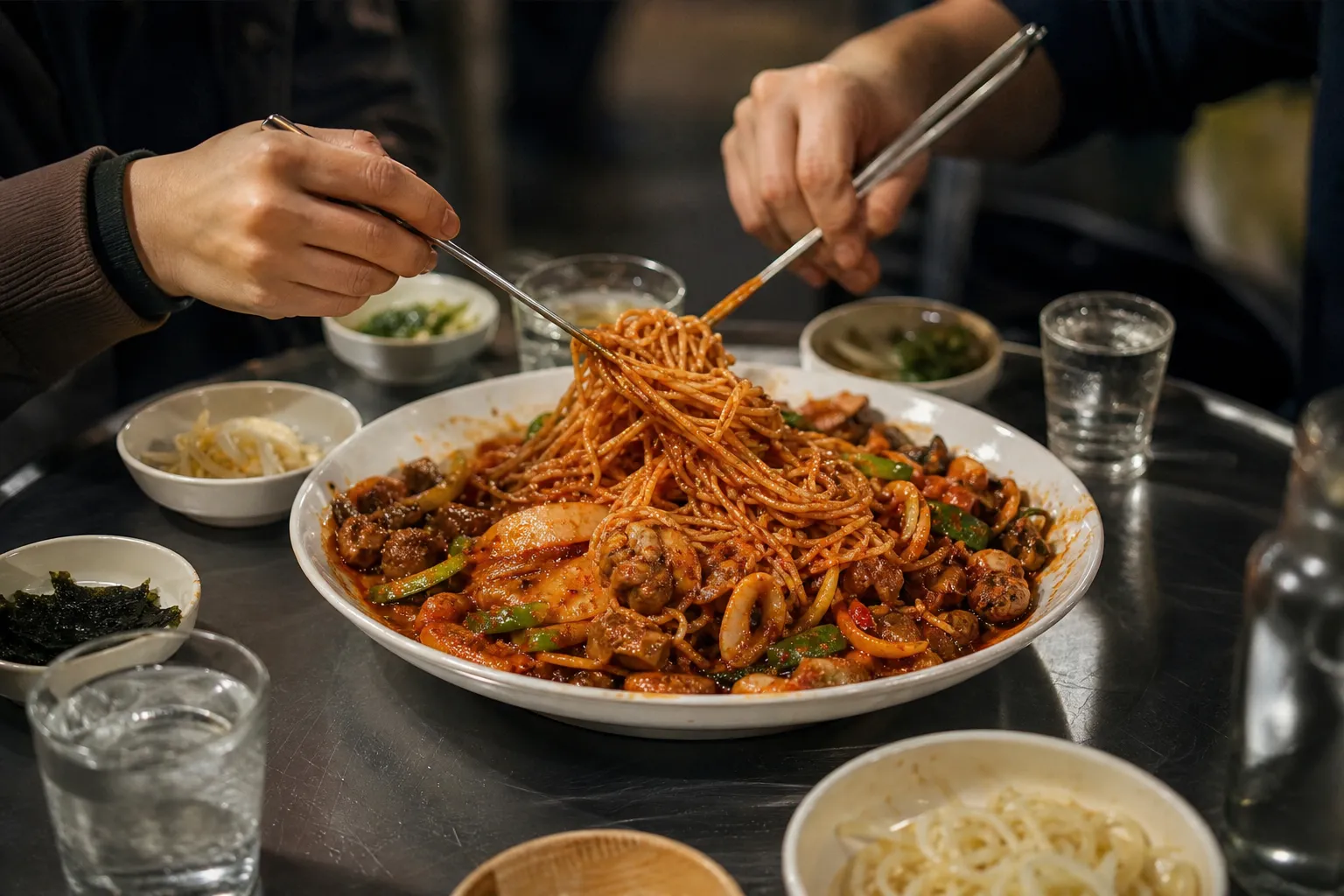
Golbaengi somyeon pairs seasoned whelk with somyeon, a thin wheat noodle often served in a cool, flexible tangle that absorbs spicy seasoning well. In the Euljiro style described in restaurant coverage, the dish brings together scallions, thick whelk, dried fish strips, and garlic. 1 Those ingredients are important because they point to a dish that is not mild or decorative. It is aromatic, sharp, chewy, and made for mixing.
If you are new to Korean whelk noodles, the texture is part of the appeal. Whelk has a firm bite, while somyeon gives the dish its slurpable body. Scallions add freshness and snap, garlic gives it a direct savory edge, and dried fish strips deepen the flavor with a salty, seafood-driven note. The source material does not provide a full recipe for Dongpyo Golbaengi, so it is better to describe the dish through the documented Euljiro-style components rather than inventing a precise house formula.
There is also a practical naming detail worth knowing. Review Times notes that map services may label the place differently, with Dongpyo Golbaengi and Hwasan Golbaengi both appearing in relation to the restaurant. 1 For older Seoul restaurants, that kind of naming inconsistency can happen when local names, signboard names, and platform listings do not line up perfectly. If you are looking it up, the address may be more reliable than relying on a single English spelling.
Why Rolled Omelet Keeps Appearing Beside Whelk Noodles
One reason this food story has drawn broader attention is the way Euljiro whelk noodles are often discussed alongside rolled omelet. SBS’s official VOD page for Life Master episode 1029 says the May 4, 2026 episode covered, among other items, “Euljiro golbaengi somyeon” and a rolled omelet master in its Hidden Food Master segment. 2 The source does not identify Dongpyo Golbaengi by name, so the careful reading is simple: Dongpyo Golbaengi is separately documented as an Euljiro-area old restaurant, while SBS separately highlighted an Euljiro whelk noodle and rolled omelet story.
That distinction matters, but the wider context is still useful. The SBS episode description refers to a 50-year-tradition shop in an Euljiro alley and notes the feature of an instantly prepared rolled omelet. 2 bntnews also reported ahead of the May 4, 2026 broadcast that the program would include Mapo kimchi stew, rolled omelet, and Euljiro golbaengi somyeon, describing a method in which the omelet is cooked over strong heat so the outside sets while the inside remains soft. 3
The omelet was not treated as a throwaway side dish. One official SBS clip presents a special rolled omelet with golbaengi somyeon and describes it as similar to okonomiyaki. 4 Another SBS clip title lists dried squid, carrot, green onion, and salted shrimp as ingredients contributing to the omelet’s rich savory flavor. 5 These details help explain why the pairing is memorable: spicy whelk noodles bring heat and chew, while a generously cooked omelet can add softness, warmth, and umami.
Biz Enter reported that the Life Master Hidden Food Master segment introduced the rolled omelet master at an Euljiro golbaengi somyeon restaurant and framed the omelet as a side menu with enough presence to draw attention of its own. 6 Again, that reporting should be kept in its lane: it supports the broader Euljiro whelk noodle and omelet context, not a direct identification of Dongpyo Golbaengi as the featured shop.
What Makes This Dish Feel So Euljiro
Part of the appeal of Dongpyo Golbaengi’s golbaengi somyeon is that it belongs to a neighborhood food pattern rather than a polished trend. The documented ingredients are straightforward and strong: whelk, scallions, dried fish strips, garlic, and noodles. 1 Nothing in the available sources suggests a luxury presentation or a modern reinterpretation. The charm is in the old-neighborhood format and the directness of the flavors.
That is why “Euljiro Whelk Noodles” works as more than a translation. It signals a style of eating connected to central Seoul’s compact restaurant streets, where shared plates, punchy seasoning, and side dishes with personality all fit together. Even without a full menu record, the source-backed picture is clear enough: Dongpyo Golbaengi sits in the Euljiro and Myeong-dong orbit, and its golbaengi somyeon belongs to a tradition of whelk dishes that are flavorful, social, and distinctly local.
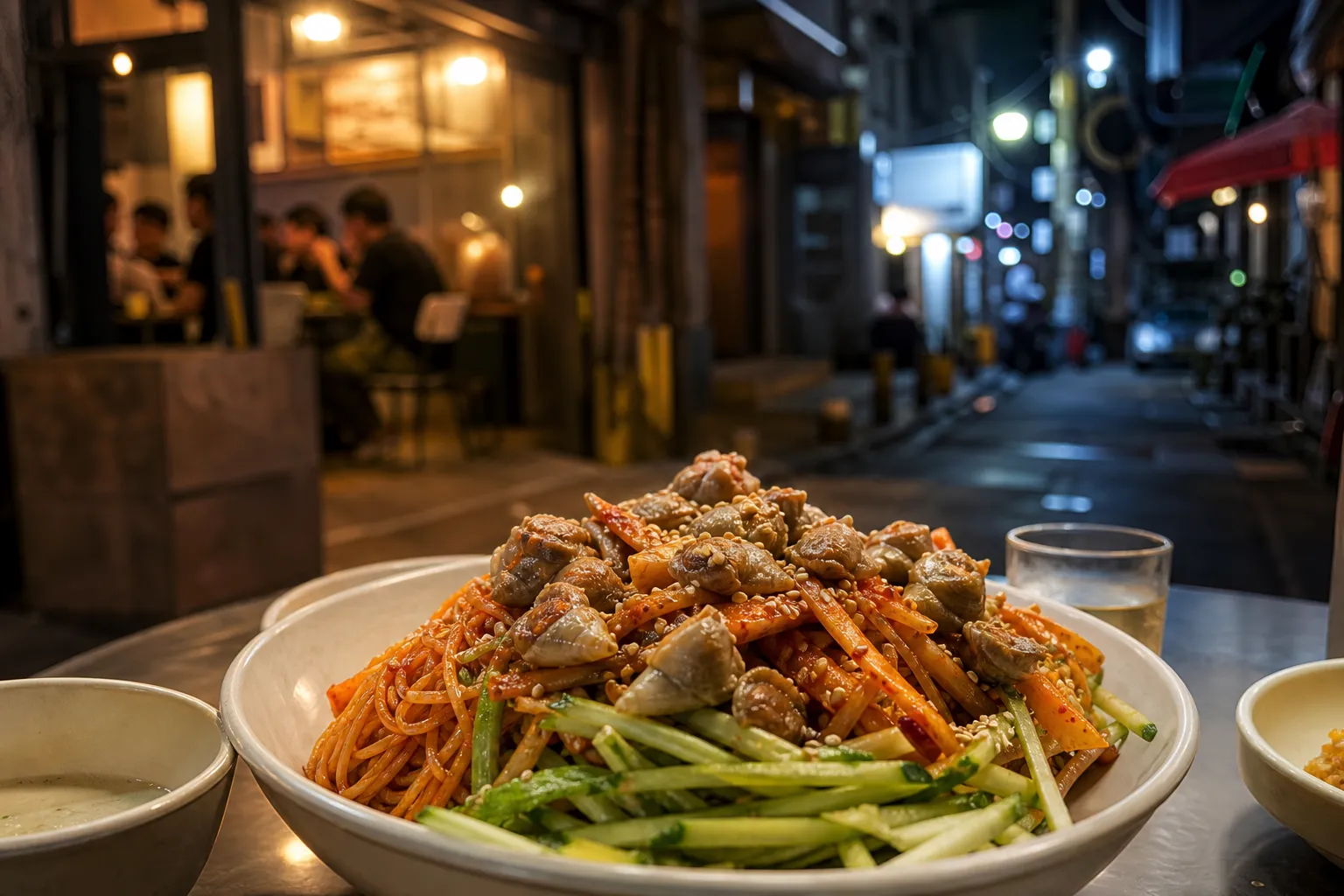
In the end, Dongpyo Golbaengi golbaengi somyeon is most compelling when described carefully: an Euljiro-area whelk noodle dish tied to an older Seoul restaurant, built around bold ingredients, and best understood alongside the neighborhood’s wider love for spicy golbaengi somyeon and hearty rolled omelet pairings. The available sources do not support every claim a reader might want, but they do support a useful, grounded portrait of a dish with a strong sense of place.
References
- [식당] 을지로 노포 맛탐사, 동표골뱅이 (리뷰타임스)
- [다시보기] 생활의 달인 1029회 : SBS (SBS, 2026-05-04)
- ‘생활의달인’ 골뱅이소면·김치찌개·오코노미야키 달인 (bnt뉴스, 2026-05-04)
- 생활의 달인 : ‘오코노미야끼’와 비슷한 달인만의 특별 계란말이 공개★ (ft. 골뱅이 소면) : SBS (SBS)
- 생활의 달인 : 건오징어×당근×대파×새우젓 들어가 풍부한 감칠맛이 일품인 ‘을지로 대장’의 계란말이♨ : SBS (SBS)
- ‘생활의 달인’ 마포 김치찌개·을지로 골뱅이, 주객전도 ‘계란말이’의 유혹 (비즈엔터, 2026-05-04)
About the Author