
The Yoonse AI editing debate around BLACKPINK’s “GO” music video is best understood through two sets of facts: the official-style production credits that openly list AI-related visual roles, and behind-the-scenes reporting that shows several questioned scenes were physically filmed. That distinction matters because the BLACKPINK AI controversy is not a simple case of “AI or not AI,” but a more specific question about where AI artwork and AI VFX fit inside a large-scale music video production.
BLACKPINK’s “GO” arrived as the lead track of “DEADLINE,” the group’s third mini album, released on February 27, 2026. YG Entertainment had announced the project on January 15, 2026, saying the album would be released at 2 p.m. KST on February 27 and that major production, including the music video shoot, had already been completed and moved into post-production.1 Korea JoongAng Daily later reported that YG identified “GO” as the lead track and listed the five-track album, including the 2025 prerelease single “Jump.”2
Yoonse AI Editing and the Confirmed Credits
The strongest confirmed basis for the AI discussion is not viewer speculation. It is the credits. A Vimeo credits page posted by post EMOTION studio lists “GO” as a Rigend Creative production directed by Rima Yoon, and it identifies Junhwa Yoon for “A.I ARTWORK.” The same credits also list multiple people and teams under “AI VFX,” confirming that AI-related visual work was formally credited in the production materials.3
That credit line is important, but it should be read carefully. “A.I ARTWORK” and “AI VFX” indicate credited roles in the visual pipeline; they do not, by themselves, prove that every disputed scene was generated by AI, nor do they explain the exact workflow, software, prompts, compositing methods, or division between human-made and AI-assisted elements. The available source material confirms the presence of AI-related artwork and visual effects roles, not a complete technical breakdown of the video.
A second production-facing source supports the same direction. Stash described the “GO” video as a surreal fantasy created by Rima Yoon and Rigend Film, released with “DEADLINE,” and highlighted design and VFX elements including traditional Korean ornamental patterns. Its published credits list YG Entertainment as client, Rigend Creative as production company, and Junhwa Yoon for “A.I. Artwork.”4 This reinforces that AI artwork was not hidden in the credit record, even if the broader public conversation may have treated it as a controversy after viewers began parsing the video’s visual style.
Practical Filming Complicates the AI Suspicion
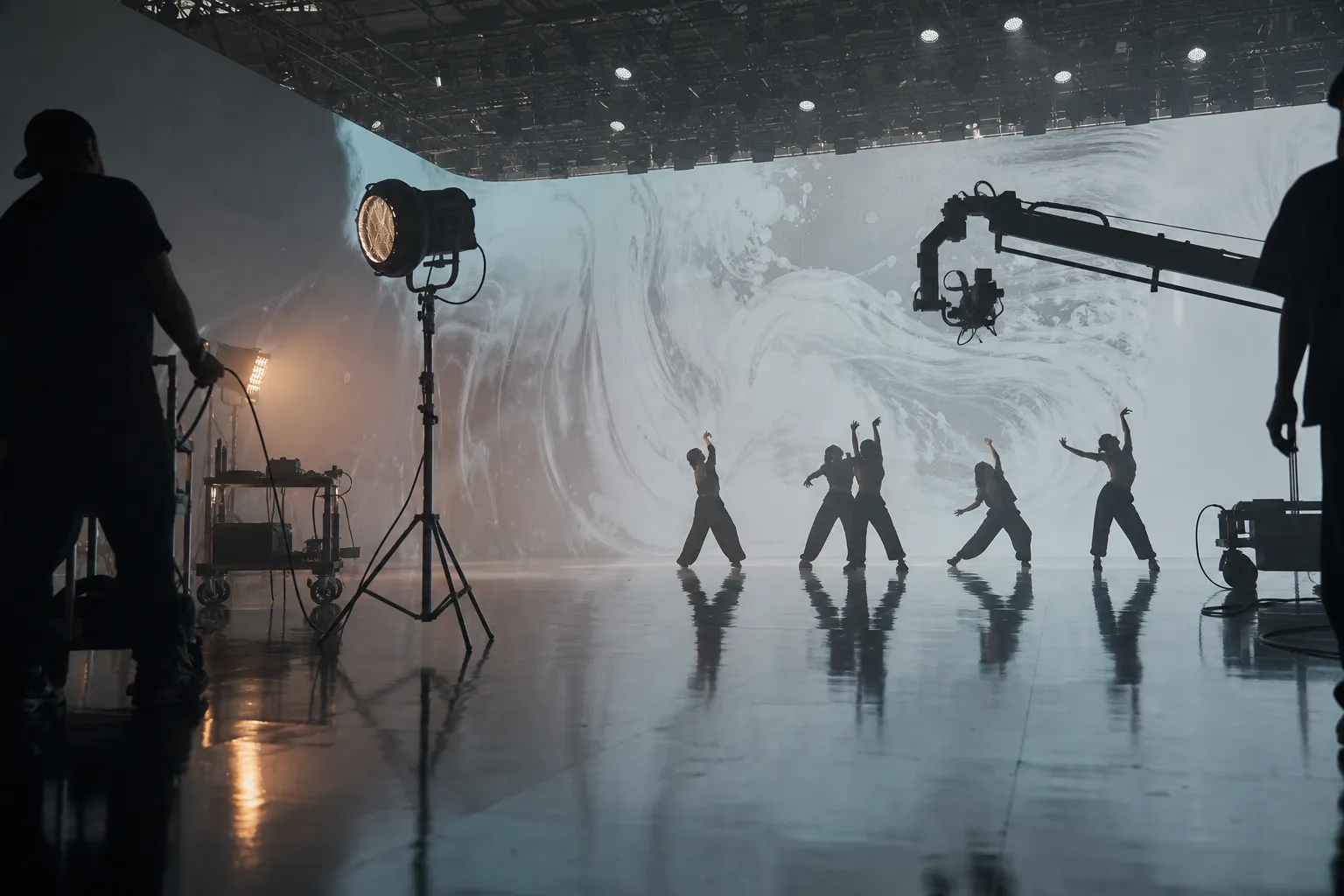
The other side of the evidence comes from behind-the-scenes context. IDN Times reported, using BLACKPINK’s official behind-the-scenes footage, that several scenes viewers suspected were AI or green-screen work involved physical sets, props, and practical filming. The report specifically said the G-Force scene and Lisa’s glass bridge scene appeared in behind-the-scenes footage, while also noting that green-screen use was limited in some parts.5
This does not cancel out the AI credits. Instead, it narrows the interpretation. The more defensible reading is that “GO” combined multiple production methods: practical sets and staged filming for some moments, conventional post-production and VFX, and credited AI artwork or AI VFX within the visual pipeline. That is a more precise conclusion than saying the video was either “made by AI” or “not AI.”
The behind-the-scenes material also helps explain why the controversy became confusing. Highly polished fantasy imagery can look synthetic even when built from physical staging, lighting, props, choreography, and compositing. At the same time, formally credited AI roles can make viewers more suspicious of scenes that may have been shot practically. In this case, the available facts support both viewer instinct and production nuance: AI was credited, but some moments suspected of being artificial were reportedly filmed with real sets or practical elements.
What the Debate Says About K-Pop Visual Production
The “GO” discussion sits within a broader shift in how audiences read music video credits. BLACKPINK’s comeback was positioned as a major group return: YG Entertainment described the release as the group’s first full-group comeback after three years, and said it was working to deliver “music of the highest quality.”1 The Korea Times, citing Yonhap, reported that “DEADLINE” combined EDM, hip-hop, and pop, and credited all four BLACKPINK members as co-lyricists on “Go.”6
Those details show the scale and scrutiny around the project. For a global group, even a single credit category can become a public interpretive frame. Once “A.I ARTWORK” and “AI VFX” appear in the credit trail, viewers may revisit the entire video through that lens. Yet the production record does not support reducing the whole work to AI generation. It supports a narrower, more industry-relevant point: AI is becoming a named part of high-end visual production, while traditional direction, set work, performance, and post-production remain central.
This is why the Yoonse AI editing focus is most useful when treated as a credit and workflow question rather than a binary accusation. The confirmed credits establish that AI-related visual labor was part of “GO.” The behind-the-scenes reporting establishes that not every visually uncanny scene should be presumed AI-generated. The gap between those two facts is where much of the controversy lives.
In conclusion, BLACKPINK’s “GO” does contain source-backed AI-related production credits, including “A.I ARTWORK” and “AI VFX,” but the available evidence also points to practical filming for scenes that some viewers questioned. The most careful reading is that the video reflects a hybrid production model, not a simple replacement of filmed performance with AI-generated imagery.
References
- BLACKPINK to Return as a Full Group After 3 Years… Comeback Set for February 27 with ‘DEADLINE’ (YG Entertainment, 2026-01-15)
- Blackpink announces upcoming 'Deadline' EP's lead track 'GO' (Korea JoongAng Daily, 2026-02-06)
- BLACKPINK – ‘GO’ MV (post EMOTION studio / Vimeo)
- Rima Yoon & Rigend Film Conjure a Surreal Fantasy for BLACKPINK “Go” Music Video (Stash Media, 2026-03-04)
- 4 Fakta di Balik Layar yang Gak Terlihat di MV GO – BLACKPINK, Bukan AI! (IDN Times, 2026-03-10)
- Girl group BLACKPINK returns with new EP 'Deadline' (The Korea Times / Yonhap, 2026-02-27)
About the Author