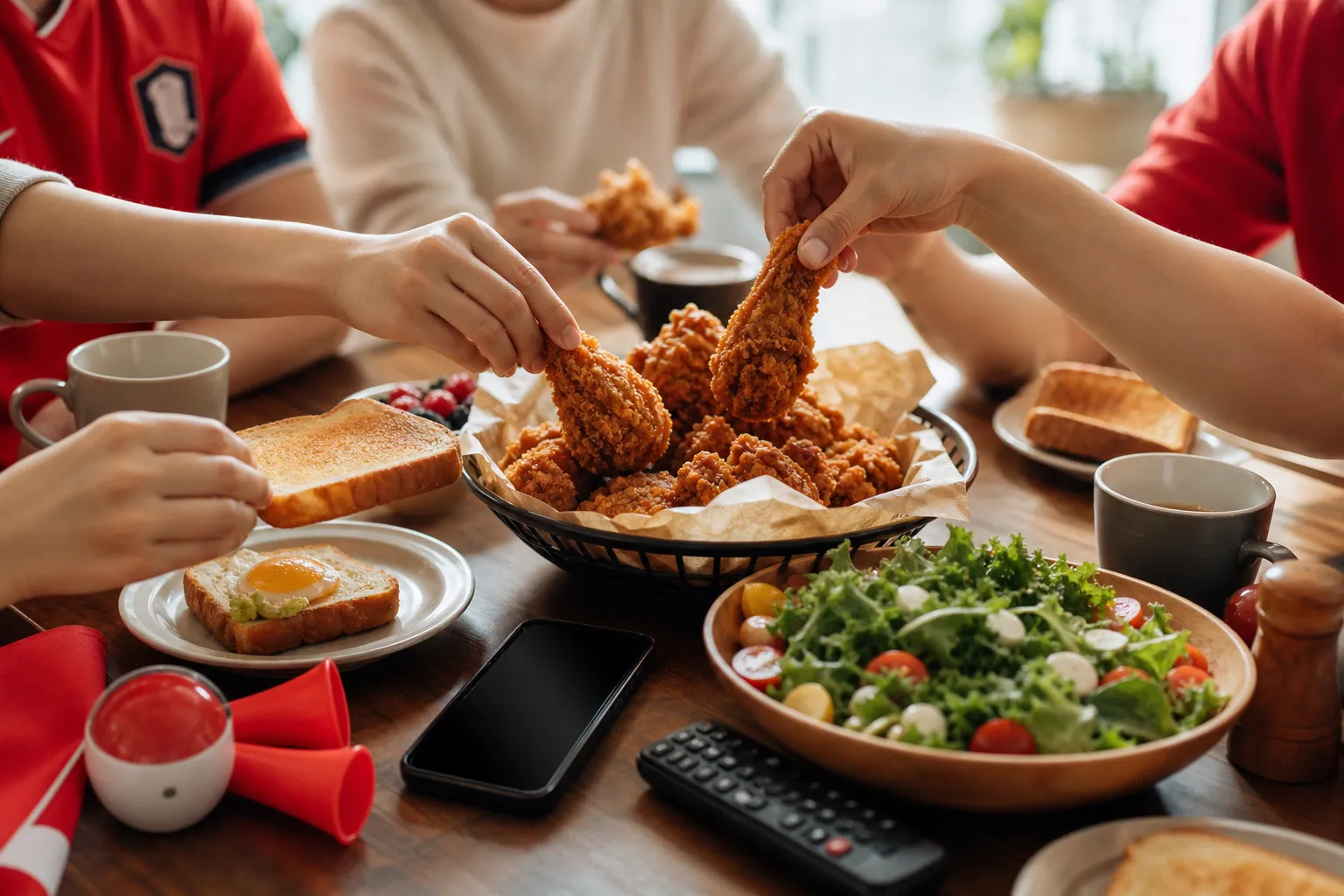
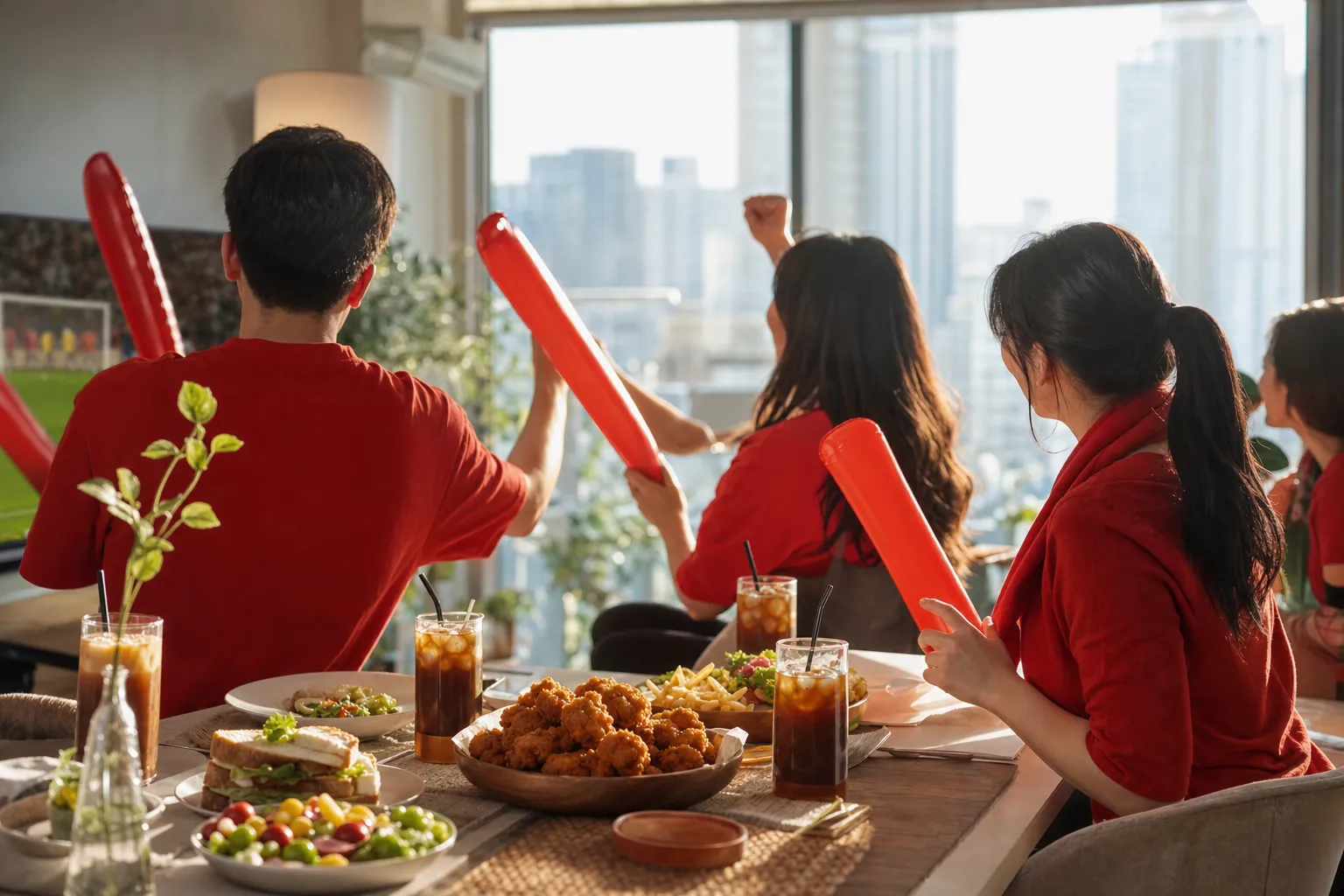
Korea’s World Cup morning cheering has become more than a scheduling inconvenience. With national team group-stage matches falling at 10 a.m. and 11 a.m. Korea time, the familiar evening pattern of beer-and-chicken viewing is shifting toward a Brunch World Cup rhythm built around workplaces, schools, cafes, convenience stores, and lunch-break public gatherings.1
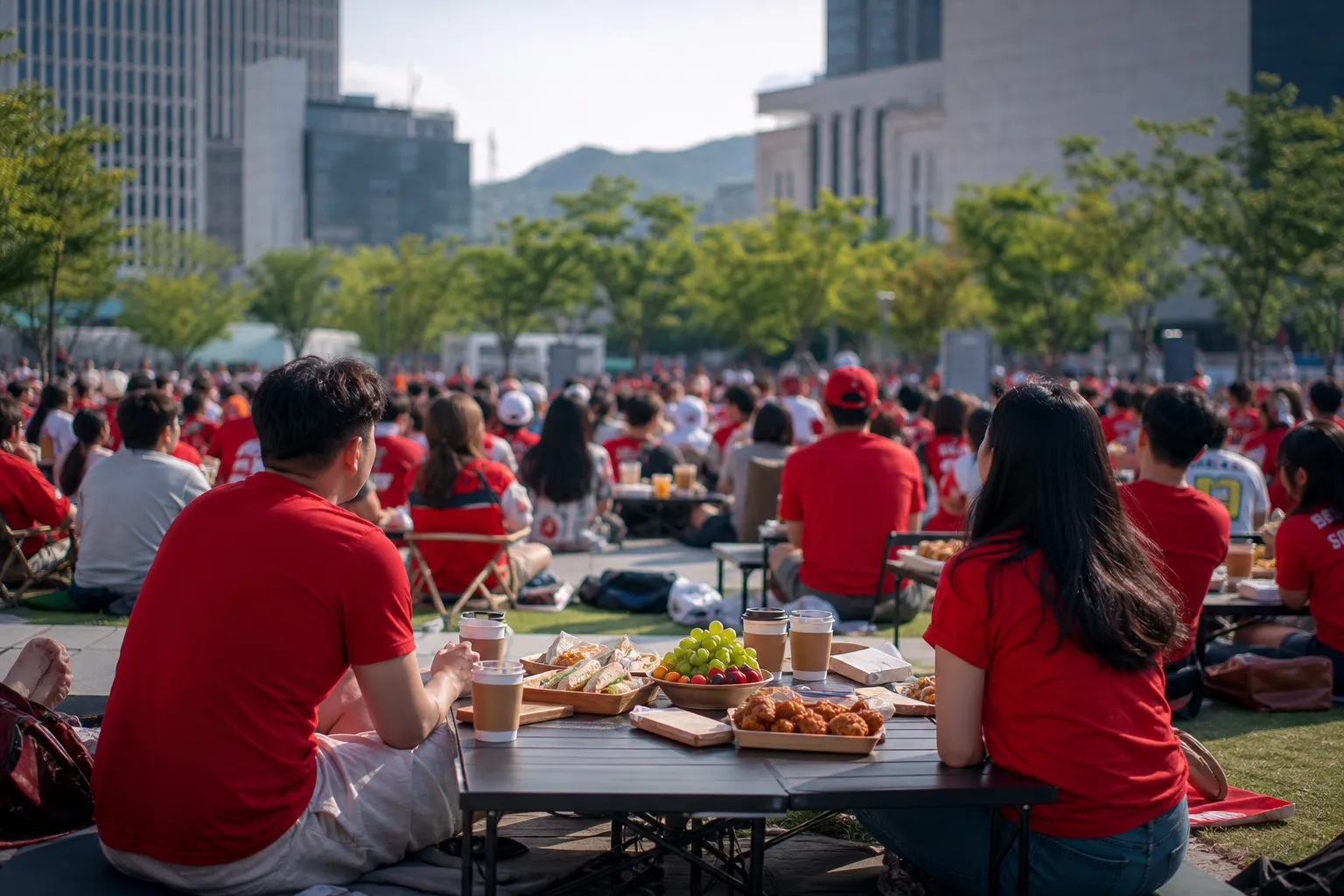
The clearest early test came on June 12, 2026, when Korea Republic faced Czechia in a FIFA World Cup 2026 First Stage Group A match at Guadalajara Stadium.2 In Seoul, that overseas kickoff translated into a weekday late-morning public viewing at Gwanghwamun Plaza, where crowd behavior, food purchasing, and office schedules all pointed in the same direction: morning football can still mobilize mass participation, but the format looks different.
Morning Cheering Moves From Nightlife To Lunch Breaks
Confirmed reporting before the match anticipated a practical change in fan routines. YTN noted that Korea’s preliminary matches were scheduled for 10 a.m. and 11 a.m. Korea time, making it likely that fans would watch in small pockets at work, school, or cafes while eating something simple rather than gathering primarily for late-night chicken and beer.1
That forecast was supported by match-day scenes on June 12. MBC reported that office workers and citizens adjusted their schedules, including moving lunch earlier, to watch the Korea-Czechia match. The viewing was not confined to one kind of venue: theaters, beer pubs, and outdoor cheering spaces all appeared in the coverage.3
The analytical point is not that the old cheering culture disappeared. Rather, the time slot forced it to become more modular. A weekday morning match cannot rely only on the long evening meal, the post-work gathering, or the late-night pub crowd. It instead favors shorter, more flexible participation: stepping out for an extended lunch, gathering with colleagues, ordering food earlier than usual, or joining a nearby public viewing if geography allows.
Direct comments from fans reinforce that the morning format still carried emotional weight. One interviewee, Wi Dae-han, described it as a first World Cup watched with his son, while Lee So-yeon said she had come after playing only one hour of golf especially because of football. Park Soo-bin said she was thankful because the players performed so well.3 These comments do not prove a nationwide sentiment by themselves, but they show that morning timing did not reduce the match to background content.
What The Gwanghwamun Schedule Shows
Seoul’s official public-viewing plan gives the morning trend a concrete civic frame. The city announced Gwanghwamun Plaza cheering events aligned with Korea’s group-stage schedule: June 12 at 11 a.m., June 19 at 10 a.m., and June 25 at 10 a.m. The events are co-hosted by the Korea Football Association, KT, and the Red Devils, with safety personnel, emergency medical support, and heat-response measures in operation.4
| Date | Scheduled Gwanghwamun cheering time | Status on June 15, 2026 | Key practical note |
|---|---|---|---|
| June 12, 2026 | 11 a.m. | Completed | Weekday late-morning crowd formed around the Korea-Czechia match.4 |
| June 19, 2026 | 10 a.m. | Upcoming | Seoul advised public transit use and heat precautions for plaza cheering.4 |
| June 25, 2026 | 10 a.m. | Upcoming | Same official public-viewing framework applies.4 |
| Gwanghwamun Plaza operations | Match-aligned | Active for listed group-stage dates | Safety staff, emergency medical support, and heat measures are part of the plan.4 |
The June 12 turnout suggests that a weekday daytime slot can still generate large-scale public energy. Seoul Shinmun reported that up to about 18,000 people gathered at Gwanghwamun Plaza despite strong sunlight, with fans wearing red shirts and holding Taegeukgi flags. Seoul’s real-time city data estimated the plaza crowd at about 18,000 as of 1 p.m.5
Here, the morning schedule matters because it changes the risk profile as well as the atmosphere. Evening street cheering often raises late-night transport and alcohol-management issues. A late-morning plaza event brings a different set of pressures: daytime heat, lunch-hour pedestrian flow, nearby office movement, and traffic congestion in central Seoul. Seoul’s public notice specifically urged people to use public transportation and prepare for hot weather.4
Retail Signals Behind The Brunch World Cup
The consumer side of morning cheering is harder to measure broadly from the available sources, but the early indicators are notable. Money Today reported that chicken franchises and convenience-store orders increased from the morning of June 12, with some BBQ and bhc stores opening earlier than usual. A GS25 store near Gwanghwamun recorded an 85.7% sales increase from 9 a.m. to 1 p.m. compared with the previous week.6
That figure is geographically narrow, so it should not be stretched into a claim about the entire convenience-store sector. Still, it fits the wider pattern: when a World Cup match lands before lunch, food demand shifts forward. The phrase “brunch cheering” is not just a cute label; it describes a real change in when fans buy and consume match-day food.
Retailers appear to be reading the remaining group-stage schedule the same way. Money Today reported that the distribution industry expected additional morning cheering demand for the June 19 and June 25 matches and was preparing discount events. OB Beer marketing vice president Seo Hye-yeon said the company planned to “share the heat of the World Cup with consumers,” a short promotional quote that also signals how beverage brands are adapting to the altered viewing window.6
For brands, the opportunity is specific but time-limited. The strongest demand is likely tied to match windows, commuting patterns, and central viewing locations rather than all-day celebration. For public organizers, the lesson is equally practical: crowd services, shaded waiting areas, medical readiness, and transit guidance are not secondary details when the cheering event begins under the late-morning sun.
Quick FAQ
When are the remaining Gwanghwamun Plaza morning cheering events?
After the completed June 12 event, Seoul’s listed Gwanghwamun Plaza cheering schedule includes June 19 at 10 a.m. and June 25 at 10 a.m. for Korea’s remaining group-stage matches.4
What should fans consider before joining a morning street cheering event?
The available official guidance emphasizes public transportation, possible traffic congestion, and heat precautions. Seoul also said safety personnel, emergency medical support, and heat-response measures would be in place at the Gwanghwamun Plaza events.4 !Korea World Cup morning cheering early chicken orders brunch trend Korea’s morning World Cup cheering is best understood as an adaptation, not a downgrade. The June 12 match showed that fans could gather in large numbers, retailers could shift sales into the morning, and workers could reshape lunch breaks around football. If the June 19 and June 25 events follow the same pattern, the Brunch World Cup may become one of the defining local features of Korea’s 2026 group-stage experience.
References
- 치맥 대신 '브런치'…월드컵 응원 풍경 바뀐다 [앵커리포트] (YTN, 2026-06-09)
- Korea Republic vs Czechia | First Stage | FIFA World Cup 2026 (FIFA, 2026-06-12)
- 점심시간 앞당겨 열띤 응원전‥곳곳에서 "대한민국" (MBC 뉴스, 2026-06-12)
- '북중미 월드컵' 광화문광장 응원…교통혼잡·폭염 주의하세요! (서울시 내 손안에 서울, 2026-06-10)
- [월드컵]“대한민국” 함성에 광화문 들썩…평일 낮에도 1만 8000명 모였다 (서울신문, 2026-06-12)
- "오전에 월드컵? 누가 봐" 심드렁했는데 대반전…'브런치 치맥' 떴다 (머니투데이, 2026-06-14)
About the Author