
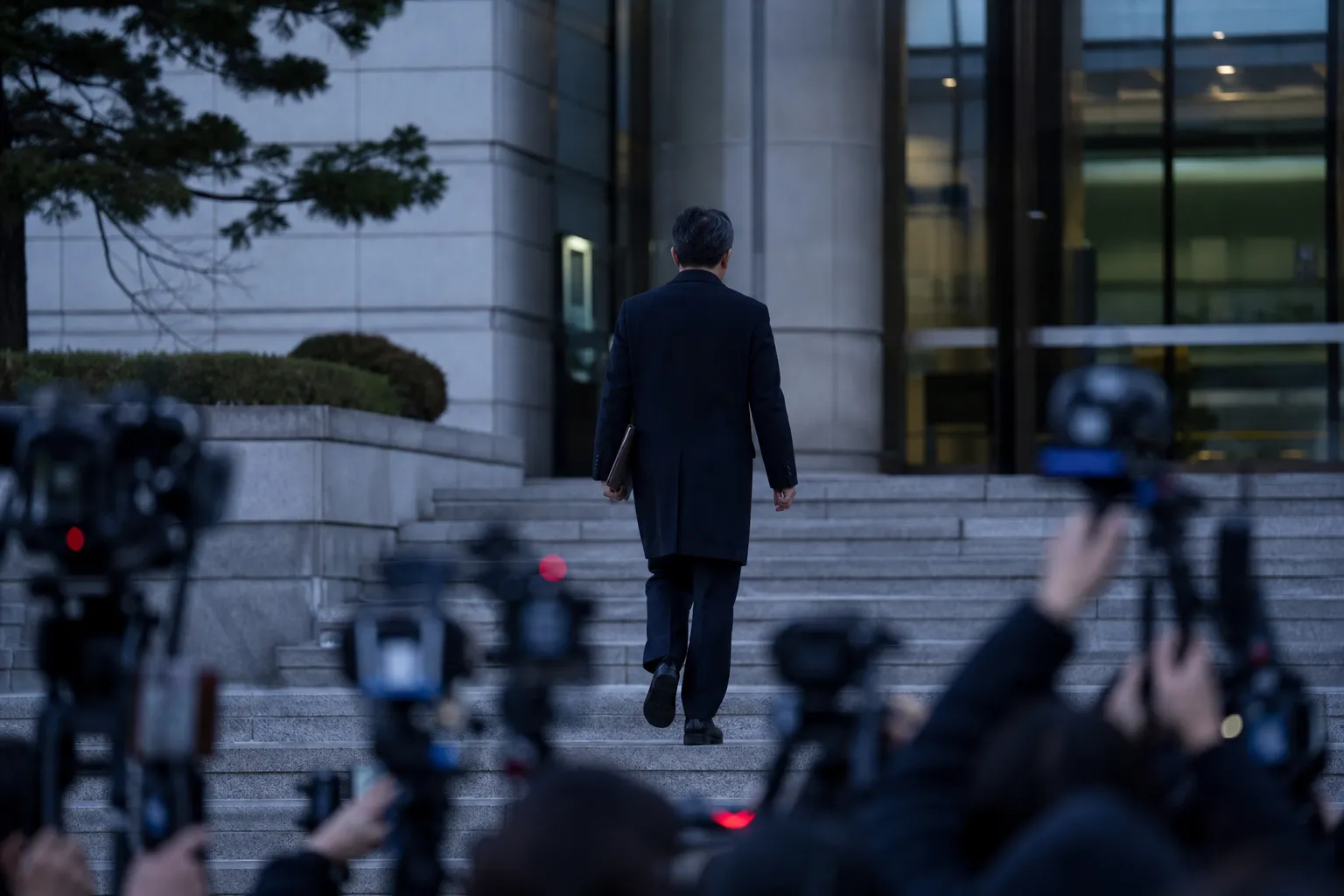
South Korea’s Supreme Court has finalized the acquittal of actor O Yeong-su in a sexual misconduct case, dismissing the prosecution’s appeal and upholding the appellate court’s not-guilty ruling. The O Yeong-su acquittal became final after the Supreme Court’s third division rejected the appeal on June 25, 2026, with the decision reported on June 26.1
The ruling ends a case that began with allegations connected to a 2017 regional theater tour and led to O’s indictment without detention in November 2022. Yonhap reported that the case concluded about three years and seven months after the indictment, leaving the actor cleared of the charge at the country’s highest court.2
Supreme Court Upholds O Yeong-su Acquittal

The Supreme Court’s decision did not create a new factual finding but left in place the appellate court’s acquittal. Multiple Korean outlets reported that the court dismissed the prosecution’s appeal, meaning the second-trial judgment became final.3
O, known internationally for his role in Netflix’s “Squid Game,” had been accused of forcibly molesting another actor while staying outside Seoul for a theater performance in 2017. Kyunghyang Shinmun reported that O’s real name is Oh Se-kang and that the allegation concerned an actor who appeared in the same production.4
The case followed a sharply different path through the lower courts. The first trial found the complainant’s statement credible and sentenced O to eight months in prison, suspended for two years. The appellate court later overturned that conviction and acquitted him, finding that the charge had not been proven sufficiently.4
MBC also summarized the same sequence: an eight-month prison term suspended for two years at the first trial, a reversal at the second trial, and a Supreme Court rejection of the prosecutor’s final appeal.3
Why The Lower Court Reversed The Conviction
The appellate court’s reasoning centered on the criminal standard of proof and doubts about whether the alleged conduct had been established beyond reasonable doubt. Yonhap’s Korean-language report quoted the second-trial court as saying, “When in doubt, the benefit must go to the defendant,” a formulation of the principle that unresolved doubt cannot support a criminal conviction.2
The same report said the appellate court also found there was a possibility that the complainant’s memory had been distorted. The court’s language, as reported, was that “there is a possibility that the victim’s memory was distorted.”2
Dong-A Ilbo reported that O had denied the allegations and that the appellate court relied on the possibility of memory distortion and the reasonable-doubt principle in reversing the first-trial guilty judgment.5
The Electronic Times report added further detail on the evidentiary assessment, saying the appellate court found circumstances that could raise suspicion of misconduct but judged that proof was insufficient regarding the intensity of an alleged hug and an alleged kiss on the cheek.6
Those findings became decisive once the Supreme Court declined to accept the prosecution’s appeal. In South Korea’s court structure, the Supreme Court’s dismissal of the appeal left the second-trial acquittal in force, making the actor’s not-guilty status final in this case.1
Reaction And Case Timeline
The case attracted broad attention because O had become widely recognized after the global success of “Squid Game.” The allegations, however, were tied to the 2017 theater tour, before the series made him internationally known. Yonhap reported that he was indicted in 2022 over those allegations, while the final Supreme Court outcome came in June 2026.1
The complainant’s side criticized the appellate ruling after the acquittal. Yonhap’s Korean-language report quoted the side as calling it “a shameful ruling” that helps reinforce the structures in which sexual violence occurs and hierarchical power structures.2
The Supreme Court outcome does not erase the earlier split between the lower courts. The first trial accepted the credibility of the complainant’s account and imposed a suspended sentence, while the second trial found the prosecution had not met the burden required for a criminal conviction. The Supreme Court’s action resolved the legal process by leaving the second-trial decision intact.4

The final ruling closes the criminal case against O Yeong-su with an acquittal confirmed by South Korea’s highest court. Based on the reported court sequence, the decisive legal point was not a new public account of the 2017 events but the appellate court’s conclusion that the charge had not been proven beyond reasonable doubt, a conclusion the Supreme Court allowed to stand.
References
- Supreme Court finalizes acquittal of 'Squid Game' actor O Yeong-su in sexual misconduct case (Yonhap News Agency, 2026-06-26)
- '깐부 할아버지' 배우 오영수 강제추행 무죄 확정…기소 3년 반만 (연합뉴스, 2026-06-26)
- '오징어게임 깐부' 오영수 강제추행 혐의 무죄 확정 (MBC 뉴스, 2026-06-26)
- ‘강제추행 혐의’ 배우 오영수, 대법서 무죄 확정 (경향신문, 2026-06-26)
- ‘오겜 깐부’ 오영수, 강제추행 무죄 확정…법원 “피해자 기억 왜곡 가능성” (동아일보, 2026-06-26)
- 오징어 게임 '깐부 할아버지' 오영수, 강제추행 무죄 확정 (전자신문, 2026-06-26)
About the Author