Munhwaok Yangji Seolleongtang is one of those Euljiro food names that carries more than a menu item. The restaurant’s story reaches back to 1952, when Munhwaok began serving seolleongtang in Seoul, before later moving to its current Euljiro 4-ga location in 1957.1
For anyone trying to understand Euljiro Seolleongtang beyond a simple bowl of soup, Munhwaok offers a useful window into Seoul’s old restaurant culture: practical, steady, and built around a dish that has stayed close to its roots. The available sources describe it not as a flashy destination, but as a long-running Korean restaurant whose identity has been shaped by broth, beef, neighborhood memory, and quiet acts of care.
Munhwaok Yangji Seolleongtang and Its Euljiro Roots
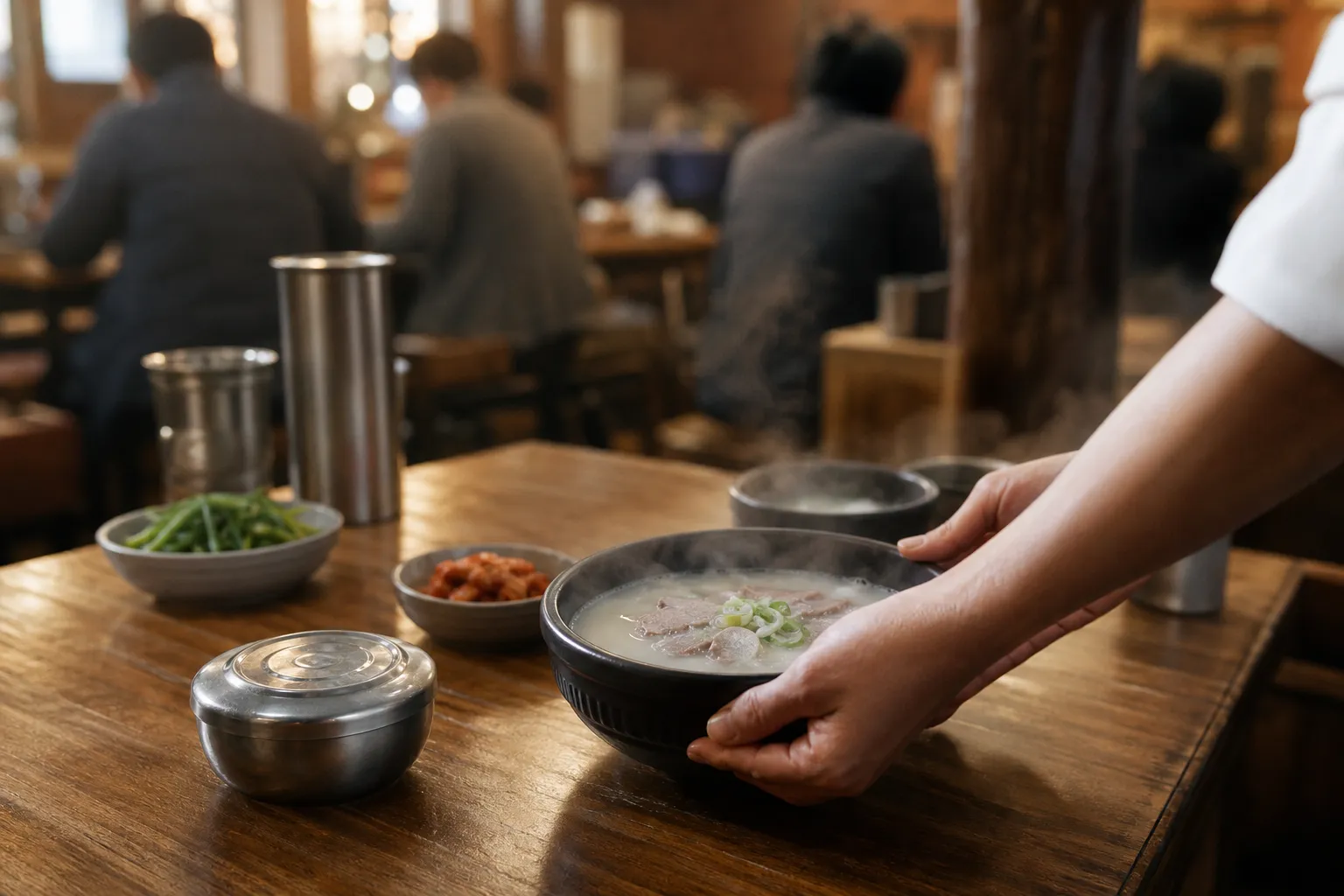
Munhwaok’s history is usually traced to 1952. Seoul Metropolitan Government material listing long-loved restaurants within the Seoul Future Heritage program identifies Munhwaok as a Jung-gu gomtang restaurant that opened in 1952, placing it among old restaurants that began in the 1950s.2 Other source material adds more detail: Munhwaok was founded in Jongno 5-ga in 1952 and moved to its present Euljiro 4-ga location in 1957.1
That movement from Jongno 5-ga to Euljiro 4-ga matters because it places the restaurant inside a part of Seoul known for industry, markets, print shops, and older commercial streets. The sources do not describe every stage of the restaurant’s daily life, but they do consistently frame Munhwaok as an old establishment, or nopo, with a long memory in the city’s dining scene.
Several accounts also connect the restaurant’s beginning to postwar Seoul. Jeonmae reported that Munhwaok started selling seolleongtang near Dongdaemun Market in 1952, during the Korean War period.3 That background gives the dish a practical context. Seolleongtang is not presented here as a luxury food. It is a sustaining bowl: broth, beef, noodles, and the kind of warmth that makes sense in a busy market district.
Munhwaok’s recognition helps explain why it continues to appear in discussions of Seoul’s old restaurants. Kookmin Ilbo reported that the Euljiro 4-ga restaurant was selected for the “100 Old Korean Restaurants Loved by Koreans” list and was designated a Seoul Future Heritage site in 2015.4 Senior Chosun likewise reported that Munhwaok was chosen for the “100 Old Korean Restaurants Loved by Koreans” in 2012 and selected as Seoul Future Heritage in 2015.5
What Makes the Seolleongtang Seoul-Style
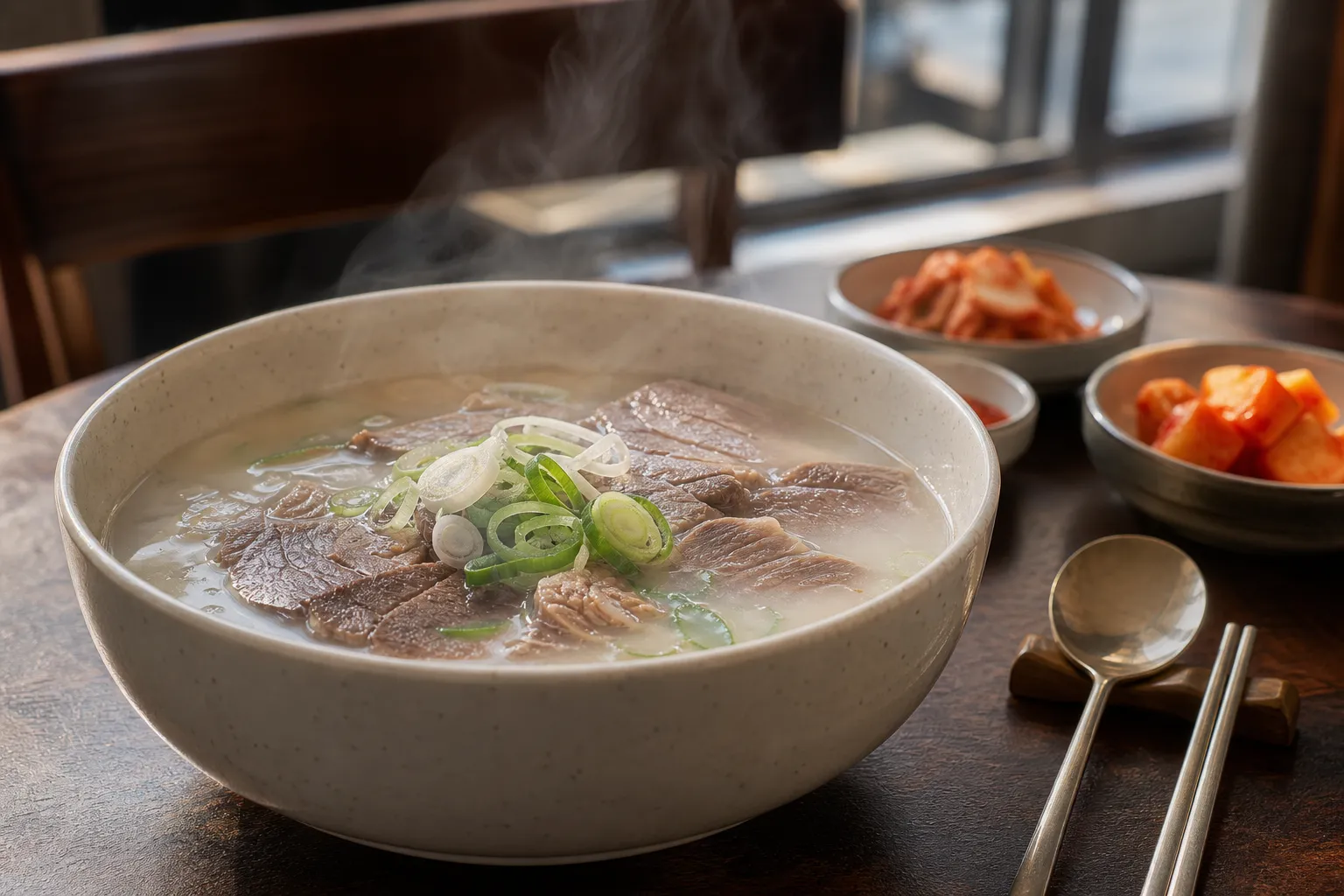
The core of Munhwaok’s identity is the bowl itself. The Seoul Future Heritage-hosted Hankyung column describes its seolleongtang as broth made with beef bones, ox feet, tail, and brisket, served with noodles and slices of boiled brisket.1 That combination gives the dish its structure: a pale, beef-based soup, a simple noodle filling, and yangji suyuk, or boiled brisket, as the central topping.
Lampcook’s Korean food story material, drawing on Korean Food Promotion Institute content, describes Munhwaok’s seolleongtang as a Seoul-style version made mainly with beef bones, brisket, and head meat.6 The wording varies slightly across sources, but the repeated theme is clear: the restaurant’s bowl depends on beef stock and restrained, clean flavor rather than an overloaded presentation.
This is where the “yangji” in Munhwaok Yangji Seolleongtang becomes important for an English-language reader. Yangji refers to brisket, a beef cut often used in Korean soups because it can contribute both broth depth and tender slices of meat. In Munhwaok’s case, sources specifically mention brisket either as part of the soup base or as the boiled beef served on top.1
The available material does not provide a current menu price, opening hours, or a full menu list, so those details should not be guessed. What can be said is more grounded: Munhwaok is repeatedly described through the lens of long-running Seoul-style seolleongtang, especially a broth built from beef parts and finished with noodles and brisket. That is enough to understand the restaurant’s appeal without overdecorating the story.
The restaurant’s own relationship with its customers also appears in the source record. In one interview quote preserved by Lampcook, Lee Soon-ja says, “The people who know the taste of our seolleongtang better than anyone are our customers.”6 It is a modest line, but it fits the character of a restaurant whose reputation seems to rest on long familiarity rather than constant reinvention.
A Bowl Connected to Community Care
Munhwaok’s story is not only about age or culinary recognition. Multiple 2017 reports focus on Lee Soon-ja and the restaurant’s long-running practice of serving meals to older adults living alone in the neighborhood. Kookmin Ilbo reported that Lee had served lunch to local elderly people living alone every last week of the month since 1990.4 Senior Chosun similarly reported that she had been serving seolleongtang to elderly people living alone for 27 years by 2017.5
That detail gives the restaurant’s public image a different kind of weight. Many old restaurants are remembered because they survived; Munhwaok is also remembered in the sources because it kept feeding people beyond regular customers. Jeonmae also reported that the restaurant provided meals to elderly residents living alone during the last week of each month.3
One quoted line from Lee captures the spirit behind that practice: “I hope many people become happy after eating our restaurant’s food.”5 The quote is simple, but it connects neatly with the dish itself. Seolleongtang is often valued for comfort and nourishment, and in Munhwaok’s case, the sources show that comfort extending into a repeated community meal.
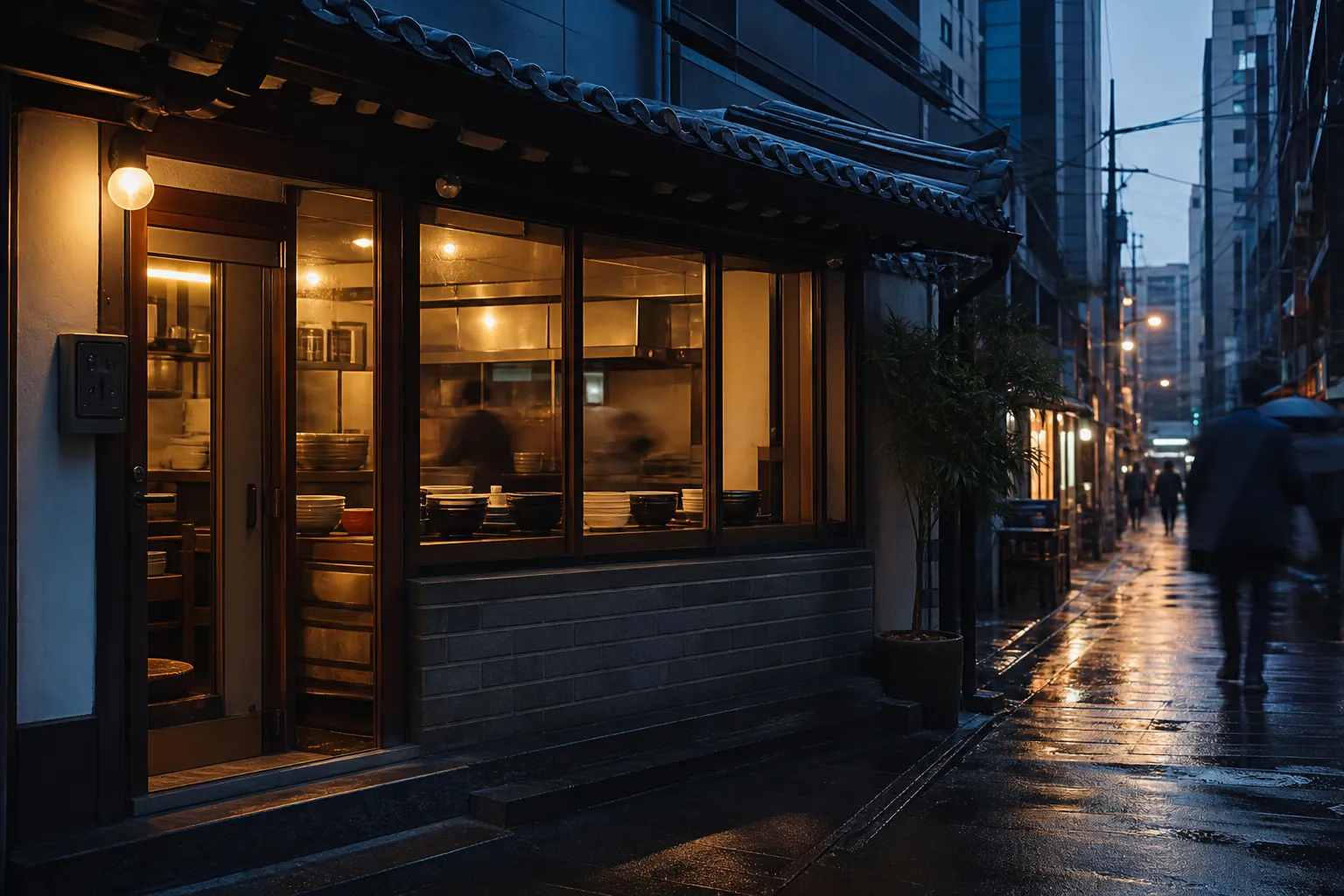
For readers exploring Euljiro through food, Munhwaok Yangji Seolleongtang stands out because its meaning is layered. It is a 1952-founded Seoul restaurant, a recognized heritage nopo, a place associated with Seoul-style beef broth, and a restaurant linked in reports to decades of meals for neighborhood seniors. The best way to describe it, using only what the sources support, is as a steady Euljiro seolleongtang house whose bowl has carried both flavor and memory across generations.
References
- [19.05.30 한국경제][유성호의 휴먼&푸드] 삼성 이병철 회장이 자주 갔던 이태리 음식점은? (서울미래유산 / 한국경제, 2019-05-30)
- 오래 사랑받은 노포들, 서울미래유산 속 식당 50 (서울특별시 정보소통광장 / 내 손안에 서울, 2021-11-11)
- 을지로4가 설렁탕 맛집 '문화옥' 이순자 대표, 27년째 어르신들에게 무료 식사 제공 (전국매일신문, 2017-03-27)
- “시어머니 생각에… ” 27년째 어르신에 설렁탕 대접 ‘문화옥’ 이순자 사장 (국민일보, 2017-03-28)
- 노인들에게 퍼준 '사랑의 설렁탕' 3만 그릇 (시니어조선, 2017-03-27)
- 약 70년간 이어온 깔끔하고 담백한 서울식 설렁탕의 맛 (램프쿡 / 한식진흥원 자료)
About the Author