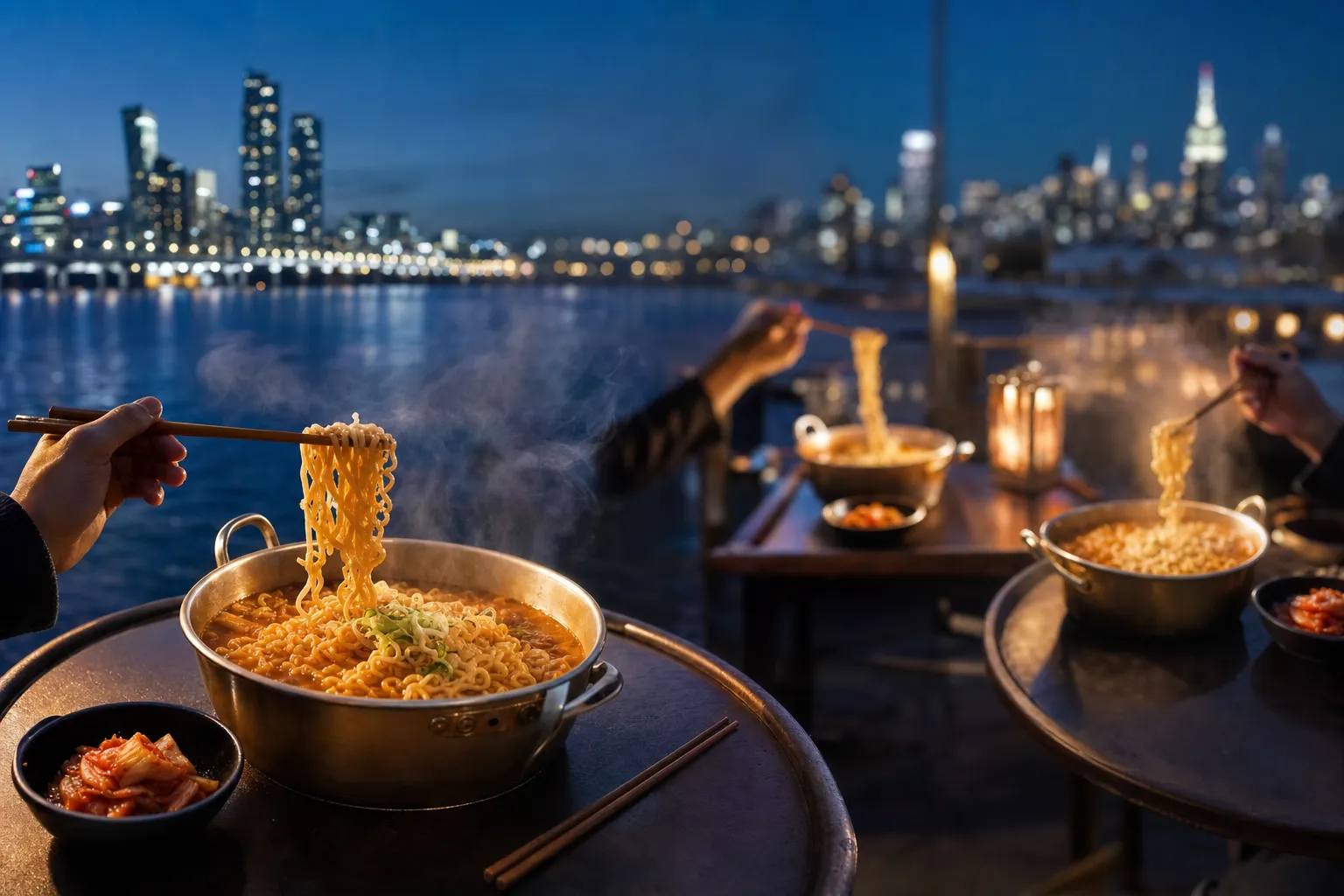
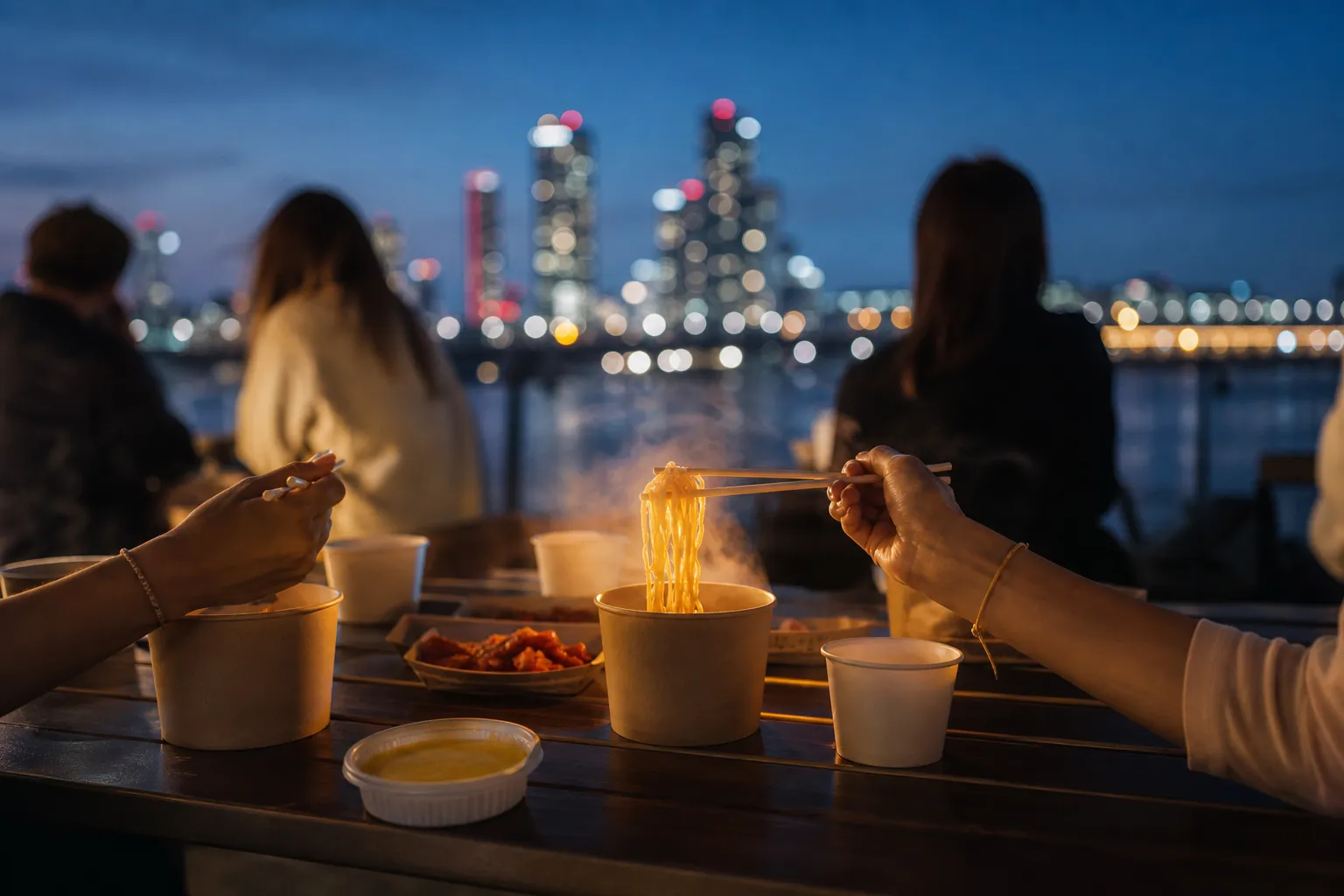
The K-food boom is no longer only about buying Korean products overseas; it is increasingly about trying Korean food as a cultural experience. Han River Ramen has become one of the clearest examples, connecting Korean instant noodles, K-drama imagery, outdoor Seoul food culture, and hands-on pop-up events in Korea and abroad.
Korean food exports give the trend its commercial backdrop. South Korea’s Ministry of Agriculture, Food and Rural Affairs reported that preliminary K-Food+ exports reached $7.0451 billion in the first half of 2026, up 4.1% year on year and the highest first-half figure on record. Agricultural food exports alone reached $5.3819 billion, up 5.0%, while the United States recorded $1.04 billion led by items including ramen, snacks, and kimchi. China was listed as the top destination for ramen exports, with first-half ramen exports to China at $217.6 million.1
How Han River Ramen Fits the K-Food Boom
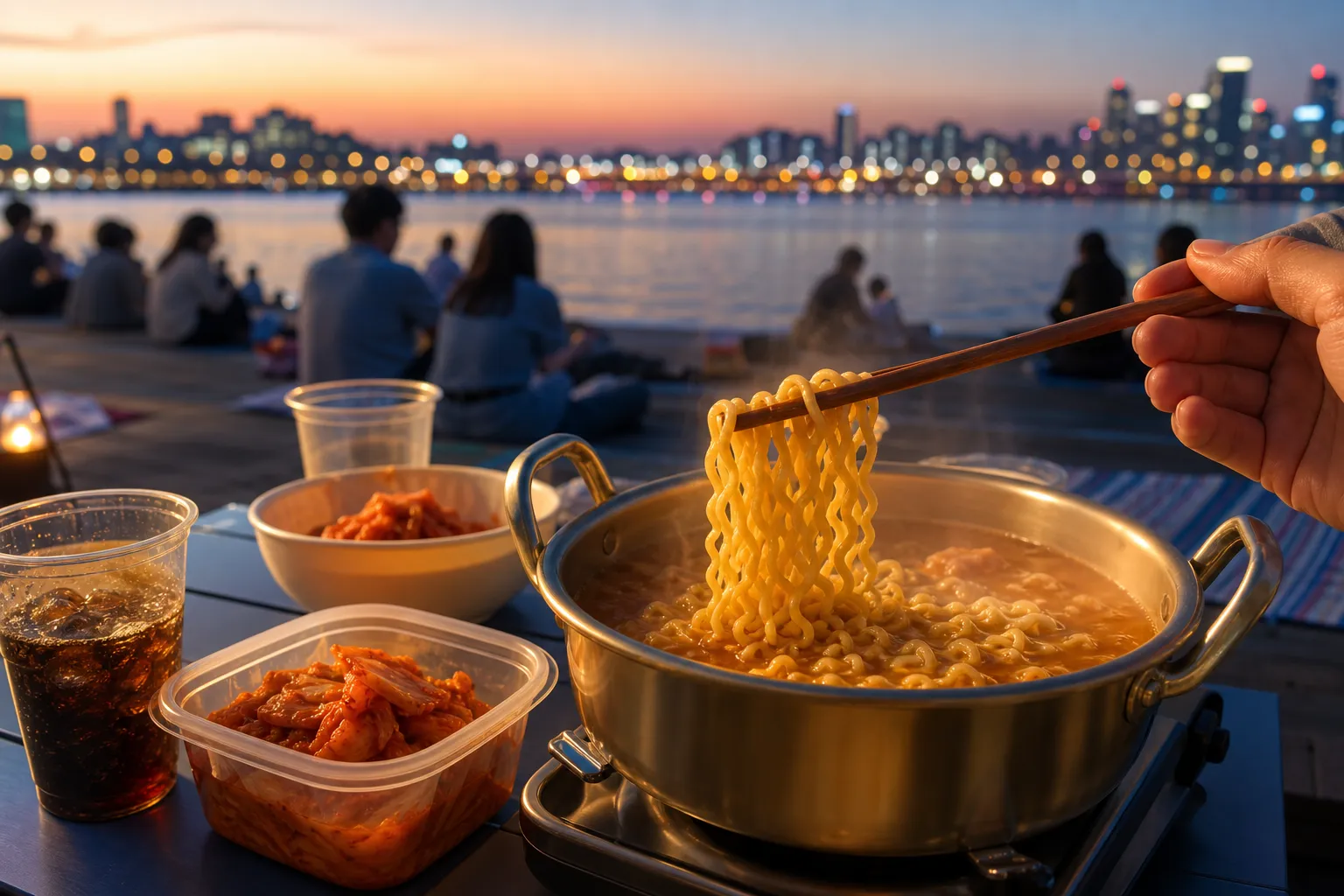
For readers trying to understand why Han River Ramen keeps appearing in travel, pop-up, and cultural programming, the key is that it works as both food and activity. The experience usually centers on making instant ramen with a self-service cooker, often associated with riverside convenience stores and park food zones in Seoul. That makes it easy to explain, easy to film, and easy to recreate at overseas K-food events.
The export numbers show that ramen is a major growth driver, not a side story. Money Today reported, citing Korea Customs Service figures, that Korean ramen exports in the first half of 2026 rose 27.9% year on year to $940 million. The same report noted that Korean ramen exports reached a record $1.52 billion in 2025, and that the industry sees a possibility of annual exports surpassing $2 billion in 2026.2
That commercial momentum helps explain why ramen experiences are being used in cultural promotion. Han River Ramen is not simply a bowl of noodles; it is a compact way to package Korean convenience-store culture, travel fantasy, and K-content familiarity. A 2025 Channel A report from Seoul’s Han River parks and the Yeouido dock area described foreign tourists enjoying Han River Ramen and chicken, and said that half of the people eating Han River Ramen were foreigners. The report also said a food zone’s cooking area filled within an hour of opening, creating lines, and that a dedicated shop had opened at Yeouido dock as K-drama interest drew attention to the experience.3
A Spanish tourist quoted in that report said they came after watching ramen being cooked on YouTube, adding that it tasted “a little spicy, sweet, and delicious.”3 The quote points to a practical detail for visitors and organizers: the appeal is visual before it is culinary. People often know what they want to try before they arrive because they have already seen the cooking process through video or drama-linked content.
Where People Could Try It in 2026
In Seoul, the most specific 2026 event in the available sources was the 3rd Slow Slow Han River Triathlon Festival, held from June 5 to 7, 2026, around Ttukseom and Jamsil Hangang Park. The Seoul Metropolitan Government introduced food programs for foreign participants built around K-content, including chicken and beer and Han River Ramen. One featured program was “making my own Han River Ramen through ramen MBTI,” and the city said the Han River Ramen experience could be used freely on site without separate advance registration.4
Because that festival date has already passed, visitors should not treat it as a currently bookable activity. The useful takeaway is different: Seoul has formally used Han River Ramen as part of foreigner-facing cultural programming, and the format may appear again where K-content and riverside leisure are combined.
Overseas, Taiwan provided a clear example of how the format travels. The Overseas Koreans Newspaper reported that about 13,000 people visited a K-food pop-up store held by the Ministry of Agriculture, Food and Rural Affairs and aT in Taipei from May 15 to 17, 2026. The event used a Korean street-stall concept and K-bunsik, or Korean snack food, experiences. Its Han River Ramen content, made with instant ramen cookers, drew long waiting lines, and on-site sales were counted at about 10 million won, or 230,000 Taiwan dollars.5
One university student visitor said that making and eating the Han River Ramen seen in dramas in the middle of Taipei felt like taking a trip to Korea.5 Jeon Ki-chan, aT’s director for export food, also said the organization would strengthen experience-based marketing connected to local MZ-generation consumer trends so K-food could take root in Taiwanese consumers’ daily lives.5
New York offers another 2026 example of ramen being placed inside a broader K-culture setting. The Korean Cultural Center New York announced “It’s Time for K-Culture 2026: Escape the Summer, Dive into Korea,” running from July 8 to August 22, 2026. The event is co-hosted by the Korean Cultural Center New York, Korea Tourism Organization, and Korea Creative Content Agency New York Center, with sponsors including Nongshim. Its PC room and snack zone combine ramen with Korean snacks, and selected operating dates include free sampling of Nongshim ramen and snack products.6
Practical Tips for Readers Following the Trend
If you are tracking Han River Ramen as part of a Korea trip, look for official city event pages, Han River park food zones, and Yeouido dock-area food information rather than assuming every festival includes the same setup. The most detailed Seoul source available here confirms a June 2026 event experience, but it does not provide a standing year-round schedule for all parks.
If you are outside Korea, search for K-food pop-ups, Korean cultural center programs, tourism events, and K-culture festivals. The Taipei and New York examples show that organizers may frame ramen not just as a tasting sample, but as an interactive activity tied to Korean snacks, PC room culture, street-stall concepts, or drama-inspired food memories.
For brands and event planners, the lesson is practical: the cooking process matters. Han River Ramen works because visitors can participate, watch the machine cook, customize the moment, and connect it to content they already recognize. That is why the experience can sit comfortably beside export growth data while still feeling like a simple bowl of noodles.
Quick FAQ
Is Han River Ramen only available in Seoul?
No. The Seoul riverside experience is central to the image, but 2026 sources also show Han River Ramen-style content appearing at a Taipei K-food pop-up and ramen-centered K-culture programming in New York.56
Did Seoul require advance booking for the 2026 Han River Ramen festival experience?
For the 3rd Slow Slow Han River Triathlon Festival held from June 5 to 7, 2026, Seoul said the Han River Ramen experience could be used freely on site without separate advance registration.4 !Han River Ramen global experience Seoul Taipei New York 2026 trend Han River Ramen has become useful because it makes the K-food boom tangible: export growth shows the market demand, while Seoul events and overseas pop-ups show how a familiar instant noodle can become a participatory Korean culture experience.
References
- 2026년 상반기 케이-푸드 플러스(K-푸드+) 수출 70.5억 달러로 역대 최고치 경신! (농림축산식품부, 2026-07-05)
- K라면 펄펄, 올수출 20억弗 예약 (머니투데이, 2026-07-07)
- 외국인들이 한강 라면 좋아하는 이유? (채널A, 2025-07-27)
- 기록 경쟁 없는 힐링 레이스, '쉬엄쉬엄 한강 3종 축제' 6월 5일 개막 (서울특별시, 2026-06-02)
- 대만 'K-포장마차'에 1만3천명 몰렸다…‘한강 라면’ 단연 인기 (재외동포신문, 2026-05-19)
- It’s Time for K-Culture 2026: Escape the Summer, Dive into Korea (Korean Cultural Center New York, 2026-07-07)
About the Author