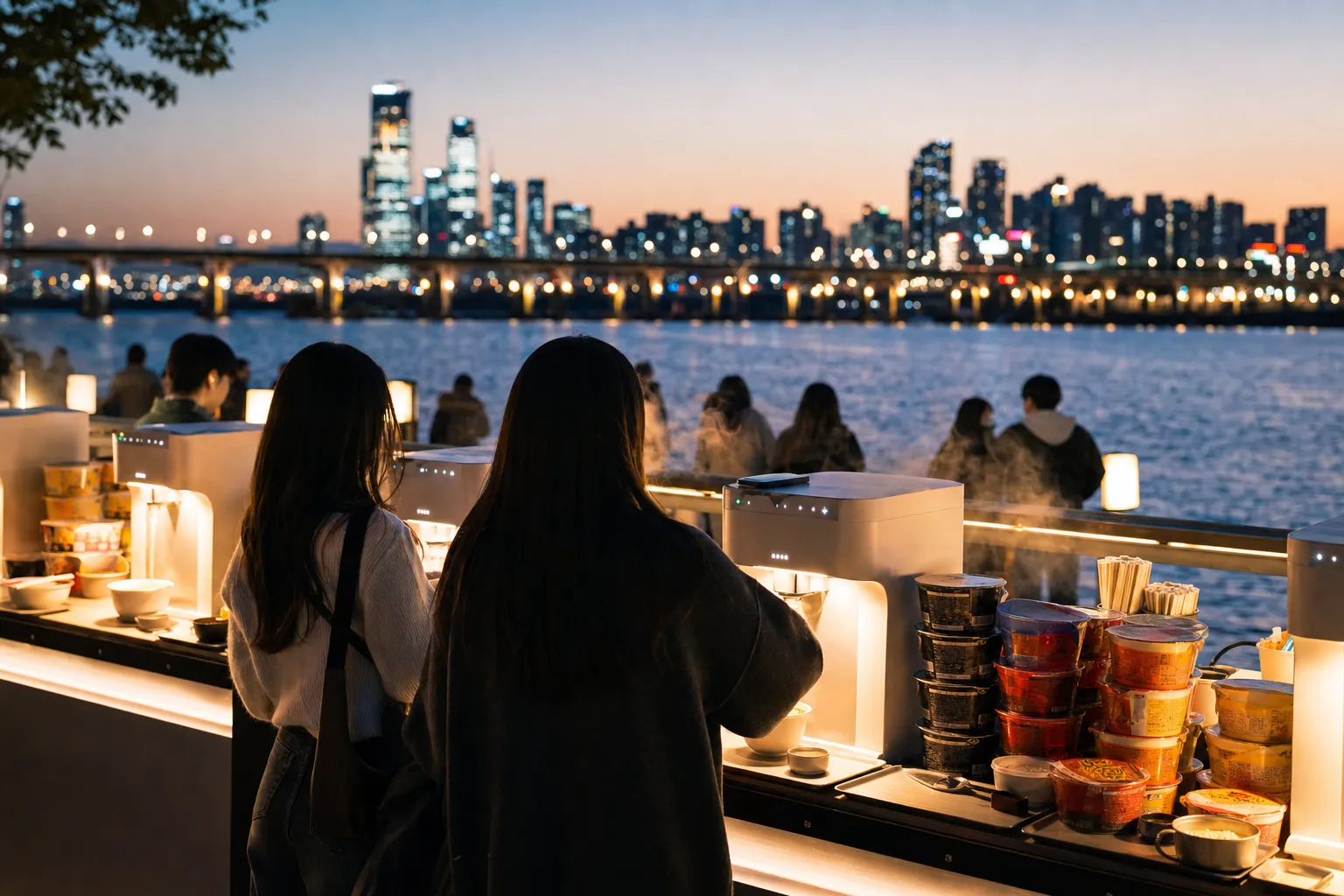
Han River Ramen experience zones became a recognizable K-food format in 2026, appearing at overseas K-food fairs, Korean culture expos, and Seoul riverside programs. Instead of presenting ramen only as a packaged product, these zones let visitors cook, customize, taste, and photograph the instant ramen culture associated with convenience stores and Han River parks.
The available records point to several different versions of the experience. Some were export-focused showcases for overseas consumers, while others were festival programs in Seoul where visitors could make a personalized cup or try a more unusual riverside ramen activity. The key point for readers is that “Han River Ramen” is not one fixed venue or single ticketed attraction; it is a flexible event concept that has appeared in different locations with different participation rules.
What a Han River Ramen Experience Zone Usually Includes
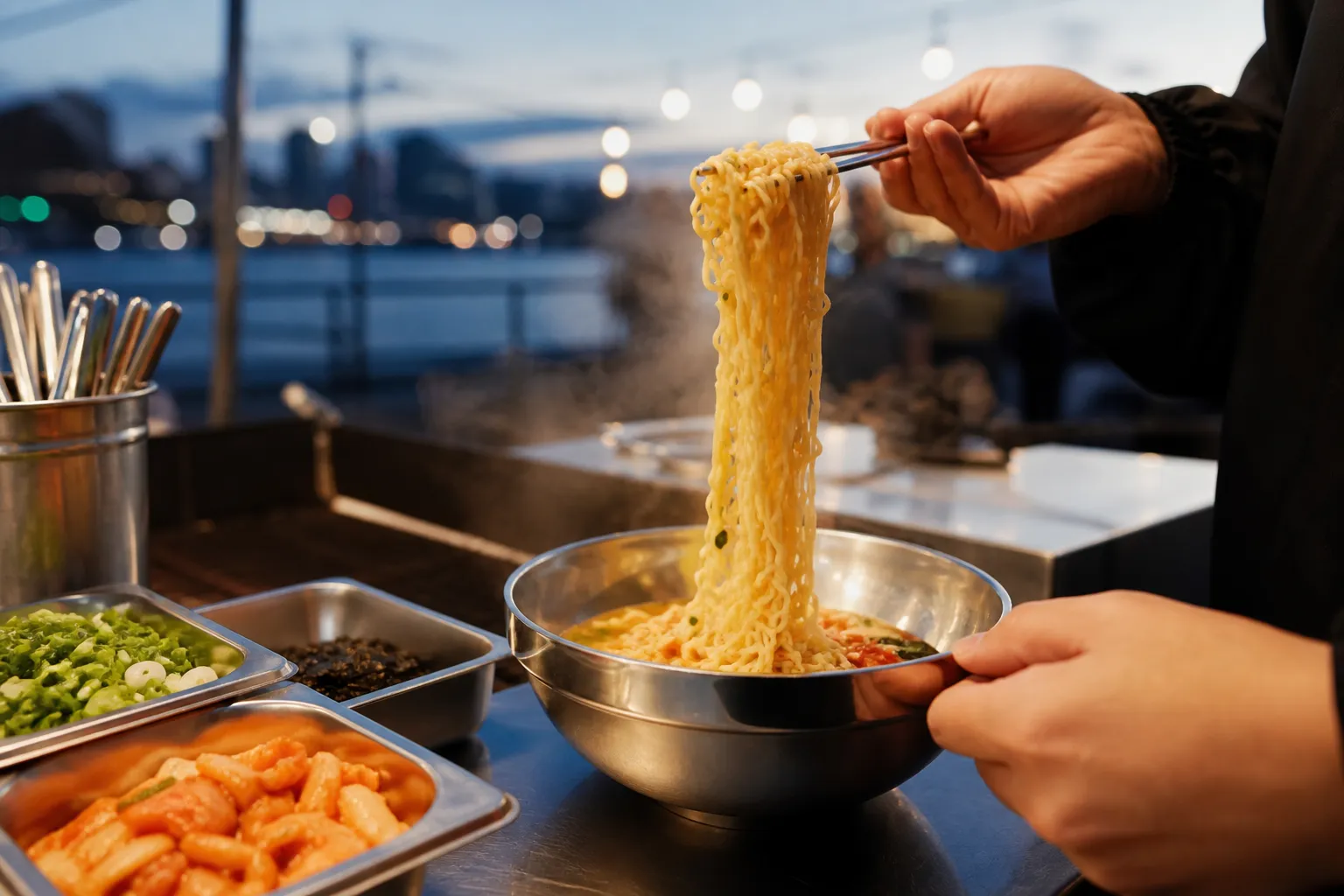
The most consistent feature is hands-on preparation. At the Europe K-Food Fair in Paris, held from June 16 to 18, 2026, the Han River ramen experience zone operated as part of a B2C event built around the concept of a “K-convenience store seen in K-dramas.” Visitors could choose toppings and cook ramen themselves in a DIY format, alongside about 200 promising export items on display.1
That structure explains why the experience travels well outside Korea. It does not require visitors to already know the etiquette of a Korean convenience store or riverside ramen machine. The zone turns the process into a guided activity: pick ingredients, cook the noodles, taste the result, and connect the food with scenes many international consumers have seen in Korean content.
The Paris event also shows how toppings can become part of the discovery. One visitor, Chloe, was quoted as saying that it was her first time cooking kimchi into ramen and that the spicier broth was addictive.1 The quote is useful because it captures the appeal of the format: the attraction is not just eating instant noodles, but adjusting the flavor and learning how a small addition changes the bowl.
A similar hands-on idea appeared in Moscow during the CIS K-Food Fair from June 4 to 7, 2026. The B2C event took place at Depo, a food-service shopping mall, and included themed areas such as a K-ramen zone, K-gimbap zone, and K-beverage zone. Around 15,000 people visited the themed experience areas, and the K-ramen zone featured an event where consumers cooked Han River ramen themselves, presented as a food experience known through Korean content.2
Where the 2026 Experience Zones Appeared
In the United States, Nongshim operated a Han River ramen experience zone at 2026 K-EXPO USA, held from May 23 to 27, 2026, at L.A. Live in Los Angeles. Visitors were able to experience the instant ramen culture associated with Korean convenience stores and Han River parks at the event site. The expo was presented as a Korean culture content fair covering food, beauty, lifestyle, drama, games, and webtoons, and was hosted and organized by the Ministry of Culture, Sports and Tourism and the Korea Creative Content Agency.3
For readers searching for Han River Ramen in the context of Seoul itself, the clearest 2026 examples are festival-based rather than a single year-round attraction. Ottogi participated as a sponsor in the 3rd Hangang Slow-Slow Triathlon Festival, held from June 5 to 7, 2026, around Ttukseom Hangang Park. At the site, the “Slow-Slow Han River Ramen” program was available for both foreign visitors and local citizens. Participants selected from three types of Jin Ramen soup powder and flakes, made their own cup ramen, took a Han River ramen MBTI-style type test, and tasted the result.4
Ottogi’s program is especially helpful for understanding the practical visitor flow. The record does not describe it as a standard restaurant purchase. It was a branded festival activity built around choosing ingredients, personalizing a cup, and sampling. An Ottogi representative said the company would continue planning programs that expand consumer contact points and communicate the brand’s appeal.4
Another Seoul example was “Real Han River Ramen,” part of the Seoul Spring Festival. The city announced that the festival would run from April 10 to May 5, 2026, across Hangang parks and Han River Bus docks. The ramen program was described as an unusual activity where participants cooked and ate ramen at a table suspended from a special crane 11 meters above the ground. The announcement included planned operation on April weekends and from May 1 to 5, with each session lasting about one hour.5
How to Use This Information Before Visiting
Because these programs are event-based, the most practical step is to identify the host and venue first. If the experience is part of a K-food fair, it may be designed for product promotion and consumer sampling. If it is part of a Seoul festival, it may require advance reservations, timed sessions, or on-site program rules. The available source material confirms dates and formats for the 2026 examples, but it does not provide a permanent booking page for a year-round Han River ramen experience zone.
For visitors in Seoul, it is also useful to distinguish between festival programs and everyday riverside ramen culture. A Channel A report from July 2025 described foreign tourists enjoying Han River ramen and chicken at a Seoul Hangang Park food zone. It reported that the cooking area filled within one hour of opening, creating a waiting line, and that half of ramen users were foreign visitors. The same report said a Han River ramen specialty store and cup ramen photo zone had appeared at the Yeouido dock.6
That means there are two related experiences. One is the everyday appeal of cooking instant ramen near the river, often connected with convenience-store culture. The other is the curated “experience zone” format used at fairs and festivals, where the process is packaged with branding, themes, type tests, toppings, photo spots, or unusual settings.
Quick FAQ
Is Han River Ramen a single permanent attraction?
The available records do not show one single permanent attraction under that name. They describe event-based experience zones at K-food fairs, K-EXPO USA, and Seoul festival programs, plus broader Han River ramen culture at riverside food areas.
What should visitors expect to do at a Han River Ramen experience zone?
Based on the 2026 examples, visitors may cook ramen themselves, choose toppings or soup and flakes, create a personalized cup, taste the result, or join related activities such as a ramen type test or photo zone. Exact participation details depend on the event host and venue. Han River Ramen experience zones work because they turn a simple bowl of instant noodles into a clear, participatory K-food activity. For anyone planning around this concept, the best approach is to check the specific event name, date, host, and participation method rather than assuming that every Han River ramen program operates in the same way.
References
- '유럽 K-푸드페어, 한국 농식품 유럽 진출에 활력' (중도일보 / Daum, 2026-06-28)
- 농식품부·aT, CIS K-푸드페어 바이어 45개 사 모여 2110만불 수출상담 (푸드아이콘, 2026-06-09)
- '한강라면' LA 상륙…농심, '2026 K-EXPO USA'서 K라면 매력 알린다 (더구루 / Daum, 2026-05-12)
- ㈜오뚜기, ‘제3회 한강 쉬엄쉬엄 3종 축제’ 참가…LIGHT&JOY·한강라면 체험 선봬 (오뚜기 뉴스룸, 2026-06-08)
- 망설이면 매진! 스프링페스티벌 '원더쇼' 예약 알람은 필수 (내 손안에 서울, 2026-03-27)
- 외국인들이 한강 라면 좋아하는 이유? (채널A, 2025-07-27)
About the Author