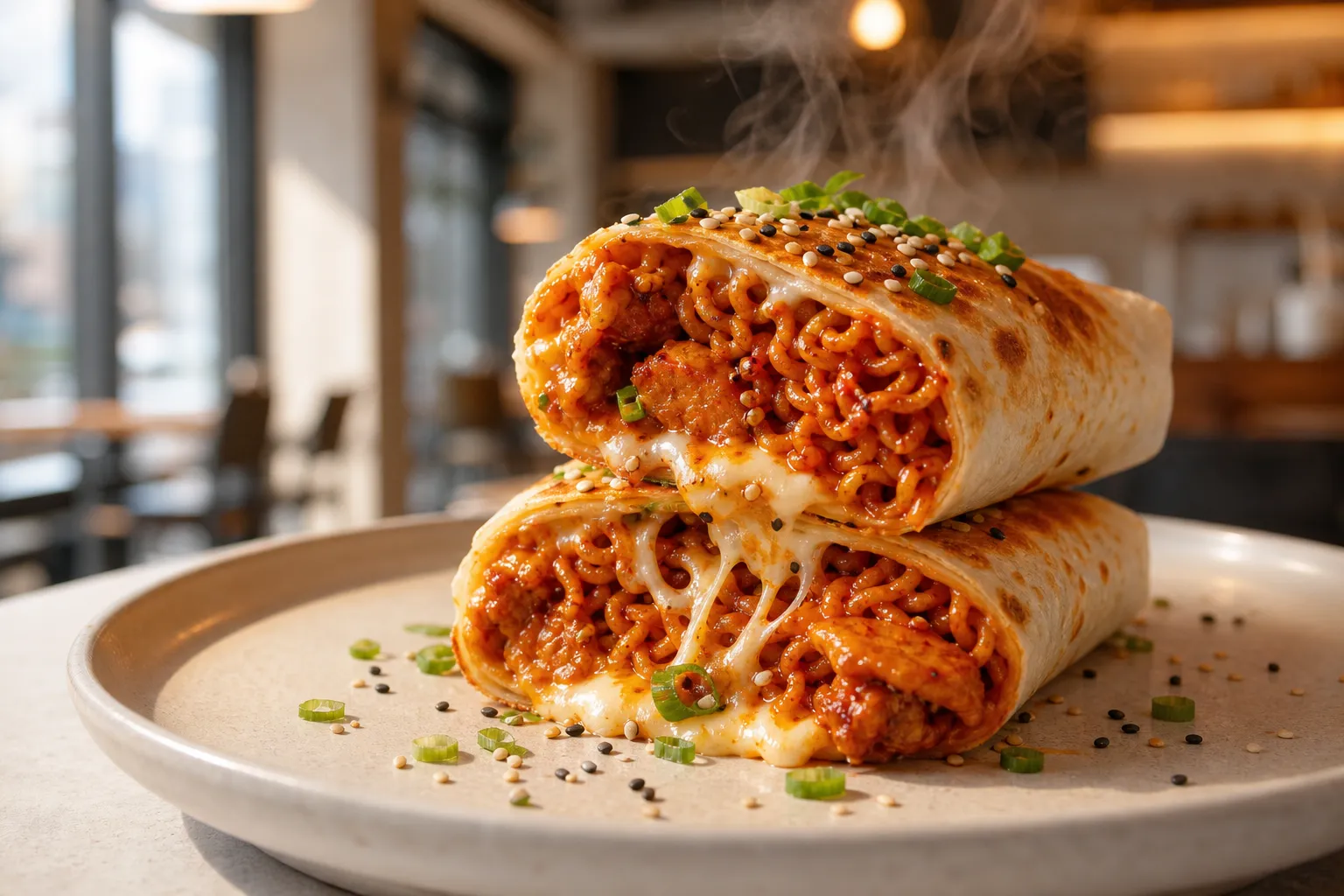
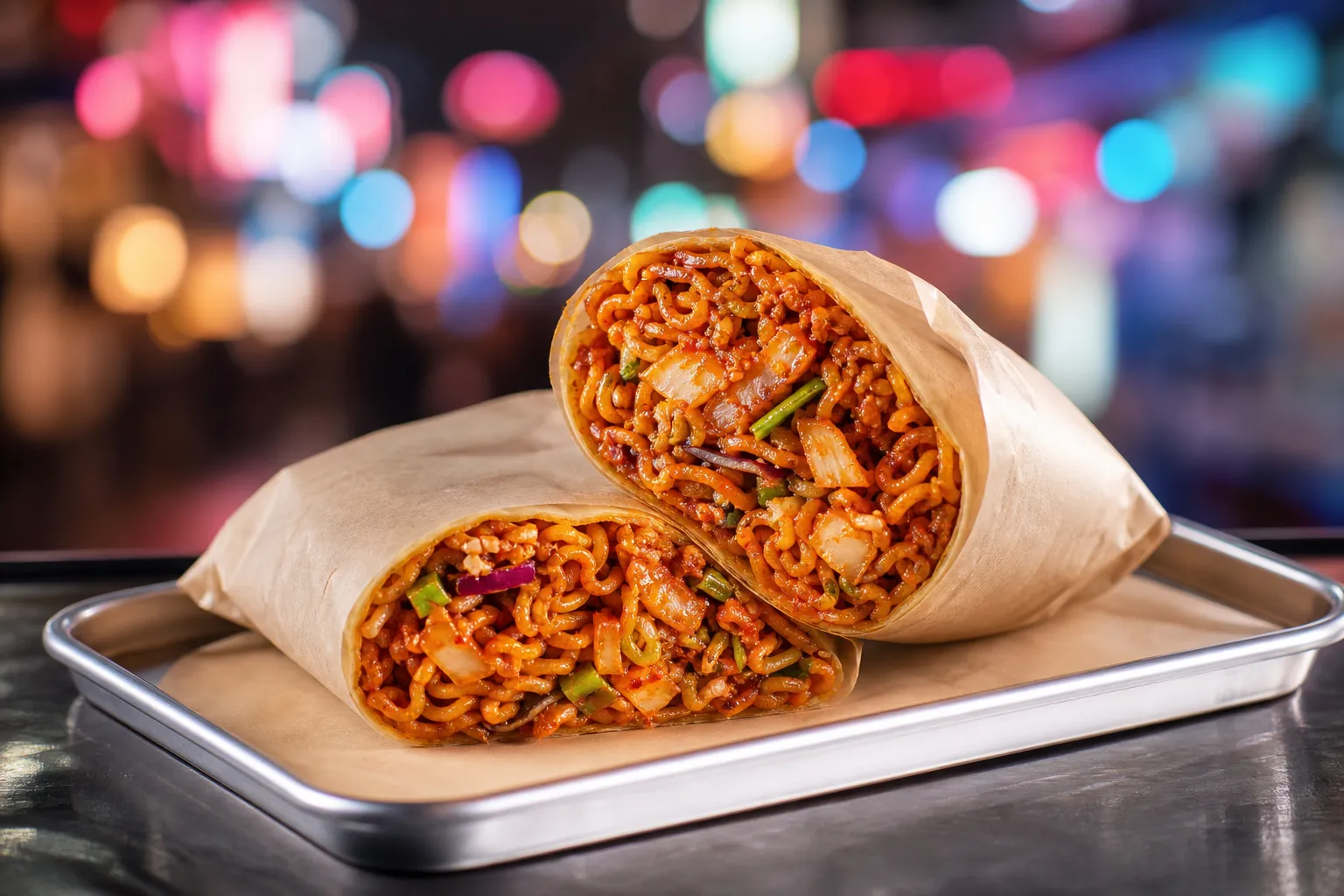
The Buldak Burrito recipe is a simple but clever twist: spicy Buldak ramen is cooked, tightened up in a pan, paired with cheese, and wrapped in a tortilla. Buldak’s official site published its burrito recipe on February 4, 2026, presenting it as one more way to enjoy Buldak-bokkeum-myeon beyond the familiar bowl of noodles.1
What makes the Buldak Burrito appealing is not just the heat. It is the way a saucy Korean instant noodle dish becomes a hand-held fusion meal, with the tortilla acting like a soft shell around chewy noodles, spicy sauce, and melted cheese. If you have seen Buldak combinations moving through TikTok or YouTube, the format makes sense: bold color, fast preparation, and a dramatic pull-apart texture all fit the short-form food style that has helped Buldak recipes travel.
What Goes Into a Buldak Burrito
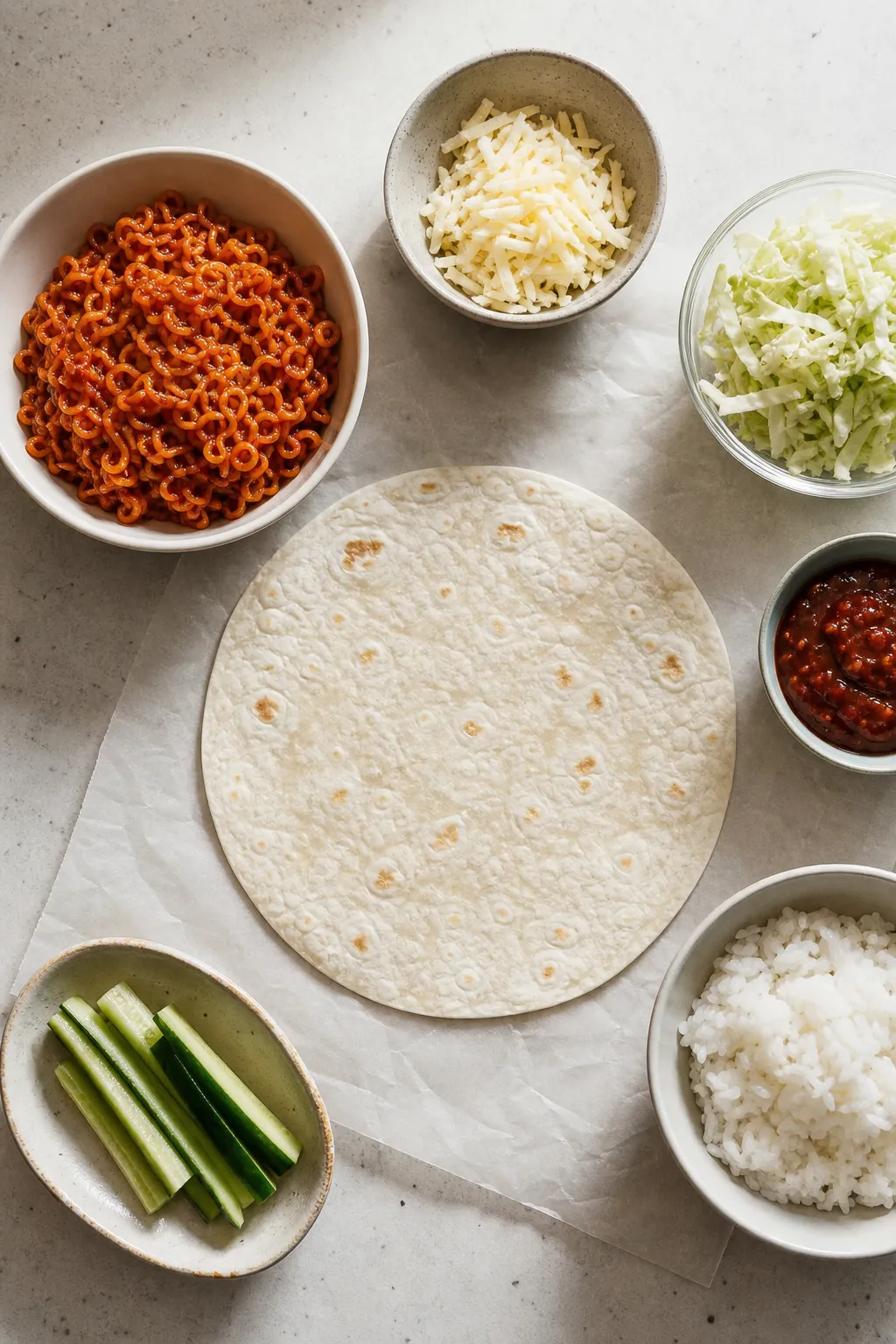
The official Buldak recipe points readers toward Original Buldak-bokkeum-myeon and Carbonara Buldak as recommended ingredients for the burrito version.1 That detail matters because the two choices offer slightly different routes into the same idea. Original Buldak gives the burrito a more direct spicy profile, while Carbonara Buldak brings a creamier base that naturally works with cheese and tortilla.
The basic structure is easy to understand from the source material: cooked Buldak noodles become the filling, the moisture is reduced in a pan, cheese is added, and the mixture is wrapped in a tortilla.1 The moisture step is especially important. A burrito needs filling that holds together instead of soaking through the wrap. By evaporating excess water in the pan, the noodles become more concentrated and easier to bundle.
Cheese plays a practical role as well as a flavor role. Buldak’s recipe guidance notes that cheese helps the filling and tortilla stick together.1 In other words, it is not only there to soften the spice; it also helps create the cohesive, sliceable texture that makes the burrito format work.
Why This Recipe Fits the Buldak Trend
The Buldak Burrito sits inside a wider pattern: Buldak is no longer treated only as instant ramen. On May 22, 2026, Buldak’s official site highlighted four viral Korean SNS recipes, including tomato ramen, cold Buldak noodles, yukhoe Buldak onion wraps, and corn cheese Buldak. The same update pointed to short cooking processes and vivid visuals as reasons these recipes spread online.2
That helps explain why a burrito version feels natural. It is quick, visually clear, and built around a recognizable transformation. Instead of asking you to learn an entirely new cooking method, it takes a familiar Buldak base and changes the eating format.
Buldak’s official fusion recipe coverage has also framed Buldak sauce as something that can move beyond ramen and into global dishes. A May 29, 2026 update described Buldak sauce as a global flavor base for foods such as buffalo wings, shawarma, meat pies, adobo, and nasi lemak.3 The burrito follows the same logic: Buldak heat and sauce meet a food format associated with another culinary context.
There is also a bigger market story behind these recipe experiments. Newstop reported on April 28, 2025 that Samyang Foods’ 2024 overseas sales for sauces and seasoning materials reached 25.9 billion won, exceeding domestic sales of 17.2 billion won, while overseas Buldak sauce sales rose 61% year over year. The same report noted Buldak sauce videos appearing on YouTube, TikTok, and Instagram.4 Those figures do not prove any single burrito recipe became popular by itself, but they do show a strong backdrop for why Buldak-based home combinations keep appearing.
The Recipe Logic: Dry, Melt, Wrap
A good way to think about the Buldak Burrito is in three source-backed moves: dry, melt, wrap. First, the noodle filling should not stay watery. The official recipe guidance emphasizes removing moisture from the noodles in a pan.1 That helps the sauce cling to the noodles and keeps the tortilla from becoming too soft.
Second, cheese is added so the filling and tortilla bind together.1 This is the quiet trick behind the recipe. Without a binding element, noodles can slide around inside a wrap. With cheese, the filling becomes more compact and easier to hold.
Third, the tortilla turns the whole thing into a portable format. The sources do not provide a long ingredient list beyond Buldak noodles, tortilla, and cheese, so it is best not to overcomplicate the recipe with unsupported add-ins. The key point is the transformation: spicy stir-fried noodles become a burrito-style filling.
This is also why the Buldak Burrito feels different from simply eating ramen with bread or a side dish. The recipe is built around texture management. The noodles are cooked down, the cheese helps bind them, and the tortilla gives the dish structure.
The broader Buldak brand context gives the trend extra weight. ZDNet Korea reported on June 5, 2026 that cumulative sales of Samyang Foods’ Buldak brand noodles had passed 10 billion units as of the end of May 2026, with cumulative revenue of 7 trillion won and current annual global sales at around 2 billion units.5 With that scale, it is easier to understand why a simple fusion idea like the Buldak Burrito can find an audience quickly.
The Buldak Burrito recipe works because it does not fight the original product. It keeps the spicy noodle identity, tightens the texture for wrapping, and uses cheese to bring the filling together. For readers curious about the Buldak Burrito trend, the source-backed takeaway is clear: start with Original or Carbonara Buldak, cook off extra moisture, let cheese do the binding, and wrap the result in a tortilla for a compact fusion version of a familiar spicy favorite.
References
- 불닭 부리또 레시피: 매운 불닭볶음면을 즐기는 방법 (Buldak 공식 사이트, 2026-02-04)
- 4 Viral Buldak Recipes from Korean SNS (Buldak 공식 사이트, 2026-05-22)
- Buldak Fusion Recipes: 5 Global Dishes to Try (Buldak 공식 사이트, 2026-05-29)
- 삼양식품, 불닭소스도 해외서 ‘훨훨’ (뉴스톱, 2025-04-28)
- 100억 개 팔린 삼양식품 불닭볶음면, 새 캐릭터 입는다 (ZDNet Korea, 2026-06-05)
About the Author