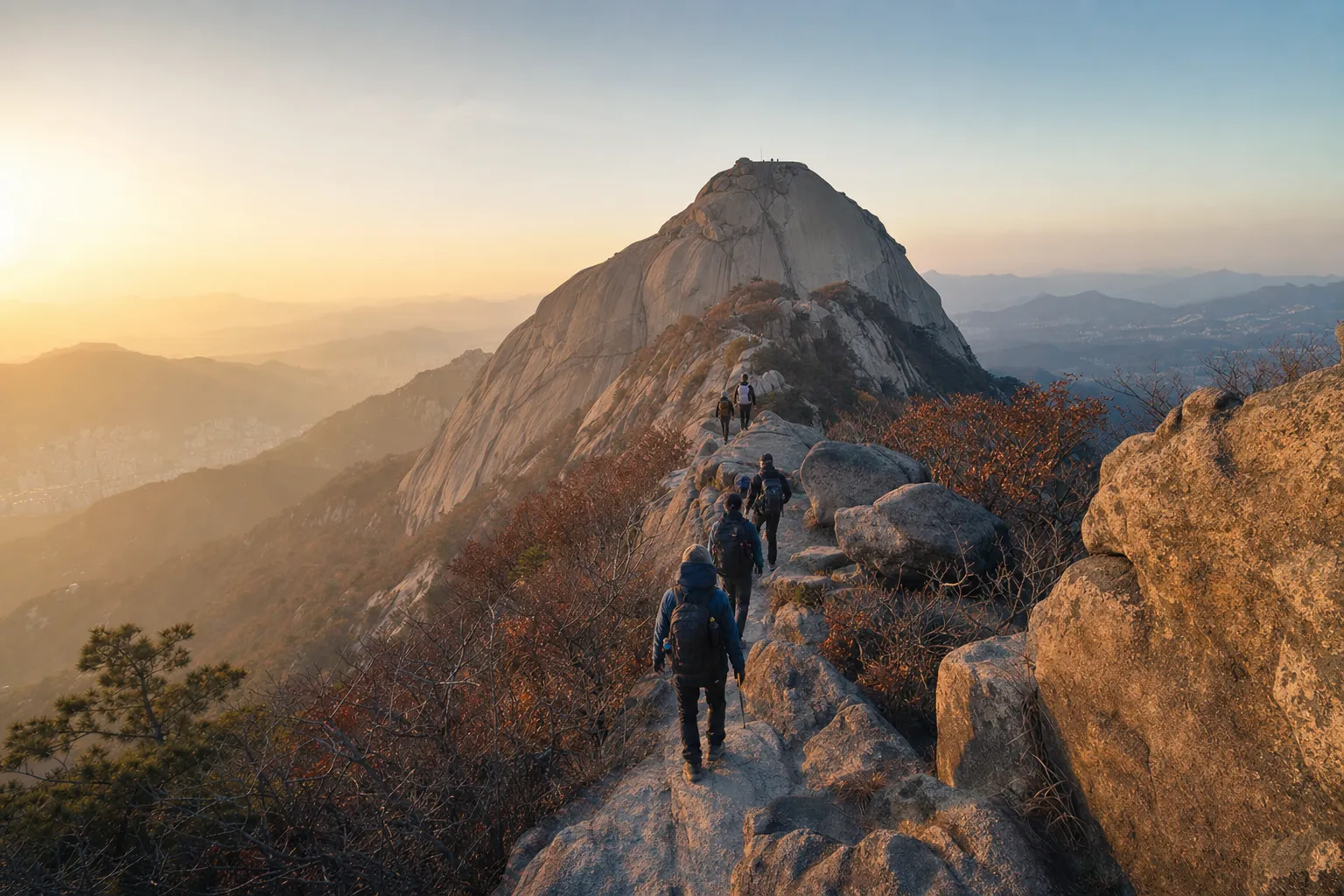
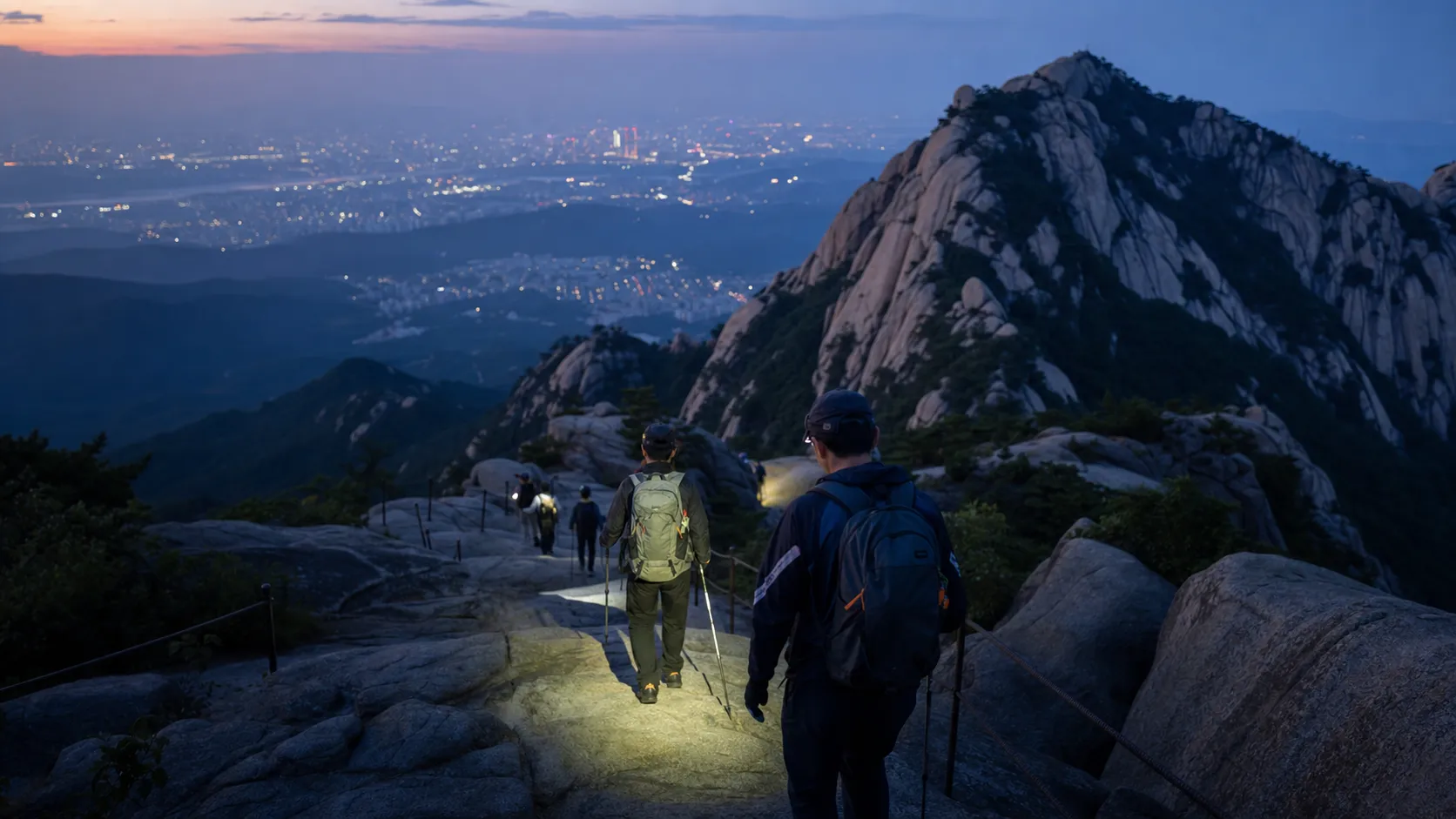
A Bukhansan Dawn Hike to Baegundae can be one of Seoul’s most memorable mountain plans, but the available source material points to a simple priority: treat the early start as only one part of the safety plan. Baegundae is the highest peak on Bukhansan, and reports about seasonal heat, slippery trail sections, summit wind, crowd growth, and past accidents all support a more careful approach than simply leaving before sunrise.1
Planning a Bukhansan Baegundae Dawn Hike
The main advantage of a dawn hike is timing. Starting early can help hikers avoid some of the daytime heat and reach the upper sections before the busiest part of the day. However, the Korea National Park Service notice from Bukhansan National Park Office, published on June 20, 2026, makes clear that summer heat remains a concern even for people who begin before daybreak. The descent can still happen during hotter hours, especially if the route takes longer than expected.2
For a Baegundae-focused hike, build the plan around the full round trip rather than the summit moment. The source material confirms that Bukhansan has routes of varying difficulty, from Bukhansanseong course sections to Baegundae, and that spring thaw periods can bring slippery trail sections, low temperatures, and strong winds near the summit.1 Those same issues matter for dawn hiking because reduced visibility can make wet, icy, or uneven sections harder to judge.
The practical takeaway is to prepare for two different environments on the same outing: a cool, dark ascent and a warmer, more crowded return. A light source, layered clothing, and enough water are not optional planning details when the route includes rocky upper sections and a high summit. The sources do not provide a single official dawn itinerary, a required start time, or a recommended pace, so hikers should avoid treating any unofficial schedule as guaranteed.
Heat, Shelters, and Seasonal Risks
Summer planning deserves special attention. The June 20, 2026 Korea National Park Service notice identified heat-vulnerable trails and announced nine heat shelters in the Bukhansan area. The listed shelters include Bukhansanseong Visitor Support Center, Baegun Visitor Support Center, Insu Shelter, and Baegun Shelter.2 For anyone hiking toward Baegundae at dawn, those names matter because they help frame where support points may exist during hot-weather conditions.
Do not assume that an early summit means a low-risk day. A slow descent, crowding near rocky sections, or time spent resting near the peak can push the return into hotter conditions. The heat notice is especially relevant because it was issued for summer heat preparation, not for a single event day.2
Spring has a different risk profile. Yonhap News TV reported on March 29, 2026 that warmer weather was bringing more hikers to Bukhansan, while also warning about thaw-season safety issues, including slippery trail sections and low temperature or strong wind near the summit.1 This means a dawn hike in mild-looking weather can still require summit-level preparation. Conditions at street level or near a transit station are not the same as conditions near Baegundae.
A serious accident also underscores why the final rocky sections should be handled conservatively. Asia Economy reported that a woman in her 70s died after a fall at Baegundae in Bukhansan, with the incident reported at about 2:15 p.m. on November 7, 2025; police were investigating the exact cause and circumstances.3 The report does not say the incident involved a dawn hike, so it should not be overstated. Still, it is directly relevant to Baegundae as a reminder that the peak area requires attention, spacing, and caution.
Crowds, Foreign Visitors, and Park Rules
Bukhansan is not only a local hiking destination. Multiple 2026 reports describe growing interest among foreign visitors, which can affect crowd expectations on popular routes. MBC reported on May 1, 2026 that K-hiking had become a new tourism course, and that users of a tourist center renting hiking equipment had increased by nearly 50% from the previous year, with 8 out of 10 users being foreigners.4
The Korea Economic Daily also reported, citing Seoul Tourism Organization data, that foreign visitors to hiking tourism centers in 2025 reached 18,693, up about 49% from the previous year. For the Bukhansan center specifically, 8,677 of 12,144 visitors were foreigners, accounting for more than 70%.5 These figures do not isolate Baegundae dawn hikers, but they do support one planning assumption: Bukhansan’s most recognizable routes may feel busier than a first-time visitor expects.
One Canadian tourist quoted by MBC described the hike plainly: “It’s pretty hard.” The same visitor said they were already soaked with sweat and exhausted by the time they reached the information center.4 That short comment is useful because it cuts through a common mistake: treating Bukhansan as easy simply because it is close to Seoul.
Rules also matter. Monthly Mountain reported on March 23, 2026 that mountain marathons and similar events are banned across all areas of Bukhansan National Park until December 31, 2030. The enforcement period began on January 13, 2026, and violations may result in fines of up to 2 million won under relevant law.6 The Bukhansan National Park Dobong Office described the measure as a decision “to prevent safety accidents among general visitors.”6 For dawn hikers, the practical lesson is to keep movement predictable and visitor-focused: Baegundae’s narrow rocky sections are not the place for speed-based hiking behavior.
Quick FAQ
Is a Bukhansan Dawn Hike to Baegundae safer than hiking later in the day?
The sources do not say dawn hiking is automatically safer. An early start may reduce exposure to peak daytime heat, but the official summer notice still makes descent-time heat a concern, and summit wind, cold, slippery sections, and rocky terrain remain relevant.21
Are there official heat shelters near routes used for Baegundae hikes?
The Korea National Park Service listed nine heat shelters for Bukhansan, including Baegun Visitor Support Center, Insu Shelter, and Baegun Shelter. Hikers should use these as planning reference points, especially in summer conditions.2 !Bukhansan Baegundae dawn hike crowds and summit route conditions A Baegundae dawn hike is best planned as a full safety route, not just a sunrise target. The source-backed picture is clear: prepare for darkness, summit conditions, summer heat on the way down, and growing visitor numbers, then move through the peak area with enough time, space, and caution to finish the hike well.
References
- 봄 햇살 가득 북한산…해빙기 안전사고 주의 (연합뉴스TV, 2026-03-29)
- [북한산] 폭염 취약 탐방로 및 무더위 쉼터 안내 (국립공원공단, 2026-06-20)
- 북한산 백운대서 70대 여성 등산객 추락해 사망 (아시아경제, 2025-11-08)
- 이제는 배낭 메고 산으로‥한국에 '푹' 빠진 외국인들 (MBC, 2026-05-01)
- "지하철역 나오자마자 깜짝 놀랐다"…한국 온 외국인들 '감탄' [현장+] (한국경제, 2026-03-28)
- 북한산 ‘산악마라톤’ 5년간 전면 금지 (월간산, 2026-03-23)
About the Author