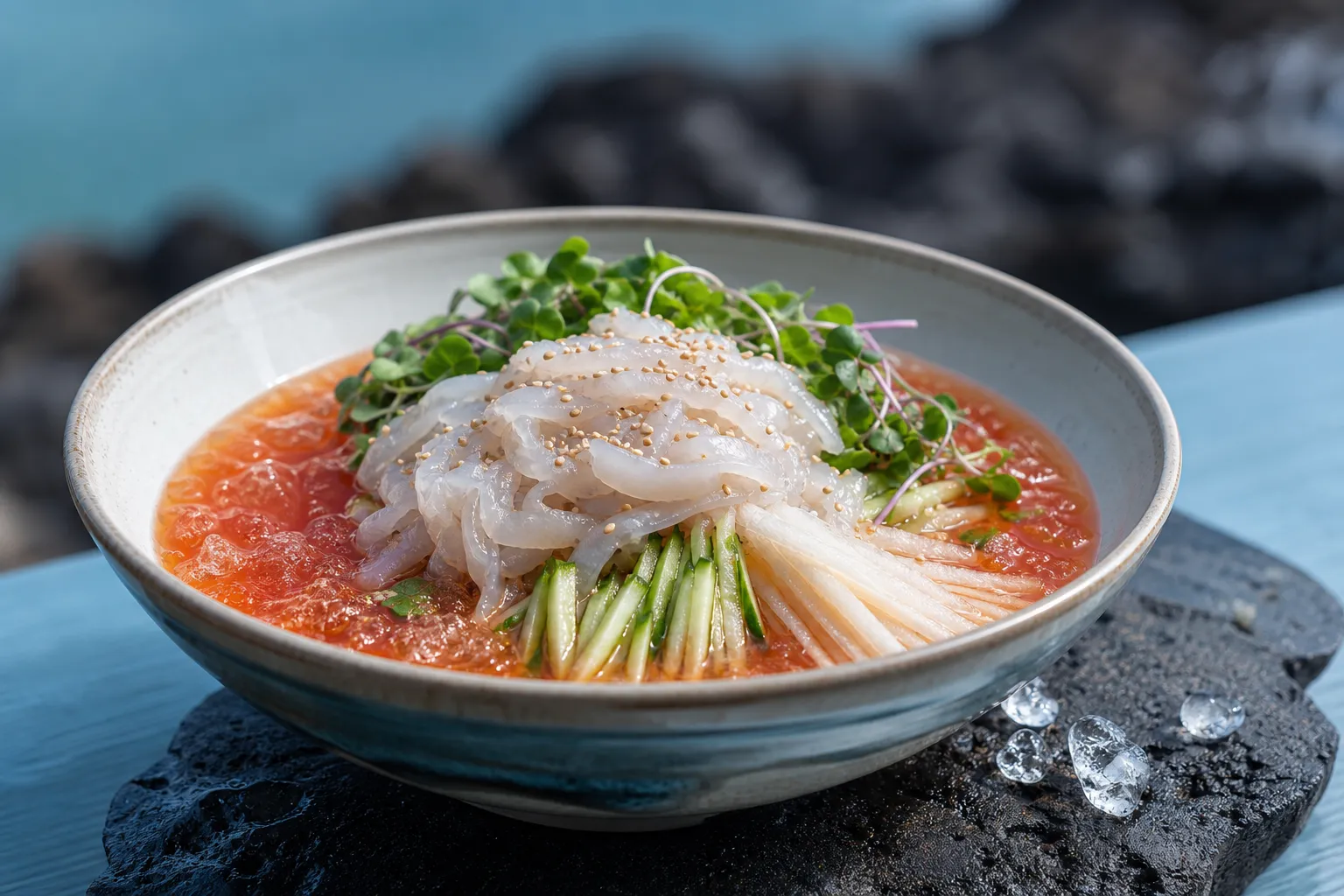
Jeju hanchi mulhoe is more than a chilled seafood dish for hot weather; it has become a clear window into how Jeju’s summer seafood culture is changing. For travelers following the Jeju seafood trend, the story of this squid-based cold soup now includes warmer seas, tighter catches, and restaurants adjusting to what the ocean can provide.
Why Jeju Hanchi Mulhoe Matters
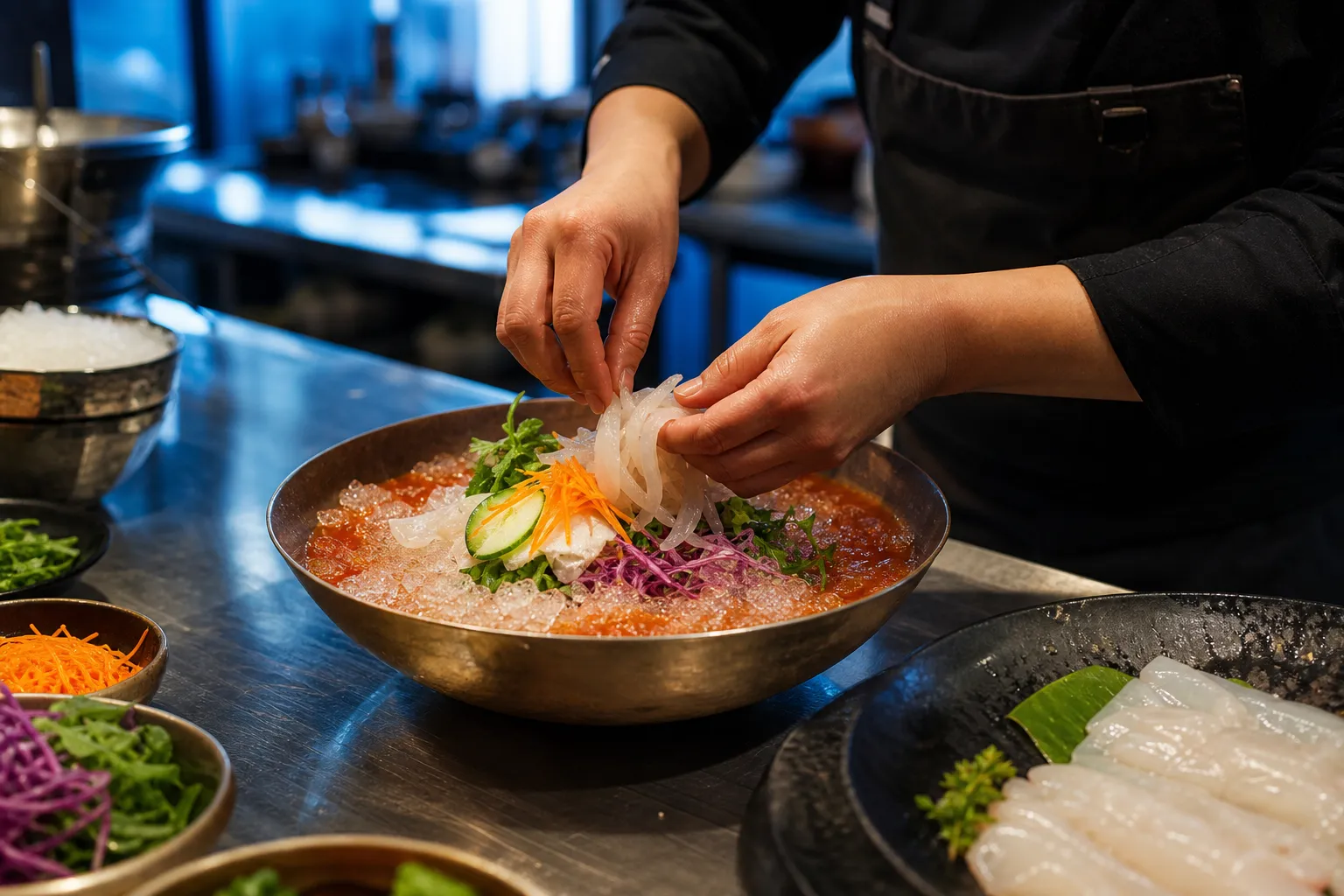
In Jeju, mulhoe is not simply raw seafood in an icy broth. The Jeju style is described as a local dish that uses doenjang cold soup, vinegar, and chopi tree leaves, giving it a regional identity that is different from many mainland versions of spicy cold raw-fish soup. Demand for hanchi mulhoe is especially strong from June through September, when the dish fits naturally into the island’s summer dining rhythm.1
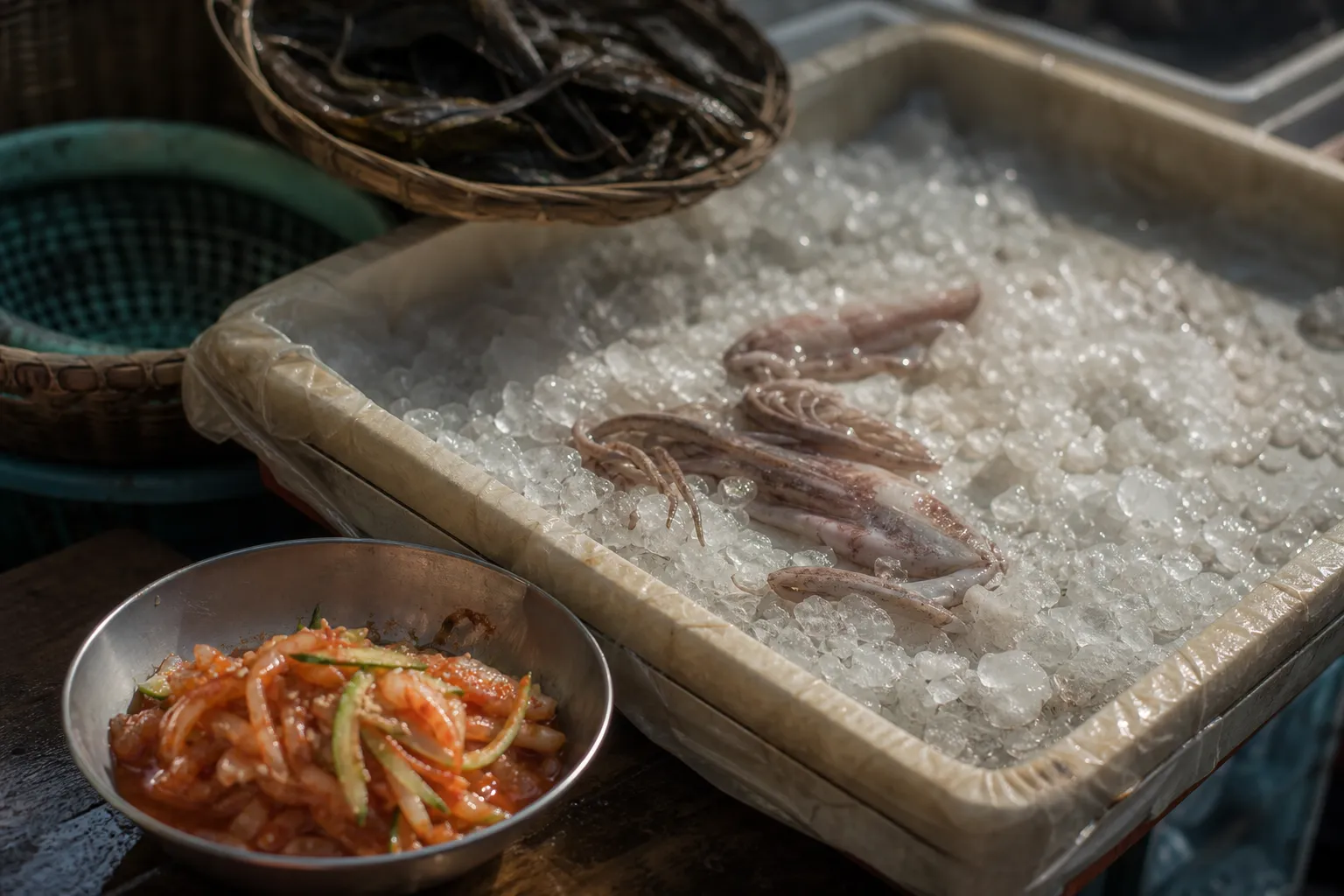
That seasonal appeal is exactly why the recent strain around hanchi feels so noticeable. Hanchi has long been treated as a representative summer seafood in Jeju, especially for sashimi and mulhoe. But reports from 2024 and 2025 show that it has become harder for restaurants to serve the dish in the familiar way, because the squid itself has become less available.
The numbers explain the mood. Based on Statistics Korea KOSIS data cited by Yonhap News, Jeju’s hanchi catch in June 2024 was 55 tons, down 40.9% from 93 tons in the same month of the previous year. Some restaurants responded by selling mulhoe made with frozen hanchi instead of live hanchi.1 That does not erase the dish, but it changes the expectations around freshness, price, and availability.
A Hotter Sea, a Smaller Catch
The main pressure point in the sources is sea temperature. JIBS reported that the ideal water temperature for hanchi fishing grounds is around 20 to 24 degrees Celsius, while Jeju waters reached 30 degrees Celsius in 2025 and a preliminary high-temperature advisory was issued. The same report described the shrinking hanchi catch as a year-by-year pattern, with high water temperatures suspected as a cause.2
Other reporting points in the same direction. Jeju Ilbo reported that high water temperatures prevented hanchi fishing grounds from forming properly, leading to a sharp drop in catches and rising prices. Its figures show how dramatic the change has been: Jeju’s June hanchi catch fell from 215 tons in 2021 to 55 tons in 2024. The report also said recent live hanchi auction prices at Seongsanpo Fisheries Cooperative reached 80,000 to 90,000 won per kilogram, more than double the previous year.3
For diners, this can show up in very practical ways: a favorite dish may not be on the menu, may cost more than expected, or may be served in a smaller portion. One raw-fish restaurant worker told Jeju Ilbo that hanchi had become “so scarce” that the restaurant could provide only one small plate per table.3
Halla Ilbo’s field reporting from the Donghandugi raw-fish restaurant street in Yongdam 1-dong, Jeju City, captured a similar picture. It found that restaurants selling hanchi sashimi and hanchi mulhoe were difficult to find, while local reactions pointed to a much smaller catch and auction prices roughly doubling. One restaurant owner said boats that usually caught 20 kilograms were now catching only 2 to 3 kilograms.4
What This Means for Jeju Seafood Dining
The hanchi story does not mean all Jeju seafood is moving in the same direction. In May 2026, Jeju Province data cited by JejuMBC showed that hairtail catches reached 681 tons, up 1.2% from a year earlier, while auction value rose 21.5% to 13.2 billion won. Tilefish catches also rose 47.4% to 171 tons, and the overall Jeju coastal auction volume for the month was 2,255 tons, up 1.1% year on year.5
That contrast is important. Jeju’s seafood scene is not simply shrinking; it is becoming more uneven. Some major species showed gains in the available 2026 data, while hanchi, a beloved summer specialty, has been under pressure in the reports from 2024 and 2025. For anyone planning meals around Jeju’s seasonal seafood, the smarter approach is to treat hanchi mulhoe as availability-dependent rather than guaranteed.
The environmental backdrop also remains active. The Jeju Ocean and Fisheries Research Institute said it expected sea temperatures around Jeju in summer 2026 to be above normal and would strengthen monitoring for high water temperatures and inflows of low-salinity water. Surface temperatures at 13 coastal observation points in May and June were 1 to 1.5 degrees Celsius higher than the previous year, and intensive temperature and salinity monitoring was set to focus on western and southwestern waters from July.6
For readers, the takeaway is practical as much as cultural. If you are looking for hanchi mulhoe, it may help to stay flexible: restaurants may have limited quantities, prices may reflect tighter supply, and some places may use frozen hanchi when live hanchi is hard to secure. None of those details are presented as a universal rule across every restaurant, but they are patterns clearly reflected in the available reporting.
Conclusion
Jeju hanchi mulhoe still carries the appeal of a cool, local summer dish, but its place in the island’s seafood culture is changing under pressure from warmer seas and reduced hanchi catches. The dish now tells a broader story about seasonal eating in Jeju: the best-known flavors are still meaningful, but their availability increasingly depends on ocean conditions, market prices, and the daily realities facing local restaurants.
References
- [내일은 못 먹을지도] ① 한치물회로 무더위 싹? "잡혀야 먹지" (연합뉴스, 2024-08-04)
- 한치 사라진 제주바다..어획량 급감, 한치값 급등 (JIBS 제주방송, 2025-07-12)
- “뜨거운 바다, 사라지는 여름 별미”…한치 어획량 ‘뚝’ (제주일보, 2025-07-13)
- [현장] 제주여름 별미 ‘한치’ 사라졌다.. “고수온 서식지 이동” (한라일보, 2025-07-11)
- 제주 주력 어종 갈치·옥돔 어획량, 위판액 증가 (제주MBC, 2026-07-06)
- 올여름 제주바다 고수온·저염분수 유입 가능성…관측 강화 (연합뉴스, 2026-06-30)
About the Author