
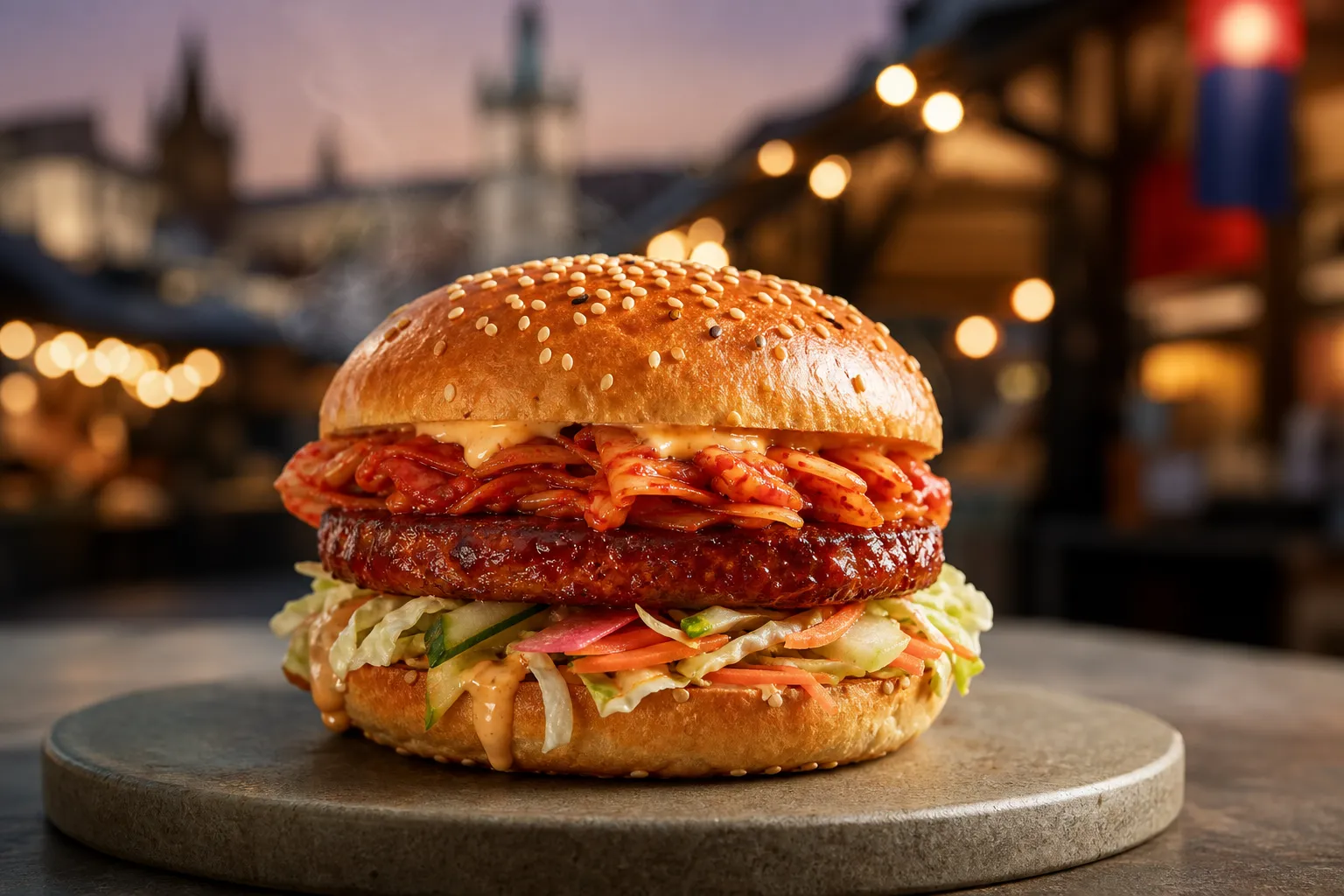
A Czech Vegan Kimchi Burger is best understood as an emerging K-food opportunity rather than a confirmed nationwide menu item. The strongest source-backed angle is clear: in Czech festival food zones, kimchi and vegetable-based fusion dishes such as kimchi burgers are being discussed as a way for Korean food to stand out in a plant-based, global street-food setting.1
That matters because the Czech food scene described in the sources is not limited to traditional restaurant dining. It includes open-air cultural festivals, embassy-led food events, younger consumers, and a growing interest in vegan and clean-label options. Put those pieces together, and the Vegan Kimchi Burger becomes a useful symbol of where K-food could travel next: familiar enough to be approachable, Korean enough to be distinctive, and flexible enough to fit plant-based expectations.
Czech Vegan Kimchi Burger and the Festival Food Zone
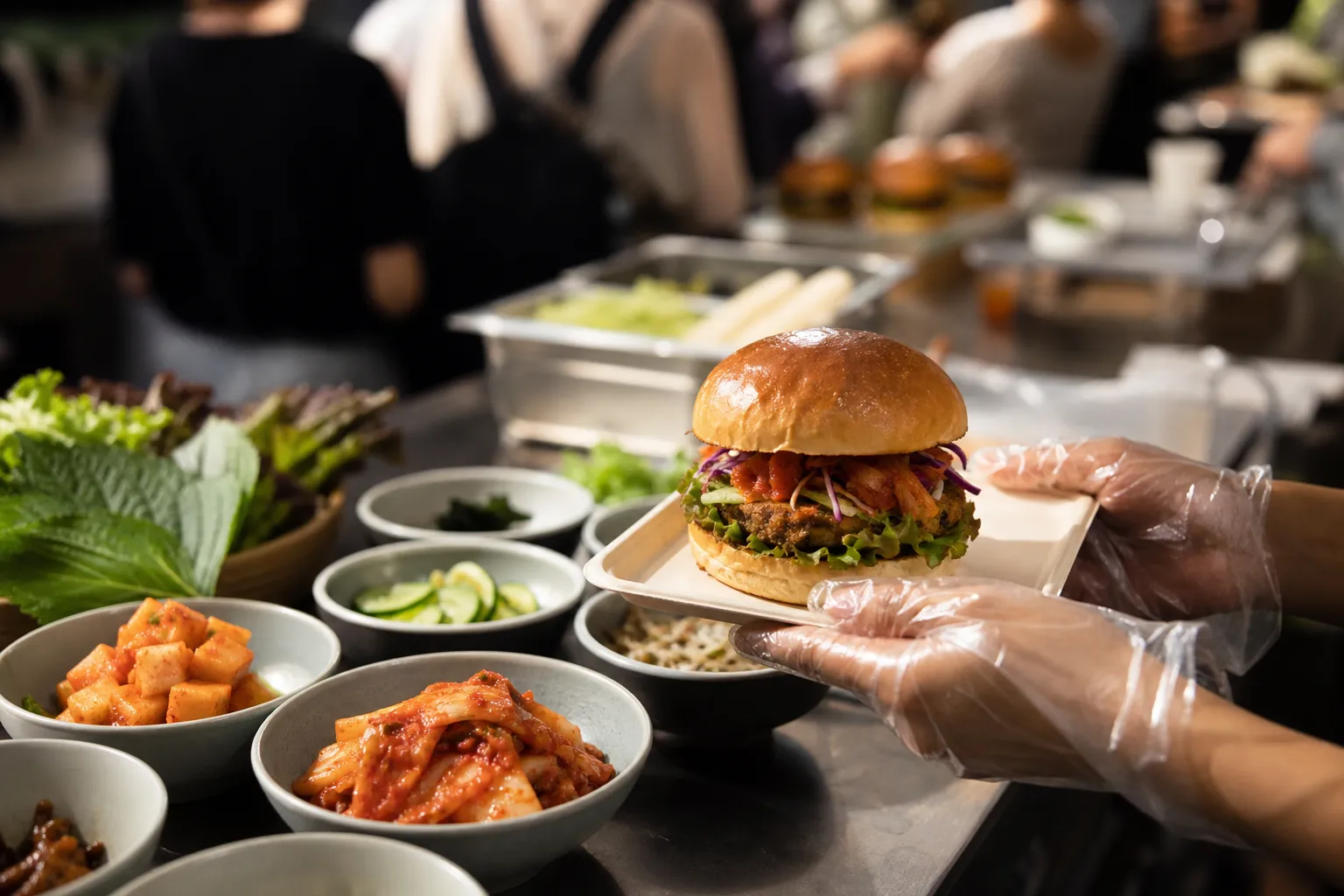
KATI, Korea’s agricultural export information service, described Czech music and culture festival food zones as spaces where global street food, vegan food, and clean-label food are becoming more visible. In that same analysis, kimchi and vegetable-based fusion vegan menus, including kimchi burgers and tofu ramen, were presented as examples with potential for differentiation as vegan demand expands in the Czech market.1
The appeal is easy to understand. A burger format does not require a newcomer to already know Korean dining customs. At the same time, kimchi brings a recognizable K-food identity through fermentation, spice, acidity, and crunch. For a festival visitor walking between international booths, that combination could make a plant-based Korean item feel both accessible and memorable.
The Prague setting is especially relevant. Festival Ambasád 2025 was held on June 7, 2025, at Vítězné náměstí in Prague 6, with 56 countries registered to present food cultures through embassies, honorary consulates, and chambers of commerce.2 KATI also noted that a Korean food booth operated at the Prague festival on June 7, 2025, introducing items including kimchi, bulgogi, tteokbokki, and gimbap.1
Those details do not prove that a vegan kimchi burger was served at that event. They do show something more practical: there is already a public-facing channel in Prague where Korean food can meet curious local audiences. If kimchi, tteokbokki, and gimbap can appear in that environment, a carefully developed vegan kimchi burger would fit the same kind of street-food logic.
Why Prague Is a Natural Test Bed
The Embassy Festival format gives K-food a useful stage because it is built around sampling, comparison, and cultural discovery. The official Trhy na Kulaťáku page listed the 9th Embassy Festival of Food & Culture for June 6, 2026, again at Vítězné náměstí, and described the event as unique in the Czech Republic for its scale and number of participating countries. It also noted that country booths are mainly organized by embassies, honorary consulates, and chambers of commerce.3
For K-food, this matters because a festival booth can reduce the pressure that often comes with unfamiliar cuisine. You do not need to commit to a full restaurant meal to understand a flavor. A small street-food portion can introduce kimchi’s tangy, fermented character in a format that feels familiar.
The Czech plant-based context also looks more open than restrictive. ProVeg International reported in January 2025 that the Czech Ministry of Agriculture would not proceed with restrictions on using terms such as “burger,” “patty,” and “sausage” for plant-based foods. Czech Minister of Agriculture Marek Výborný was quoted as saying, “We don’t want to meddle in people’s lives.”4
That decision is directly relevant to a Vegan Kimchi Burger because the name itself depends on ordinary plant-based menu language. ProVeg also described plant-based foods in the Czech Republic as popular not only among vegans, but also among consumers interested in health, diet improvement, and lowering environmental impact.4 In other words, the audience for a kimchi burger does not have to be limited to strict vegans. It can include flexitarian festival visitors, curious food fans, and people simply looking for a lighter or more vegetable-forward choice.
The Policy Push Behind Plant-Based K-Food
The Czech opportunity also lines up with Korea’s broader export planning. On February 4, 2026, Korea’s Ministry of Agriculture, Food and Rural Affairs held the first meeting of a public-private K-food export planning group, discussing region-specific strategic products and plans for K-food ambassadors. The ministry’s examples included kimchi for the United States and vegan products for Europe, placing European vegan demand inside an official K-food export frame.5
That does not mean every vegan Korean product will succeed automatically. It does mean that plant-based K-food in Europe is being treated as more than a passing trend. The same ministry release also included plans involving overseas diplomatic missions as K-food export bases, marketing connected to the Korean Wave, and support for overseas certification.5
A later ministry announcement on April 9, 2026 said 145 companies had been selected for the “Global NEXT K-Food Project,” a follow-up program tied to strategic products discussed by the export planning group. The project supports B2B and B2C marketing as well as product development, and the ministry cited a functional low-sugar grain syrup aimed at Europe’s vegan and wellness market as one example.6
For a Czech vegan kimchi burger concept, this policy background is useful because it connects the menu idea to a wider commercial direction. The product would need more than novelty. It would need taste, labeling clarity, festival-friendly preparation, and a way to communicate kimchi’s Korean identity without making the dish feel difficult.

The most honest takeaway is that the Czech Vegan Kimchi Burger is still best framed as a promising K-food fusion concept supported by festival culture, plant-based demand, and export strategy. Prague’s international food events have already offered Korean food a visible stage, while Czech plant-based labeling conditions and Korea’s Europe-focused vegan strategy make the burger format especially plausible. If K-food brands want a friendly doorway into Czech street-food culture, a Vegan Kimchi Burger is one of the clearest ideas on the table.
References
- [체코] 젊은층 중심, 문화 페스티벌 푸드존 중심에 K-Food (KATI 농식품수출정보, 2025-09-09)
- 8th Festival Ambasád 2025 in Prague: A World of Culinary Delights (Prague Daily News, 2025-06-03)
- Festival of Embassies 2026 (Trhy na Kulaťáku)
- Czech government drops label restrictions on plant-based foods after public backlash (ProVeg International, 2025-01-29)
- 민‧관 합동 K-푸드 수출기획단, K-푸드 글로벌 도약 밑그림 그린다 (농림축산식품부, 2026-02-04)
- 농식품부, ‘제2의 라면’ 육성 위한 ‘글로벌 NEXT K-푸드 프로젝트’ 가동 (농림축산식품부, 2026-04-09)
About the Author