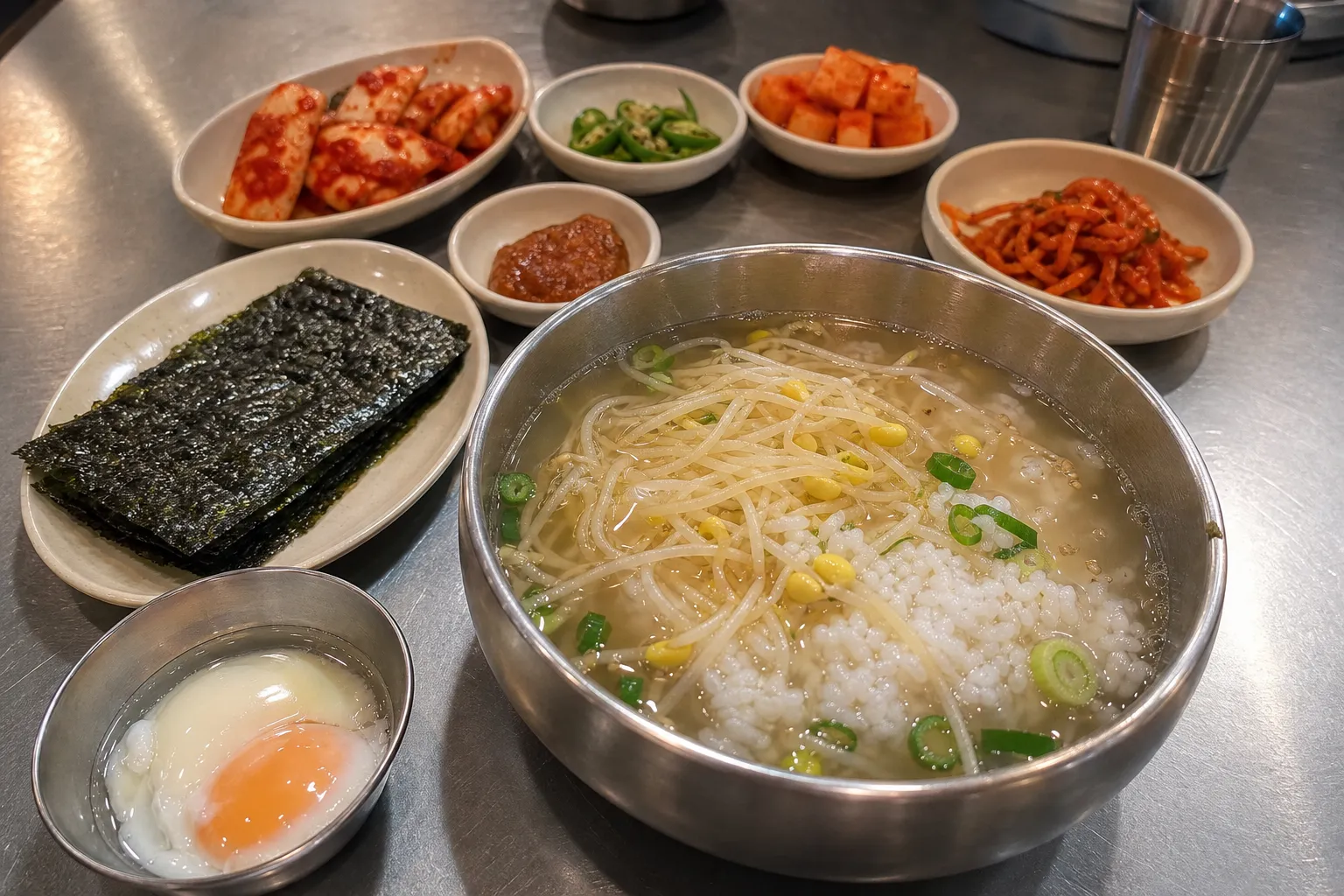
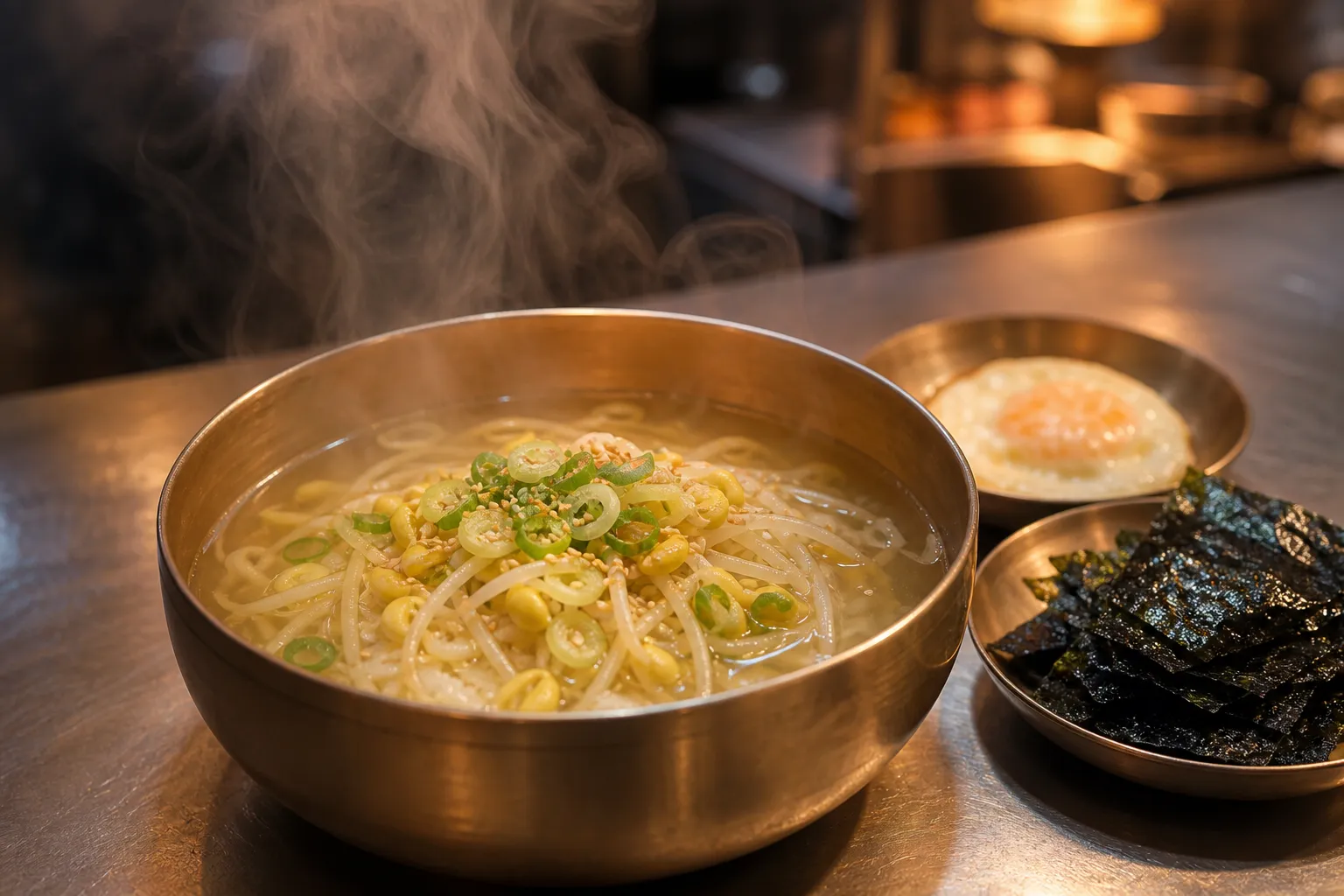
Nambu Market kongnamul gukbap is one of Jeonju’s most grounded food stories: a hot, clear bowl of bean sprout soup rice shaped by the rhythms of the city’s dawn market. If you are looking for Jeonju Hidden Gukbap with real local roots, this market-born dish is a good place to start because its appeal comes from everyday ingredients, practical comfort, and a way of eating that has stayed closely tied to Nambu Market culture.
Jeonju’s official tourism information describes kongnamul gukbap as a hangover-style soup that grew from the food culture of Nambu Market’s early-morning merchants, giving workers a warm and filling meal before or after long market hours.1 Another Jeonju tourism feature connects the dish directly with the dawn market, describing it as a light yet hearty breakfast built from cool broth, well-cooked bean sprouts, powdered seaweed, and a soft poached egg.2
Nambu Market Kongnamul Gukbap and Its Dawn-Market Roots
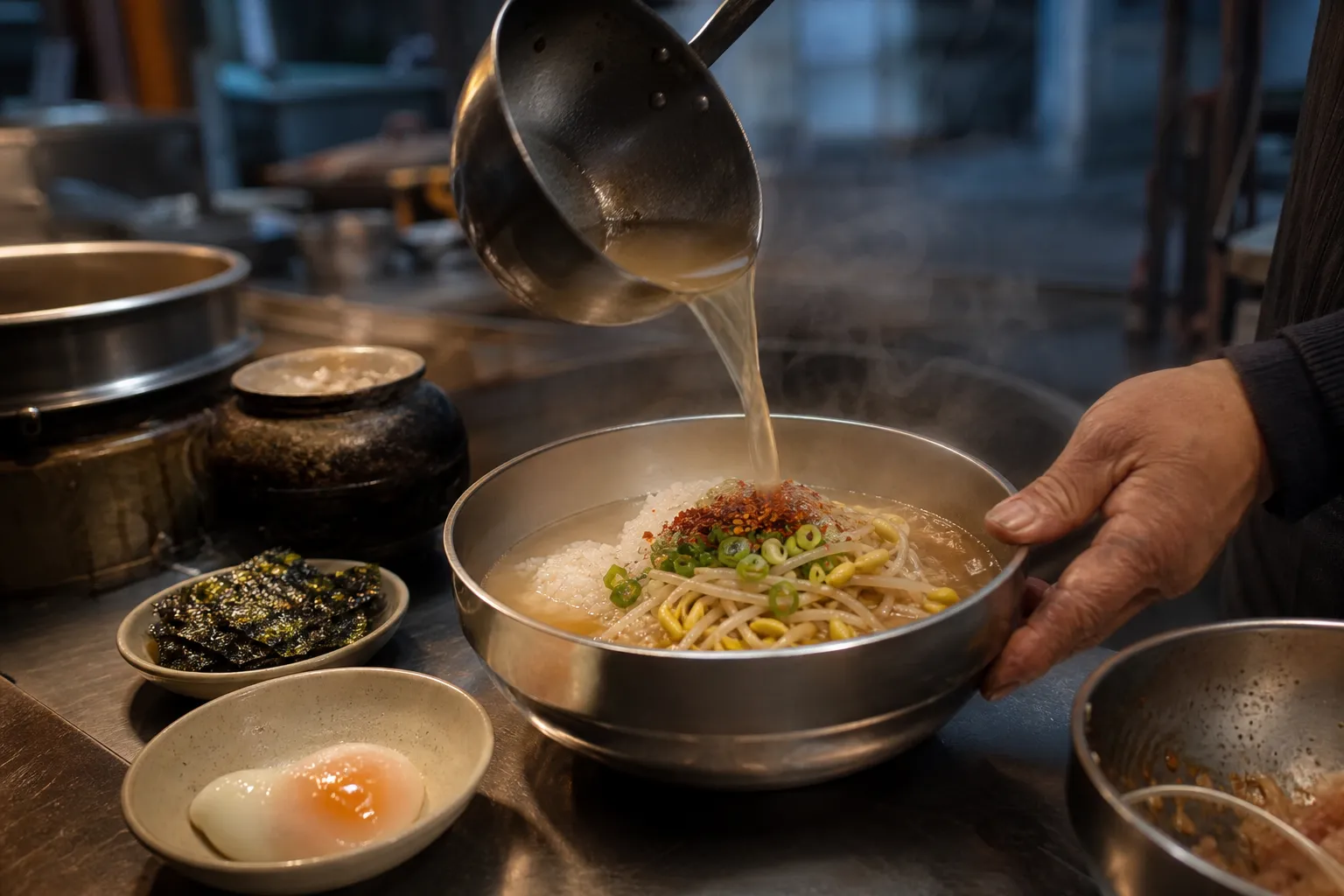
The charm of Nambu Market kongnamul gukbap is that it does not need to be dressed up to make sense. At its center are rice, boiled bean sprouts, and broth, but the market style is defined by how those elements are brought together. Jeonju’s official Nambu Market guide explains that the Nambu Market version uses a tor yeom method, where anchovy and kelp broth is poured repeatedly over rice and boiled bean sprouts.3 That repeated pouring warms the rice and bean sprouts while keeping the bowl clean, clear, and lively rather than heavy.
This technique also helps explain why the dish feels so suited to morning eating. It is not a thick stew or a spicy soup designed to overwhelm you. It is closer to a careful balance: hot broth, soft rice, crunchy bean sprouts, and savory accents that wake up the palate without making the meal feel excessive. The official descriptions repeatedly highlight the combination of bean sprouts, deep broth, seaweed powder, and poached egg, which gives the bowl its familiar Jeonju identity.1
The dish also reflects the practical environment around the market. Maeil Shinmun reported that the reputation of Jeonju bean sprouts is linked with the geographical conditions around Gyo-dong in Wansan-gu and the Nambu Market area, including abundant water and the demand created by a nearby market. The same report notes that Nambu Market had bean sprout sellers and several kongnamul gukbap restaurants with histories stretching back decades.4
How the Bowl Is Usually Enjoyed
Part of the fun of Nambu Market kongnamul gukbap is that the side elements are not decorative. They are part of the eating rhythm. Jeonju tourism materials describe the poached egg as a key companion, and one official guide suggests adding some broth and powdered seaweed to the egg first, then eating it before turning fully to the soup.1 That small step gives you a gentle, savory opening before the clearer broth and bean sprouts take over.
Roasted seaweed is another important detail. Jeonju’s official Nambu Market page notes that many shops in the market sell freshly roasted seaweed, and that this helped establish the pairing of seaweed with kongnamul gukbap.3 In the bowl, seaweed brings a toasted, briny note that deepens the flavor without changing the dish’s clean character.
Moju, a Jeonju drink boiled with medicinal ingredients, is also mentioned alongside the Nambu Market style of kongnamul gukbap by the city’s official tourism information.3 The source material does not provide a full serving guide or claim that every diner must order it, but its presence in the official description shows how the bowl belongs to a broader local food setting rather than standing alone as a generic soup rice dish.
There is also a simple add-on tip for anyone who likes a fuller bowl: one Jeonju tourism article suggests adding squid as an extra topping.1 That detail fits the overall personality of the dish. The base remains clear and bean-sprout focused, while the extra ingredient gives a little more chew and depth.
From Local Market Food to Wider Recognition
Nambu Market kongnamul gukbap is still deeply local, but it has also been introduced to audiences beyond Jeonju. On June 7, 2022, Jeonju City announced that the Netflix K-Food show “A Nation of Broth” introduced Hyundaiok in Jeonju Nambu Market and Yetnal Pisundae, presenting Jeonju’s representative soup dishes, including kongnamul gukbap and blood sausage soup, through a global platform.5
Kyunghyang Shinmun also reported on June 7, 2022, citing Jeonju City’s announcement, that the Netflix food documentary featured Hyundaiok and Yetnal Pisundae in Jeonju Nambu Market. The article also noted that Jeonju has many well-known kongnamul gukbap places, including Hyundaiok, Waengi Kongnamul Gukbap, Migaok, and Sambaekjip.6
That wider attention matters, but it should not overshadow the most important point: Nambu Market kongnamul gukbap is compelling because it is specific. It comes from a place, a market schedule, a practical need for warm morning food, and local ingredients that made sense in Jeonju. Its reputation is not only about one famous shop or one media appearance. It is about a food culture that grew around workers, broth, bean sprouts, seaweed, and the steady life of the market.
Quick FAQ
What makes Nambu Market kongnamul gukbap different?
The Nambu Market style is described by Jeonju’s official tourism information as using tor yeom, with anchovy and kelp broth poured several times over rice and boiled bean sprouts.3 It is also closely associated with poached egg, roasted seaweed, and the market’s dawn food culture.
Is kongnamul gukbap mainly a breakfast food in Jeonju?
The source material connects it strongly with Nambu Market’s early-morning merchants and describes it as a hearty morning meal.2 That does not mean it is only eaten at breakfast, but its Jeonju story is closely tied to the dawn market. !Jeonju Nambu Market kongnamul gukbap poached egg seaweed Nambu Market kongnamul gukbap is a reminder that some of Jeonju’s best-known flavors began as practical comfort food. With its clear broth, bean sprouts, rice, seaweed, and poached egg, it remains a warm and accessible bowl that carries the market’s history in every spoonful.
References
- [2026.02] 전주 미식 밸런스 게임 (비짓전주(전주시청))
- [2025.12] 한 상 가득, 전주 먹방로드 (비짓전주(전주시청))
- 남부시장 (비짓전주(전주시청))
- [신팔도 명물] 먹는 방법도 가지가지 ‘전주 콩나물국밥’ (매일신문, 2022-07-20)
- 전주 콩나물국밥‧피순대국밥, 전 세계에 소개 (전주시청 보도자료, 2022-06-07)
- 넷플릭스에서 ‘눈독’ 들인 대표 한국음식···전주 콩나물국밥과 옛날피순대 (경향신문, 2022-06-07)
About the Author