
Seoul Visa-Free Pilot

The Seoul Visa-Free Pilot refers to the temporary visa‑free entry scheme for Chinese group tourists that began on September 29, allowing visitors to stay up to 15 days without a visa and scheduled to run until June 30 of the following year.
Policy Implementation and Expected Impact
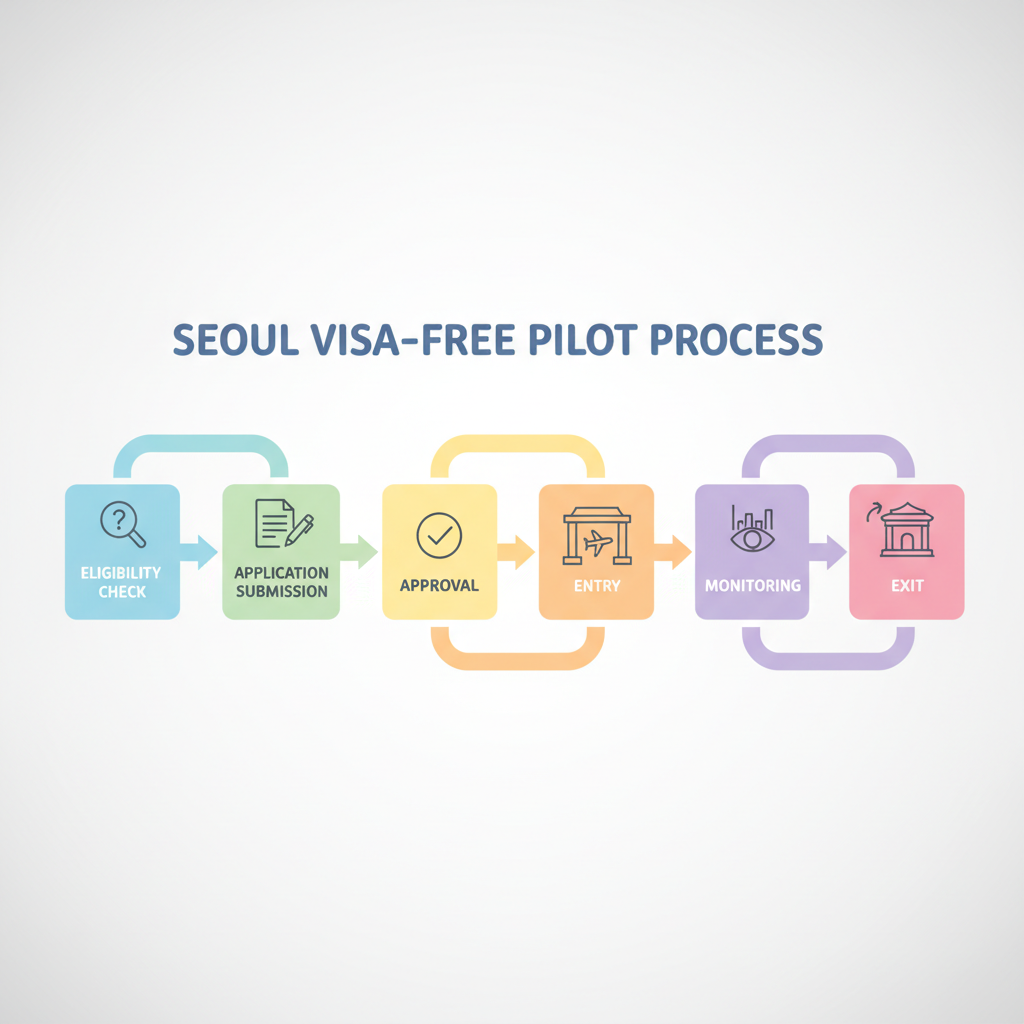
The measure applies to groups of three or more Chinese tourists. According to officials, the overlap with China’s National Day holiday is expected to draw more than one million visitors to Korea. Travelers under the scheme can visit for up to 15 days without obtaining a visa, benefiting sectors such as travel agencies, hotels, airlines, duty‑free shops and department stores. Local governments have also introduced incentive programmes to attract these tourists: 경남 offers up to 3 million 원 per group, while 전북 and 전남 provide maximum supports of 2 million 원 and 5 million 원 respectively, with additional subsidies for accommodation, meals and entrance fees.
Political Controversy and Criticism
Following the launch of the visa‑free entry, the ruling People Power Party (국민의힘) announced the ‘China‑shopping prevention bill’ as party policy, claiming it would curb alleged ‘medical shopping, election shopping and real‑estate shopping’ by Chinese nationals. The party’s floor policy chief, 김은혜, stated that concerns over the Lee Jae‑myung administration’s policies prompted the move, and the bill was formally adopted as party policy at a National Assembly strategy meeting on October 10.
Specific legislative details have not been released. Critics point out that the government’s own health‑insurance data show Chinese nationals contributed a 5.5 billion won surplus in the previous year, reversing earlier claims of a deficit. Regarding election participation, Korean law requires foreign residents to hold permanent residency, reside in a local jurisdiction for at least three years, be listed on the foreigner register, and maintain a domestic address for at least 60 days before an election—making ‘election shopping’ by short‑term visitors impossible. Real‑estate data released by 정준호 of the Democratic Party show that, among foreign-owned apartments in Seoul, Americans hold the largest share, followed by Canadians and Chinese, with analyses indicating Chinese owners tend to be end‑users rather than pure investors.
Media outlets across the ideological spectrum have criticised the bill as fact‑unsound and warned that it fuels xenophobic sentiment. Commentators note that the political debate has overshadowed the original economic expectations of the visa‑free policy, with early September coverage focusing on tourism boosts while later reports centre on party politics and accusations of ‘anti‑China’ rhetoric.
Conclusion
The Seoul Visa‑Free Pilot represents a time‑limited effort to revive inbound tourism from China by waiving visa requirements for group stays of up to 15 days, with an anticipated influx of over one million visitors coinciding with China’s National Day holiday. While the programme has been praised by industry stakeholders for its potential to stimulate travel, retail and hospitality sectors, it has also become a flashpoint for political debate, as the ruling party frames it within a broader narrative of preventing alleged ‘shopping’ abuses—a claim that fact‑checks and official data have challenged. The episode underscores the tension between economic incentives and domestic political narratives in South Korea’s foreign‑tourism policy.
About the Author