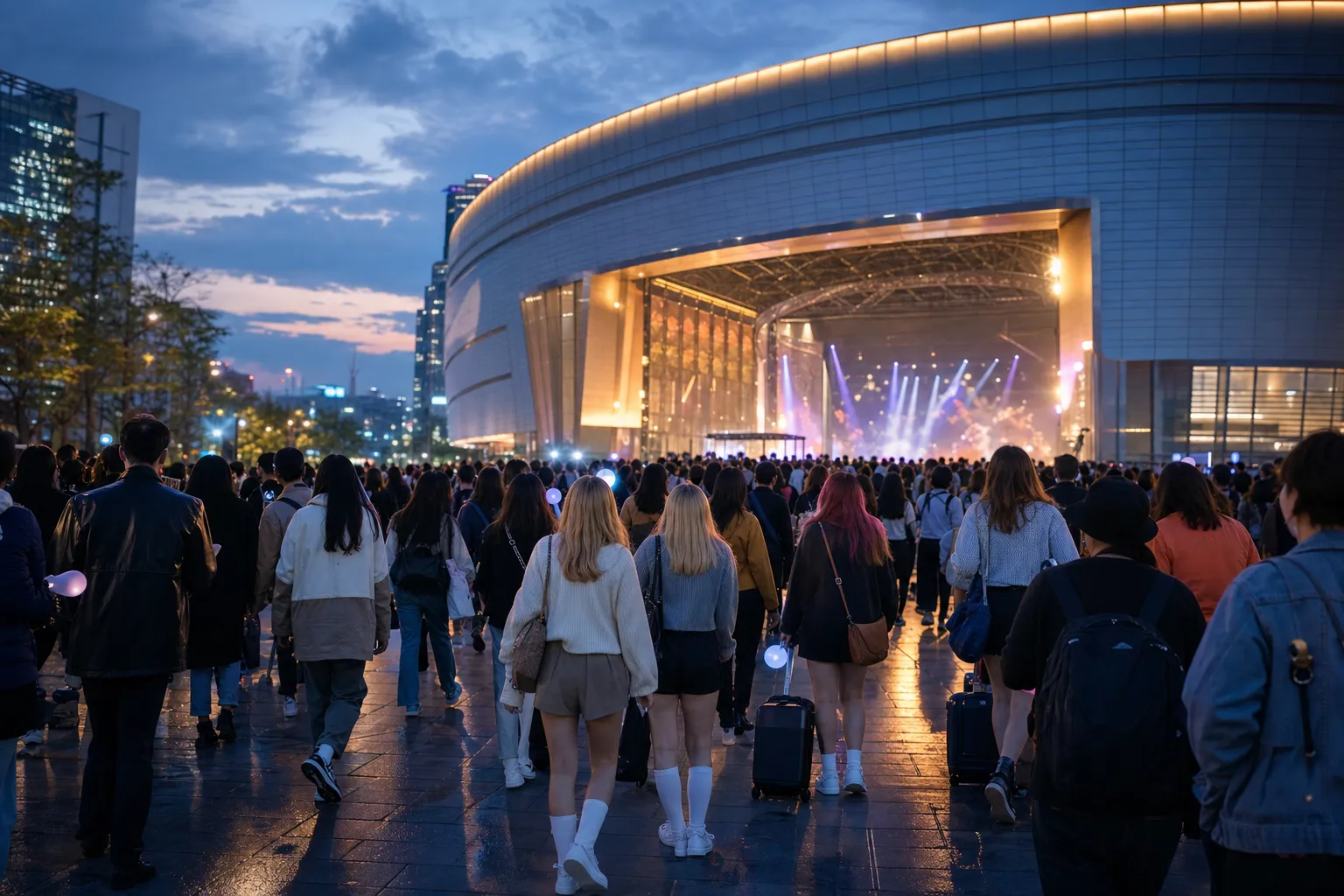
The BTS Arirang Tour has become more than a concert itinerary: it is now a measurable tourism event for South Korea. After BTS returned to the stage at Gwanghwamun Square on March 21, 2026, after nearly four years away because of members’ military service, official and media-reported indicators pointed to a rapid rise in inbound visitors, host-city demand, and culture-linked spending.1
The clearest reading is not that one concert alone explains every movement in travel data. Rather, the available figures show how a high-intensity cultural event can concentrate tourism demand, extend stays, and turn entertainment fandom into a wider consumption pattern.
BTS Arirang Tour Tourism Surge in the Data
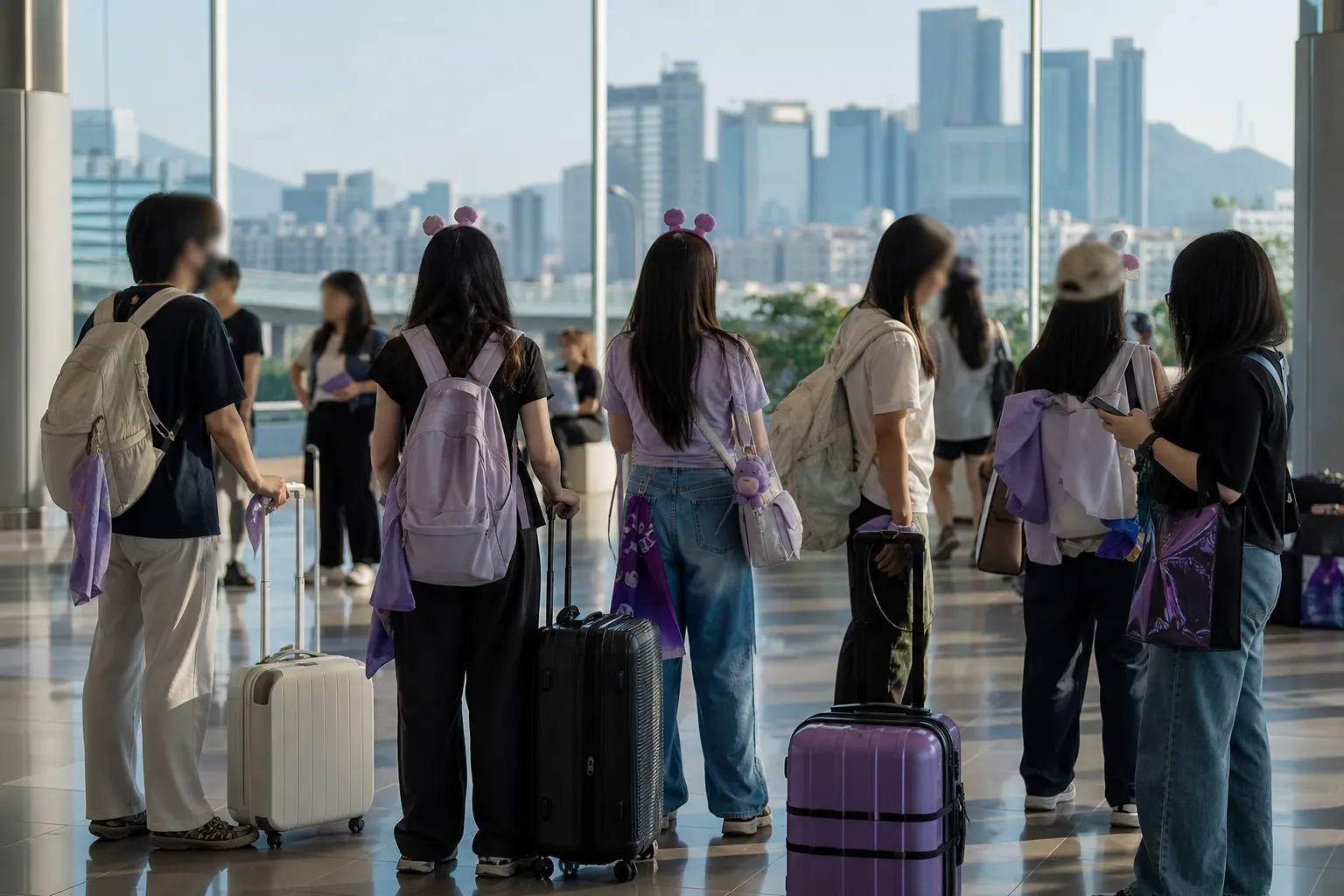
The strongest tourism signal came from the Ministry of Culture, Sports and Tourism analysis reported by Korea JoongAng Daily. Around BTS’s Gwanghwamun comeback performance and the first three Arirang tour concerts, foreign tourist numbers in the host city jumped 3,377 percent compared with first-quarter baseline figures, while spending rose 3,699 percent. The same analysis also pointed to longer stays and higher average spending around the events.2
Those percentages are unusually large, so they should be read carefully. A surge against a first-quarter baseline may reflect both the scale of BTS demand and the concentrated timing of event travel. Still, the direction is difficult to dismiss: the tour did not merely fill a venue; it appears to have shifted visitor behavior in the surrounding city economy.
South Korea’s broader first-quarter tourism numbers also show a favorable backdrop. Edaily reported, citing the Ministry of Culture, Sports and Tourism, that the country received about 4.76 million foreign visitors in the first quarter of 2026, up 23 percent year over year and a first-quarter record. March alone brought 2.06 million arrivals, while foreign credit-card tourism spending reached 3.2128 trillion won for the quarter.3
| Indicator | Source-backed figure | What it suggests |
|---|---|---|
| Inbound tourists, first 18 days of March | Up 32.7 percent from the previous month | Demand built before the March 21 comeback show |
| Host-city foreign tourist increase | Up 3,377 percent | Event timing sharply concentrated visitor flows |
| Host-city spending increase | Up 3,699 percent | Visitors spent beyond the ticketed performance itself |
| South Korea Q1 foreign visitors | About 4.76 million | First-quarter tourism reached a record level |
| March foreign arrivals | 2.06 million | BTS-linked demand coincided with a strong monthly result |
| Full Arirang tour scale | 85 shows in 34 cities | The tour has global reach beyond the Seoul kickoff |
Al Jazeera also reported that Ministry of Justice data showed inbound tourist numbers for the first 18 days of March rose 32.7 percent from the previous month as the concert approached, alongside increases in hotel demand and retail sales in Seoul.1 That timing matters because it suggests pre-event travel planning, not just same-day crowds.
From Concert Crowd to Culture Economy
The Gwanghwamun comeback show was designed as more than a performance. Korea.net, operated under South Korea’s Ministry of Culture, Sports and Tourism, said five national cultural institutions in Seoul launched special K-culture programs tied to the comeback performance. The March 21 event was expected to draw 22,000 ticketed spectators and as many as 260,000 people including nearby crowds.4
That surrounding programming is important for analysis because it shows a policy-linked attempt to convert fandom into broader cultural participation. A tourist who arrives for BTS can also be routed toward museums, exhibitions, retail districts, restaurants, and other cultural venues. The economic logic is straightforward: ticket demand creates the initial trip, while place-based programming increases the number of spending occasions.
MBC reported that the comeback performance drew large crowds and no reported crowd-safety accidents. Attendance estimates differed, with HYBE estimating 104,000 and Seoul city estimating 48,000, while police said crowd-related operations ended about 40 minutes after the concert.5 The gap between estimates is a reminder that crowd measurement can vary depending on whether the count focuses on official attendance, surrounding spectators, or operational zones.
The human side of the demand is visible in the short fan quote reported by Al Jazeera. Shekinah Yawra said, “We all came just for this.”1 In a tourism context, that sentence captures the central commercial point: BTS is not only entertainment consumed after arrival; for some visitors, BTS is the reason for arrival.
Why the Tourism Impact Matters Beyond Seoul
The Arirang Tour’s scale gives the tourism surge wider significance. Korea JoongAng Daily reported that BTS drew about 190,000 fans over three concerts at Raymond James Stadium in Tampa, Florida, according to BigHit Music. The same report said the North American leg followed three Goyang concerts and that the full Arirang tour spans 85 shows in 34 cities, described as the largest tour by a K-pop artist.6
That global footprint creates two linked effects. First, it reinforces BTS as an export-facing cultural brand capable of generating demand outside South Korea. Second, it keeps South Korea visible as the origin point of a cultural product that can send visitors back toward Seoul, Goyang, and other Korean destinations connected to the group’s story and events.
The phrase “BTS-nomics” can sound like shorthand, but the reported figures give it some concrete shape. Visitor growth, host-city spending, hotel demand, retail sales, and cultural programming all point in the same direction: the BTS Arirang Tour is operating as a demand engine across entertainment, tourism, and national branding.
Still, the evidence supports caution as well as optimism. The available source material does not prove how much of the entire first-quarter tourism record was caused directly by BTS, nor does it isolate BTS from other recovery, seasonality, or K-culture factors. What it does show is that BTS-linked events coincided with clear spikes in visitor numbers and spending, and that public institutions moved deliberately to capture that attention.
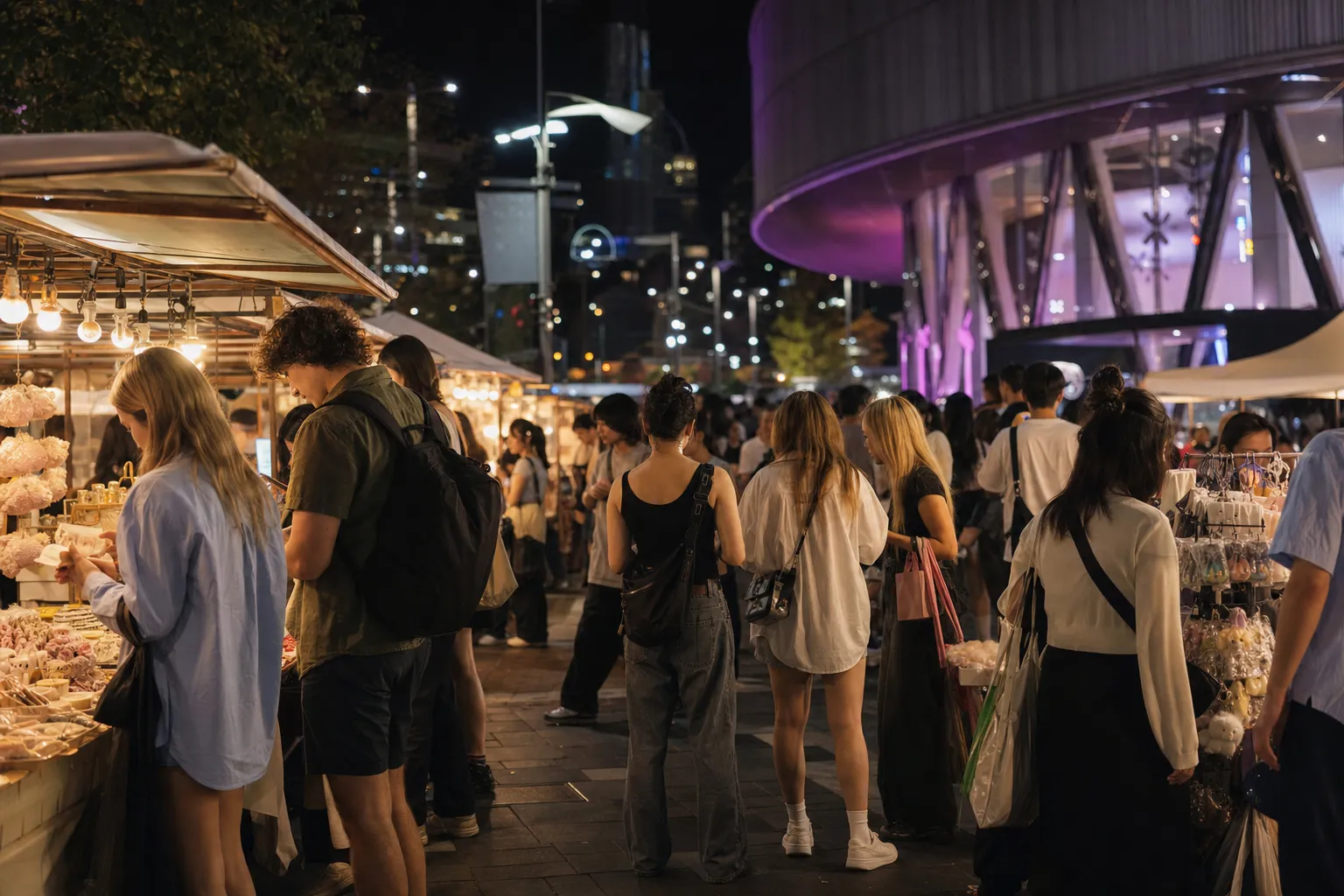
The most defensible conclusion is that the BTS Arirang Tour has turned a comeback into a tourism case study. Its impact is visible not only in stadium attendance, but also in the way visitors moved, stayed, and spent around the events. For South Korea’s soft-power strategy, that makes the tour a practical test of whether global fandom can be converted into durable cultural and economic value.
References
- K-pop’s BTS comeback tour rallies South Korea’s global ‘soft power’ drive (Al Jazeera, 2026-05-02)
- BTS's 'Arirang' tour concerts lead to 3,377% surge in number of foreign tourists in host city (Korea JoongAng Daily, 2026-04-29)
- ‘BTS 노믹스’ 효과 제대로… 1분기 외국인 476만 ‘역대 최대’ (Edaily, 2026-04-17)
- BTS와 함께하는 K-컬처···국립문화기관 5곳, 특별 프로그램 가동 (Korea.net / Ministry of Culture, Sports and Tourism, 2026-03-19)
- '아리랑' 선율에 보랏빛 광화문‥BTS '왕의 귀환' (MBC News, 2026-03-22)
- BTS kicks off North America tour in Tampa, drawing 190,000 fans (Korea JoongAng Daily, 2026-04-29)
About the Author