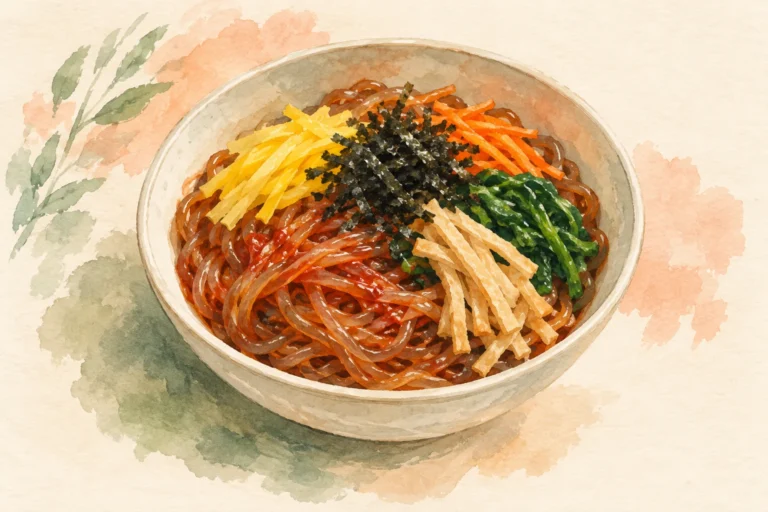
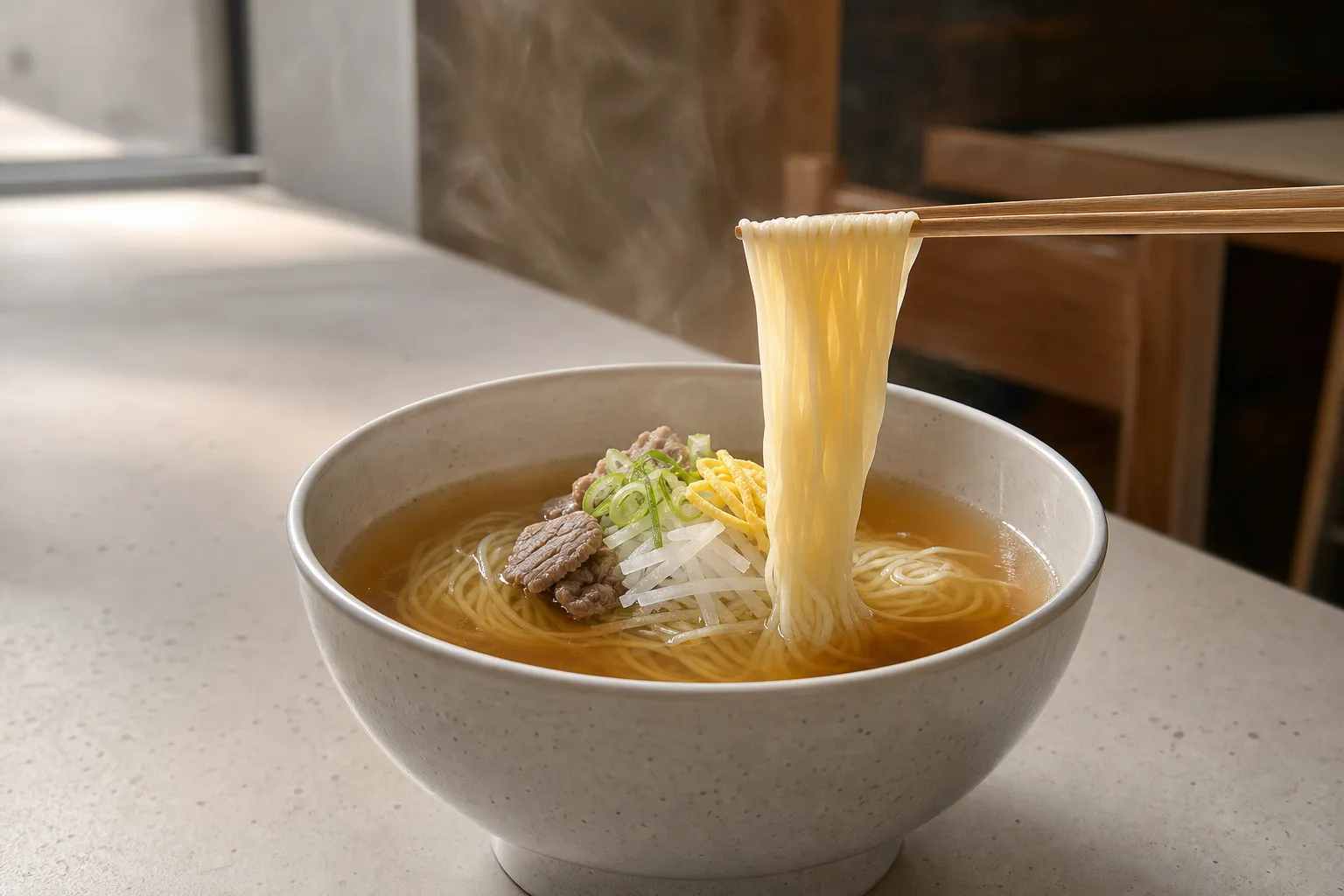
Seogyo Nanmyeonbang’s Hanwoo broth is the heart of what makes its noodle cooking feel both familiar and surprising. In the restaurant’s signature approach, Hanwoo stock is not treated as a heavy background note, but as part of a clear, carefully blended broth that brings Korean ingredients into conversation with fresh pasta thinking.
The focus is especially clear in Hanwoo Nanmyeon, a dish connected to chef Kim Nak-young’s broader work with nanmyeon, fresh noodles, and local ingredients. Rather than presenting noodles as a simple carrier for soup, Seogyo Nanmyeonbang builds the bowl around texture, broth clarity, and the meeting point between Korean noodle traditions and Italian-style filled pasta.
Seogyo Nanmyeonbang’s Hanwoo Broth
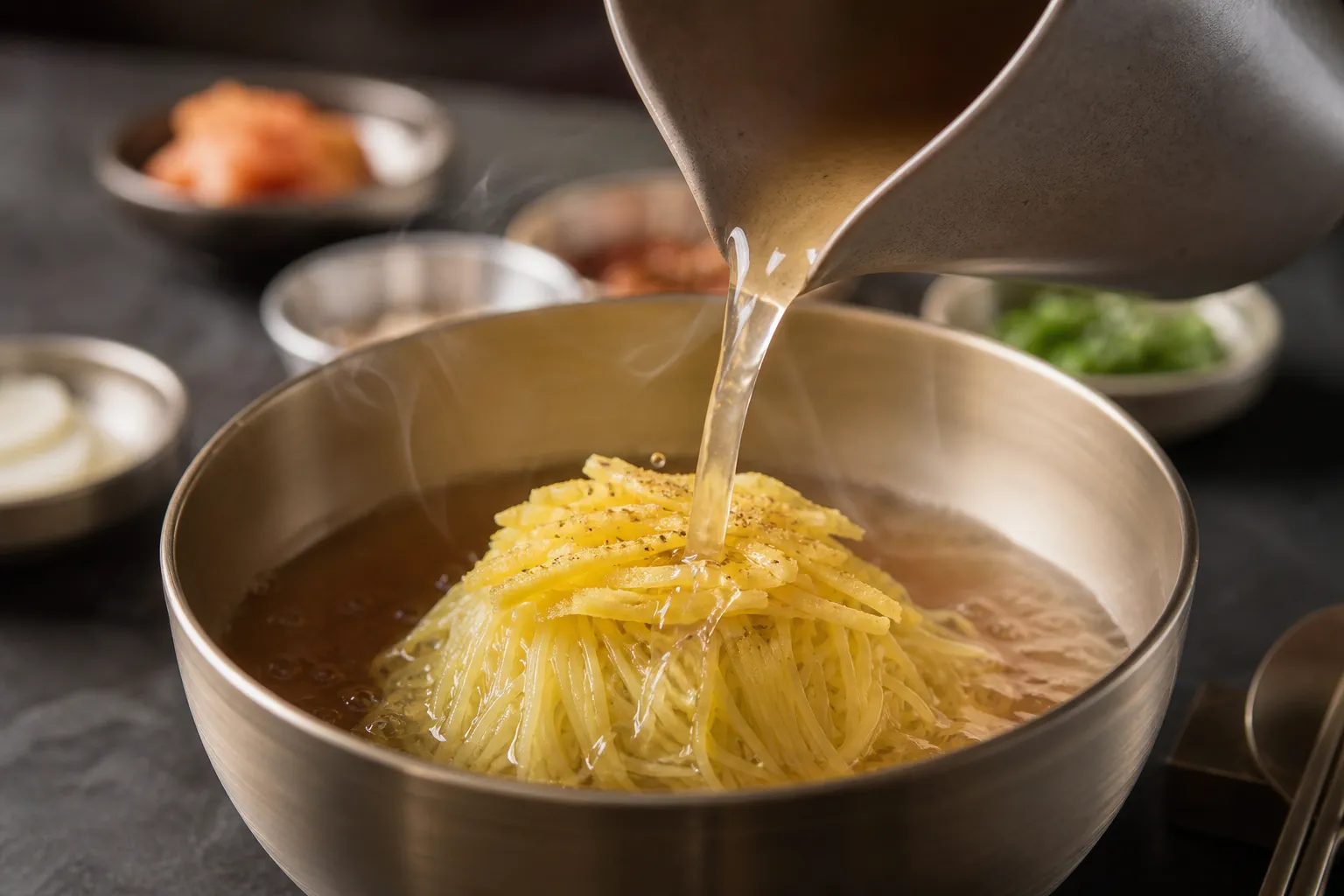
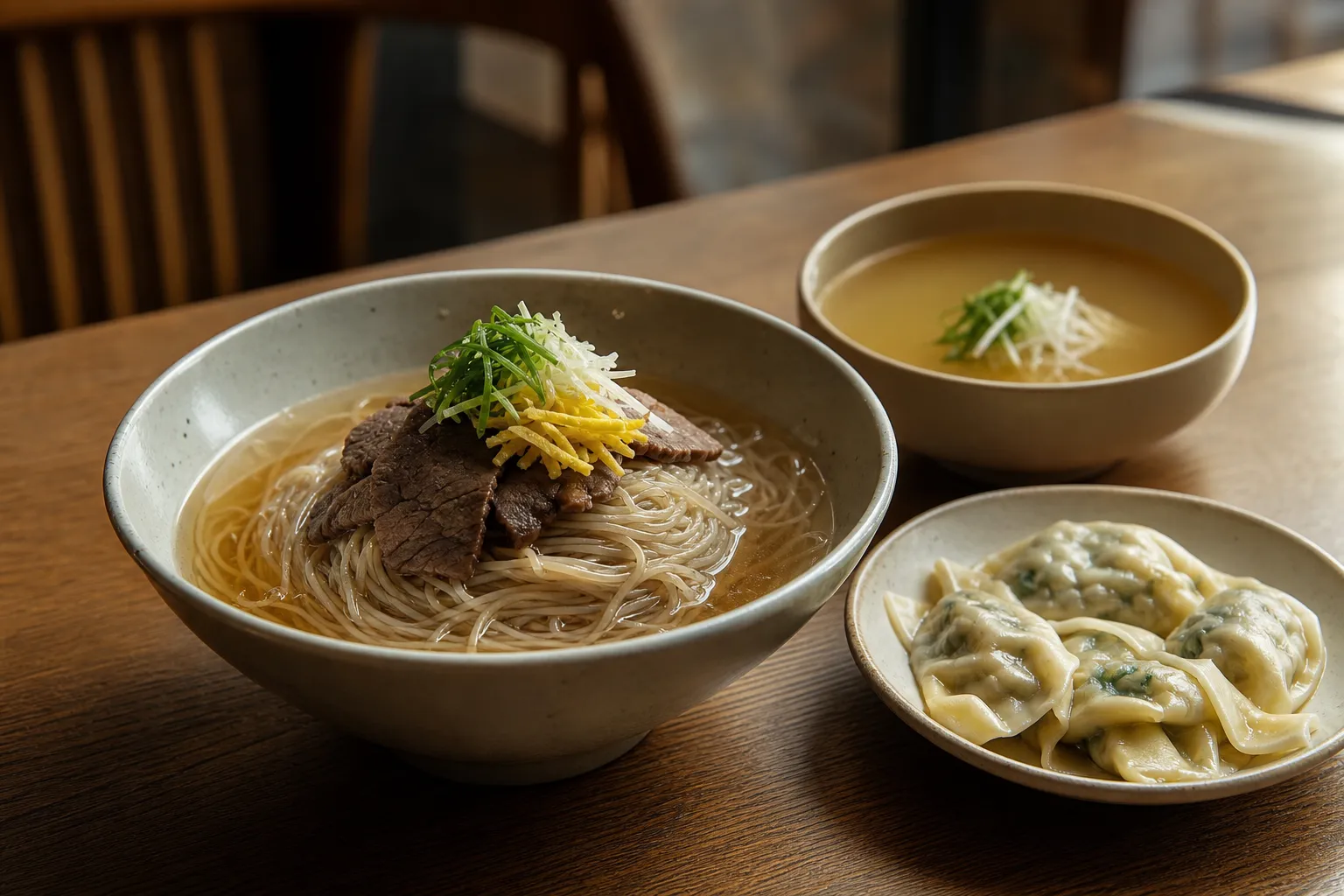
The most important thing to know about this broth is that it is a blend. Multiple sources describe Seogyo Nanmyeonbang’s representative nanmyeon as using both Gu-eom chicken and Hanwoo stock. The Chosun Ilbo described the restaurant’s signature Seogyo Nanmyeon as Italian-style ravioli served in a broth made with Gu-eom chicken and Hanwoo brisket stock, while SBS presented the bowl as a clear soup that mixes Hanwoo broth with chicken gom탕 broth and adds ravioli, beef, zucchini, and shiitake mushroom.12
Cook&Chef gives the most specific detail on the broth ratio, reporting that the key to the representative Seogyo Nanmyeon is a half-and-half blend of Jeju Gu-eom chicken stock and Hanwoo 1++ brisket stock.3 That detail matters because it explains why the dish is not simply “beef noodle soup” or “chicken noodle soup.” The broth is built as a meeting of two sources of depth: the clean poultry base from Jeju’s native Gu-eom chicken and the savory richness of high-grade Hanwoo brisket.
Herald Economy’s description helps frame the result. The outlet described Seogyo Nanmyeonbang’s soup as clearer and more refreshing than a typical Hanwoo gomtang, while still showing a strong meat aroma and umami.4 For readers trying to imagine the bowl, that is a useful clue: the Hanwoo element is present, but the dish is not described as dense, milky, or weighty. Its appeal seems to come from balance, not sheer heaviness.
What Makes the Noodles Different
The broth gets much of the attention, but the noodles are just as central to the dish’s identity. SBS described nanmyeon as noodles kneaded only with eggs, without water.2 Cook&Chef reported that Seogyo Nanmyeonbang blends four kinds of Korean wheat and uses only eggs to make its nanmyeon.3 That gives the dish a different starting point from many everyday noodle soups, because the noodle itself is designed around egg richness and chew.
This is where chef Kim Nak-young’s pasta background becomes especially relevant. The Chosun Ilbo connected his recipe book Pasta Fresca with Seogyo Nanmyeonbang’s work, explaining that he opened the restaurant in 2024 while paying attention to the overlap between fresh pasta and Korean nanmyeon.1 In a short interview line, Kim put the idea plainly: “Fresh noodles and nanmyeon are the same. The difference is what culture you place on top of the noodles.”1
That quote is a neat way into the restaurant’s logic. The bowl is not trying to hide its cross-cultural structure. It uses Korean wheat, eggs, Hanwoo, and Gu-eom chicken, but it also places ravioli in the soup. The result is not described in the sources as a novelty mash-up for its own sake. Instead, the dish is presented as a careful way to think about noodles through both Korean and Italian frameworks.
Allure Korea adds another layer to this background, noting that Kim came to know nanmyeon while learning Korean cuisine from chef Cho Hee-sook. The same article describes Seogyo Nanmyeonbang as using Korean wheat and Jeju native Gu-eom chicken, and serving a warm Seogyo Nanmyeon made with Hanwoo and Gu-eom chicken broth.5 In other words, the dish’s identity is grounded in learning, ingredient sourcing, and technique rather than a loose fusion label.
Hanwoo Nanmyeon as a Bowl of Contrasts
Hanwoo Nanmyeon stands out because several contrasts happen in one bowl. The noodles are egg-based, yet the soup is clear. The broth uses Hanwoo, yet it is blended with chicken. The dish includes ravioli, yet the surrounding structure is recognizably a warm Korean-style noodle bowl. Cook&Chef reported that Hanwoo Nanmyeon includes two ravioli, with Gu-eom chicken, Hanwoo boiled beef, and roasted seasonal vegetables used as toppings.3
That composition makes the dish feel layered before it even reaches questions of taste. The ravioli point back toward Italian filled pasta. The Hanwoo boiled beef reinforces the beef-stock side of the broth. The Gu-eom chicken connects the bowl to the poultry stock, and the roasted seasonal vegetables add another register of texture and flavor. The sources do not provide a full ingredient-by-ingredient tasting note, so it is best to stay with what is available: this is a bowl built from egg noodles, mixed broth, filled pasta, meat, and vegetables.
The Michelin Guide also gives useful context for why the restaurant drew wider attention. Ahead of the publication of The Michelin Guide Seoul & Busan 2025, Michelin announced 77 Bib Gourmand selections, including 10 new Seoul entries, and included Seogyo Nanmyeonbang among them.6 Michelin’s own description identified the restaurant as chef Kim Nak-young’s distinctive noodle restaurant and named Gu-eom chicken nanmyeon and Seogyo Nanmyeon, made with mixed chicken and Hanwoo broth, as representative dishes.6
The Bib Gourmand category is for restaurants serving excellent food at reasonable prices, which helps explain why Seogyo Nanmyeonbang’s name has appeared beyond ordinary noodle roundups.6 The attention is not only about rarity; it is also about how a seemingly humble format, noodle soup, can carry careful technique and a specific ingredient philosophy.
There is also a sustainability and local-ingredient thread running through the coverage. Herald Economy highlighted Seogyo Nanmyeonbang’s use of domestic new-crop wheat and Jeju Gu-eom chicken, along with Kim’s interest in sustainability and local ingredient markets. In the same coverage, Kim pointed to dependence on imported ingredients by saying, “Wheat is already 99% dependent on foreign sources.”4
For anyone curious about Hanwoo Nanmyeon, the most useful takeaway is that Seogyo Nanmyeonbang’s Hanwoo broth is not just a base liquid. It is part of a broader noodle idea: Korean wheat and egg-only dough, Gu-eom chicken stock, Hanwoo brisket stock, ravioli, beef, vegetables, and a chef’s interest in the shared language of fresh pasta and nanmyeon. The dish’s appeal, as supported by the available sources, lies in how deliberately those parts are brought together into one warm bowl.
References
- 麵도 건축처럼 설계하는 셰프… “생면 파스타, 우리나라에도 있었다” (조선일보, 2026-04-16)
- [다시보기] 생활의 달인 1010회 : SBS (SBS, 2025-12-15)
- [미슐랭 스토리] “쫄깃·탱글 이런 식감 처음” 우리밀과 달걀로 빚은 난면 요리 ‘서교난면방’ (Cook&Chef, 2025-12-23)
- 푸아그라 맛 토종닭, 곰탕에 빠진 파스타 ‘서교난면방’ [미담:味談] (헤럴드경제, 2025-05-18)
- ‘면’을 좋아하는 사람이라면 절대 놓칠 수 없는 맛집 (Allure Korea, 2025-07-31)
- 미쉐린 가이드 서울 & 부산, 2025 빕 구르망 리스트 발표…신규 14곳 포함 총 77곳 (MICHELIN Guide, 2025-02-20)
About the Author